
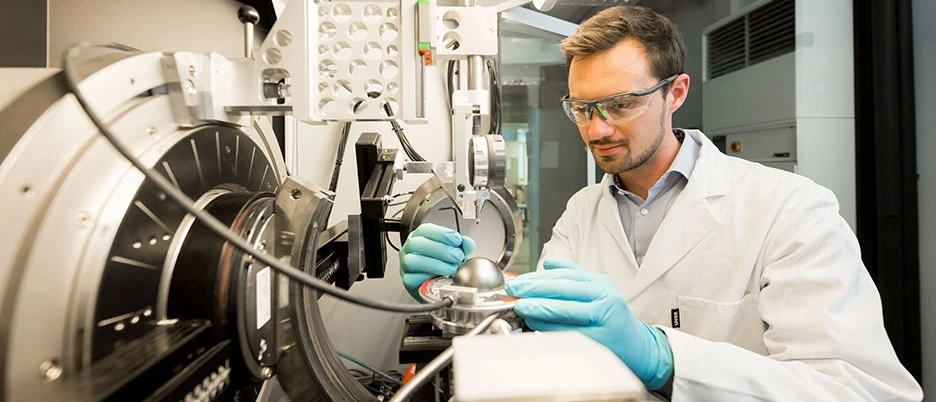
Engineering and Materials Science B. Sc. Joint Degree
Technological progress emerges where smart ideas meet scientific expertise and creative problem-solving. This is exactly where the Bachelor’s programme in Engineering and Materials Science begins: it bridges fundamental scientific knowledge with practical engineering applications and offers you the opportunity to actively shape future innovation.
During your studies, you will delve deeply into physics, chemistry, and mathematics, connecting this knowledge with exciting fields such as mechanical engineering, materials science, and modern application areas of the engineering sciences. You will not only learn how materials function, but also how they can shape our future—from sustainable materials and high-tech industries to innovative energy and mobility solutions.
A particular highlight of the programme is its joint-degree structure. This means you will study at two renowned universities—the Paris Lodron University of Salzburg (PLUS) and the Technical University of Munich (TUM)—benefiting from exceptional academic expertise, international exchange, and two vibrant campus environments.
The programme is ideal for those who
- enjoy developing, understanding, and practically implementing ideas,
- have a talent for logical, methodical thinking and want to apply it in a technical context,
- think creatively, remain curious, and wish to pursue scientific and technical questions independently.
If you have always wanted to know how to make materials more efficient, optimise technical systems, or develop sustainable innovations, this programme will equip you with the tools you need. You can look forward to:
- a varied blend of scientific foundations and applied engineering
- modern laboratories, international perspectives, and close ties to cutting-edge research
- a study environment that fosters technical curiosity and creative problem-solving in equal measure
| Type of Study | Full Time | Main Locations | Munich, Salzburg |
| Standard Duration of Studies | 6 Semester | Application Period | Details on how to apply can be found on the website of the Paris-Lodron University of Salzburg. |
| Credits | 180 ECTS | Required Language Proficiency | German |
| Start of Degree Program | Winter Semester | Tuition Fees | Semester fee, Fees for Students from Non-EU Countries |
The Bachelor’s program in Engineering and Materials Science is designed to be interdisciplinary. It builds a bridge between mathematics, the natural sciences, and engineering sciences, combining competencies from physics, chemistry, materials science, and mechanical engineering. Students gain a solid foundation in STEM subjects and acquire hands-on experience with modern measurement and analysis techniques. The mandatory internship included in the programme—completed either in industry or in research institutions—provides valuable insights into relevant professional fields and strengthens students’ abilities to solve engineering-related problems.
The program’s objective is to educate outstanding engineers who can serve as a link between research and development and production across various industrial sectors. Graduates possess methodological expertise drawn from multiple disciplines and are shaped by an interdisciplinary perspective. In their professional careers, they are able to apply their comprehensive scientific competencies to solve practical, real-world problems.
Students of the Joint Degree Bachelor’s degree program in Engineering and Materials Science at the Technical University of Munich and the Paris Lodron University of Salzburg learn to investigate, develop, and use innovative materials in line with these requirements.
The program combines subjects from physics, chemistry, materials science, computer science, and mechanical engineering. Students acquire the fundamentals of natural sciences and learn how to transfer them to various applications. In particular, they deal with the investigation and analysis of different materials to identify and utilize the potential of new materials for lighter, more energy-efficient, environmentally friendly, and safer construction methods.
They use modern investigation and analysis methods, such as spectroscopy, microscopy, and X-ray diffraction, as well as innovative methods in additive manufacturing, circular economy concepts, battery technology, or hydrogen technology. In addition, they can develop individual competence profiles in chemistry and physics of materials, energy and process technology, mechanical engineering, nature-inspired materials, and general materials.
Graduates of the degree program have a sound knowledge of materials science and natural sciences, which they can apply particularly at the interface between materials technology tasks and the various fields of application in engineering. They are, therefore, just as well qualified to start a career in the industry as they are to continue their education in a corresponding Master’s degree program.
In the first two semesters of the joint-degree Bachelor's program in Engineering and Materials Science, PLUS teaches the scientific basics of mathematics, physics, chemistry, and computer-aided measurement technology and data acquisition (including programming skills). There are courses that have a so-called connecting function that enables students to establish contact with TUM at this stage. These courses are designed and taught jointly by lecturers from both universities and are offered in hybrid form. In addition, TUM teaches initial engineering content in digital form (live transmission, teaching videos, blended learning concepts).
In the third and fourth semesters, TUM teaches the engineering fundamentals of technical mechanics, machine elements, production engineering, process engineering, and simulation technology. It focuses on expanding knowledge in materials science. Soft skills are also offered, focusing on presentation, communication, and teamwork. Similarly, PLUS hybrid courses are made available as live streams and recordings from Salzburg.
In the subsequent fifth and sixth semesters, the students choose, as part of an elective module, which specialization and thus also at which university (PLUS or TUM) they want to continue their studies and where they want to complete their final Bachelor's thesis. In addition, during the lecture-free period of study, students must complete (at least) 6 weeks of compulsory work experience in a relevant subject in the sense of full-time employment. This practice serves to apply the knowledge and skills acquired during the degree program. Information on the structure and content of the compulsory work placement can be found on the PLUS website.
The standard study period for the Bachelor's degree course in Engineering and Materials Science is 6 semesters.
The course begins in Salzburg, where the first two semesters are devoted to mathematics and the basics of natural sciences. Students then move to Munich to spend the following two semesters learning engineering methods at TUM. The fifth semester includes compulsory practical work, which is supplemented by various elective modules. The final semester consists of the Bachelor's thesis, which can be completed in Salzburg or Munich.

Current information
All information can be found on the website of the Paris-Lodron Universität Salzburg.
Introductory event for bachelor's students – SET (Semester Introduction Days):
The SET introductory event usually takes place on the first two days of lectures in the winter semester in lecture hall MW0001. Students from higher semesters and School Office staff will explain the most important points you need to know for your studies (timetable, subject examination and study regulations, contact persons, etc.).
The SET is organized by the Mechanical Engineering Student Council for first-semester students in the B.Sc. Mechanical Engineering program. To a certain extent, it is also of interest to students of the B.Sc. Engineering and Materials Science program. Just take a look!
Drawing materials for CAD and mechanical drawing:
The Chair of Materials Handling, Material Flow, and Logistics (fml), which is responsible for the “CAD and Mechanical Drawing” module, requests that you purchase the following materials:
Required
- Large TZ triangle (recommendation: 30 cm)
- Soft eraser (not the blue-red school eraser)
- Compass with pen holder
- Two mechanical pencils for drawing in two different thicknesses (recommendation: GRIP 1345, 0.5 mm with H and HB leads)
- Leads for the mechanical pencils (HB leads and H leads)
Highly recommended
- Smaller TZ triangle (20 cm) or a large ruler
- Eraser pencil, e.g., AR87190 from Aristo
- Circle and radius template
Further information can be found on the website of the Paris-Lodron Universität Salzburg.
Find the general dates and deadlines at TUM here.
You can find the binding exam dates for your degree program in TUMonline (note the selected semester).
Further information can be found on the website of the Paris-Lodron Universität Salzburg.
All relevant dates relating to exam registration can be found under Dates and Deadlines. You must register for all TUM exams via TUMonline. Instructions for exam registration can be found in the central IT Wiki. For your own security, we recommend that you print out a confirmation of registration from TUMonline after registering. Registrations after the official registration period are not possible. If you encounter any problems with registering for, assigning, or withdrawing from exams, please contact the relevant examination board immediately.
Note:
The current and valid list of modules available at TUM in the B.Sc. Engineering and Materials Science program can be found at (note the selected semester):
https://campus.tum.de/tumonline/ee/ui/ca2/app/desktop/#/slc.tm.cp/student/courses?$ctx=&$filter=&$skip=0&curriculumVersionId=5223&objTermId=206&orgId=1
Please note that the modules listed in the curriculum are not updated regularly and may therefore be out of date.
Study progress monitoring for compulsory subjects at TUM
3rd semester (= 1st semester at TUM): --
4th semester (= 2nd semester at TUM): --
5th semester (= 3rd semester at TUM): 29 credits
6th semester (= 4th semester at TUM): 50 credits
After the sixth semester, enrollment is no longer mandatory. Study progress checks are only possible if a student chooses to specialize at TUM, as they must then be enrolled.
Progress checks if TUM is chosen as the main focus:
After the 7th semester (= 5th semester at TUM): There's no check after the 7th semester because students also do work in Salzburg that TUM doesn't have an overview of. This means that no check is possible.
After the 8th semester (= 6th semester at TUM): 180 credits. In accordance with the APSO of TUM: A 9th semester is granted if students have achieved at least 150 ECTS after the 7th semester, even if they have not achieved 180 ECTS after the 8th semester.
If the course of study is not completed after the 9th semester, the course of study is considered to have been definitively failed.
Further information can be found on the website of the Paris-Lodron Universität Salzburg.
All relevant information regarding the recognition of academic achievements can be found here: Recognition of Credits.
Further information can be found on the website of the Paris-Lodron Universität Salzburg.
In the joint degree bachelor's program in Engineering and Materials Science, a subject-related compulsory internship of (at least) 6 weeks in the sense of full-time employment (corresponding to 10 credits) outside the university at an institution recognized by the relevant academic authority must be completed. This practical training serves to apply the knowledge and skills acquired during the course of study in an industry-related environment. The internship can be completed consecutively or in parts, with no part lasting less than 2 weeks. Further information can be found in the curriculum.
Further information can be found on the website of the Paris-Lodron Universität Salzburg.
Students enrolled in the joint bachelor's degree program in Engineering and Materials Science can spend a semester abroad. This can be done during the fifth or sixth semester of the program. Courses completed while studying abroad are recognized by the relevant academic authority at PLUS (https://www.plus.ac.at/international-relations-department/international-relations-office/?lang=en). The applicant must submit the documents required for assessment.
It is ensured that semesters abroad (if not completed at TUM) are possible without delays in study progress if the following conditions are met:
- at least 30 ECTS credits are completed per semester abroad;
- the content of the courses completed during the semester abroad does not correspond to courses already completed at Paris Lodron University Salzburg;
- before the start of the semester abroad, it was officially determined which of the planned exams are equivalent to the exams prescribed in the curriculum.
In addition to subject-specific skills, studying abroad allows students to acquire the following qualifications, among others:
- acquisition and deepening of subject-specific/general foreign language skills (language comprehension, conversation, etc.);
- acquisition and deepening of organizational skills through independent planning of everyday student life in international administrative and university structures;
- getting to know and studying in international study systems and broadening one's own subject perspective;
- acquisition and deepening of intercultural skills.
Students with disabilities and/or chronic illnesses receive active support from the university (AB Family, Gender, Diversity, Disability) in finding a place for a semester abroad and planning it.
A bachelor's thesis must be written as part of the joint degree bachelor's program in Engineering and Materials Science. This can be done either internally as part of research activities in working groups at PLUS and/or TUM, or externally - supervised by university lecturers - as part of project collaborations with companies. As part of their bachelor's thesis, students should solve manageable research tasks or work on defined problems in the field of natural sciences, engineering, or materials science. Relevant literature on these topics, as well as tasks, methods used, results, and their discussion, must be presented in writing and submitted in a thesis.
Topics for bachelor's theses are closely related to the natural sciences, engineering, and materials science content of the modules in the curriculum and are coordinated by PLUS. A corresponding list of topics is compiled and can be viewed on the PLUS web platforms.
Topic suggestions can be submitted by the departments, institutes, and chairs of both universities involved in the joint bachelor's degree program in Engineering and Materials Science, as well as by industry and students.
The proposed topics must be sufficiently developed to allow for an assessment of the following criteria:
- Relevance to the module content or teaching content of the curriculum,
- Fulfilment of the general requirements,
- Feasibility within the specified time frame,
- Formal supervision by university lecturers (usually with teaching authorization) from the departments, institutes, and chairs of PLUS or TUM involved in the joint degree bachelor's program “Engineering and Materials Science.”.
- Formal approval of the topic chosen by the student for their bachelor's thesis is the responsibility of the chair of the Curriculum Committee.
The bachelor's thesis (11 CP) is formally supervised and assessed by university lecturers (usually with teaching authorization) from the departments, institutes, and chairs of PLUS and TUM involved in the joint degree bachelor's program in Engineering and Materials Science.
To formally register for the bachelor's thesis, at least 120 ECTS credits from the degree program must have been completed. When formally registering for the bachelor's thesis, a module from the listed natural science, materials science, and engineering modules must be specified for the bachelor's examination.
Successful completion of the bachelor's thesis also includes a presentation of the main findings and most important parts of the thesis in a seminar lecture held in person and/or in hybrid mode, which must be completed at least three weeks before the bachelor's exam date, and the design of a poster with the main findings of the bachelor's thesis.
The program concludes with a bachelor's examination in front of an examination board.
Excerpt from the curriculum:
§ 15 Commissions-based Bachelor's examination
(1) The joint-degree Bachelor's program in Engineering and Materials Science is completed with a commissions-based Bachelor's examination worth 2 ECTS credits.
(2) The prerequisite for the bachelor's examination before a commission is proof of successful completion of all prescribed examinations, the compulsory practical training, the ring internship, and the bachelor's thesis.
(3) The bachelor's examination before a commission consists of the following components:
a. Presentation of the completed bachelor's thesis,
b. Defense of the bachelor's thesis,
c. Examination interview on a module that is related to the topic of the bachelor's thesis in accordance with §8 (2). The examination interview is conducted in relation to the bachelor's thesis and establishes curricular cross-references, so that overall it takes on the character of a defense.
(4) The examination board consists of representatives from PLUS and TUM.
Further information can be found on the website of the Paris-Lodron Universität Salzburg.