

Risk and Safety M. Sc.
Would you like to learn how to analyze complex risks, make sound decisions under uncertainty, and actively contribute to the safety of technologies, the environment, and society? The interdisciplinary Master’s program Risk and Safety at TUM prepares you for a challenging career as a risk and safety professional in industry, research, and the public sector.
The program combines strong analytical methods with a holistic perspective on technical, organizational, and societal decision-making processes. Students develop solid expertise in probabilistic modeling and data analysis, reliability and risk assessment, safety management, and decision-making under uncertainty.
These competencies enable graduates to address real-world challenges in fields such as energy and infrastructure safety, sustainable technologies, industrial systems, environmental and climate risks, and complex socio-technical systems. In doing so, they systematically consider not only technical aspects, but also organizational constraints and societal impacts.
| Type of Study | Full Time | Main Locations | Garching and Munich |
| Standard Duration of Studies | 4 Semester | Application Period | 01.01. – 31.05. |
| Credits | 120 ECTS | Required Language Proficiency | English |
| Start of Degree Program | Winter Semester (October) | Costs | Student Fees, Tuition fees for international students |

The management of risks is an essential task in engineering and society. Without demonstrating sufficient safety it is not possible to introduce new technologies, for example autonomous transportation systems or sustainable energy production and storage. Similarly, the assessment and management of risk is essential for the optimal design and operation of engineering systems and processes, ranging from management of the built environment under climate change to the optimization of maintenance processes for a fleet of aircraft.
More broadly, policy making for anthropogenic systems requires experts who understand risk and uncertainty and their impact on the outcomes of decisions, such as when developing, implementing and communicating strategies for dealing with epidemics or natural hazards.
This unique MSc program educates future experts to address these challenges. Graduates of this MSc program will be able to understand, assess and communicate risks and develop strategies for efficiently providing safety. To this end, the MSc program combines a multidisciplinary set of courses on:
- domain specific engineering expertise
- stochastic modeling and computation
- understanding risk perception and communication
- methods and tools for managing safety and risks
For a comprehensive description of the program, please refer to the degree program documentation:
The Master Risk and Safety enables graduates to provide solutions to interdisciplinary challenges by combining strong analytical skills with a dedicated toolset to assess complex systems and a holistic perspective on decision processes in management and society.
The graduates will have acquired competences in the fields of probabilistic modelling and data analysis, reliability and risk assessment, safety management and decision making under uncertainty. They can utilize these competences to address real-life decisions in diverse domains of engineering and science. In their solutions, the graduates also account for organizational challenges and societal context.
The MSc prepares you for an exciting career as a risk and safety expert, e.g., in
- Manufacturers, e.g., in automotive, aerospace, medical technology
- Transportation and infrastructure operators
- Certification and safety assurance
- Engineering consultancies
- Government agencies
- Technology start-ups
- Insurance and reinsurance
- Research and development
The degree program is divided into three compulsory areas and three elective areas:
- Compulsory areas: Fundamentals, Risk & Society, Risk in Practice
- Elective areas: Risk Methods & Analysis, Risk Management, General Elective Modules
The master’s program enables students to specialize in specific application areas by offering a broad portfolio of courses from a wide range of TUM disciplines. The MSc program emphasizes project-based learning and promotes interaction with industry, for example through a dedicated “RiskLab” module.

- You obtain your entrance qualification for master's degree program.
- by 31 May: You apply for the degree program. We recommend to apply by 15 March for international students for early feedback and visa application.
- June to August: You take part in the aptitude assessment. Possibly, you are invited to an interview.
- June to August: You are admitted.
- You then accept the study place and enroll yourself.
- Beginning of October: You start your studies.
Application via TUMonline: Apply via the TUMonline application portal and upload your documents for admission there.
Support: Instructions for applying for a master's program (step-by-step instructions) and Application Info Portal
Legal Notice: The basis is the program-specific Academic and Examination Regulations (FPSO)

Eligibility for the Master’s program Risk and Safety must be demonstrated by a qualified Bachelor’s degree (Bachelor of Science) obtained at a domestic or foreign university, with a minimum standard period of study of six semesters.
Because there is no associated bachelor to the master Risk and Safety, students with various bachelors can apply. However, students are required to have a certain amount of credits regarding different fields of study. The following table shows the different fields of study and the maximum credits per fields of study. These numbers are maximum values that can be taken into account, meaning that it is also possible for students with less credits to apply for the master. Students are requiriered to perform an analysis of their successfully completed courses within their curriculum and allocate the courses to the fields of study shown in table. A template to perform the analysis can be downloaded here.
| Fields of study | Maximum Credits |
| Engineering basics | 20 |
| Stochastic | 10 |
| Mathematics excluding Stochastic | 10 |
| Informatic | 5 |
| Management | 10 |
| Courses in social science and psychology with a connection to risk management | 10 |
Students who have not yet completed their bachelor’s degree but have already obtained at least 140 credits may also be admitted to the master’s program upon application. The bachelor’s degree certificate must be submitted no later than one year after the start of the master’s program.
The following documents must be uploaded during the online application.
- Degree Certificate and Diploma or Subject and Grade Transcript of Studies to Date
- Transcript of Records
- Proof of English Language Proficiency
- Complete and Current Résumé
- Passport
- Statement of purpose (Letter of Motivation) The statement of purpose must be written in English.
- An essay of no more than 1,000 words in English on one of the following three topics:
How should risks be communicated?
How high should the reliability of a technical system be when failure of the system can lead to fatalities?
Describe a specific risk and a possible strategy on how this risk could be addressed.
Required admission documents for some applicants:
- For students with a degree from outside Germany: Preliminary Documentation (VPD)
- Applicants with a Degree from Bangladesh, China, India, Iran, or Pakistan will have to submit a GRE (General) Test.
The requiered scores are:
Verbal reasoning: (will not be taken into account)
Quantitative reasoning: 157
Analytical writing: 3,0
(Alternatively, candidates can submit a score card of the Indian GATE test with the minimal qualifying score of the respective year.)
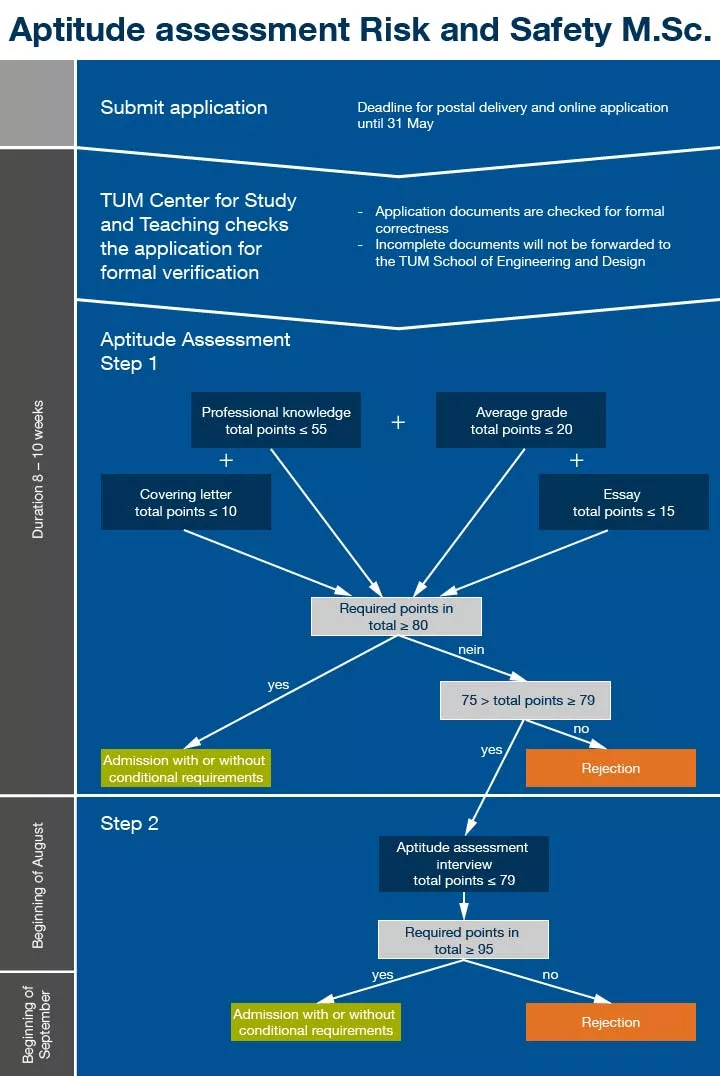
Selection takes place through an aptitude assessment procedure. The aptitude assessment is a two-part procedure after the submission of an official application to a program. In this procedure, the TUM school determines whether you meet the specific requirements for its Master’s degree program.
In the first stage, the bachelor's degree grade and the submitted documents are evaluated using a points system.
The weighting is as follows:
Subject knowledge (analysis of the study plan) (max. 55 points)
Bachelor's degree grade (max. 20 points)
Letter of motivation (max. 10 points)
Essay (max. 10 points)
Depending on the number of points achieved, applicants are either admitted immediately, rejected, or invited to a selection interview.
Aptitude Assessment for Master
Description of the Aptitude Assessment (appendix 2, German)
In case of admission, you can accept your spot and will then have to submit the application together with documents for enrollment.
Documents required for enrollment:
- Application for Enrollment (signed)
- Degree Certificate and Diploma (authentic document)
- Most Current Photo (as for ID)
- Digital notification of your health insurance status from a German public health insurance provider (requested by applicant)
We may require additional documents depending on the type of educational background you earned and your country of origin. After accepting an offer of admission in TUMonline, you will receive a list of documents you must submit to TUM in hardcopy for enrollment.
A variety of scholarships are offered at TUM. However, there is no specific Risk and Safety scholarship that we offer. If you would like to find and apply for a scholarship, we advise you to have a look at the general TUM webpage on scholarships. Information about scholarships and waivers for the TUM tuition fees for international students can be found on this webpage.
The following page contains some information that can be helpful for getting started at TUM.
Onbording: Online Event
You will be invited to an online meeting taking place a few weeks before the start of the program. The purpose of this meeting is to help you get started smoothly from an organizational perspective. The presentation slides from the online meeting can be downloaded here.
Onbording: Onside Event
Shortly before the start of the program, when all students are already in Munich, we will invite you to an informal in-person meeting. In addition to the new students, students from higher semesters will also be present, giving you the opportunity to network and make connections.
Semester Dates and Deadlines
The semester dates can be found centrally on the TUM website.
How to Find Accommodation & Living in Munich
If you are looking for further information on living in Munich, visit the TUM information page on finding accommodation.
Public student accommodation is offered by the Studentenwerk (limited availability).
TUMonline & Moodle
- TUMonline is TUM's platform for organizing your studies, which you are already familiar with from your application.
- Moodle is TUM's e-learning platform. Lecturers will usually provide their supporting material, such as lecture notes or task sheets, via Moodle.
Campus Maps & Roomfinder
Maps of TUM's buildings can be found on the maps and plans page. If you are looking for a specific room, you can use TUM's roomfinder.
The room numbers at TUM have four digits:
- the first digit represents the floor,
- the second digit represents the building,
- the third and fourth digits denote the room number.
Building numbers on the north site are prefixed with an “N”.
Fit for TUM
Fit for TUM is a service fair for newcomer students at TUM.
Sport at TUM
Sports courses can be booked here. As the number of spots is usually very limited, it is recommended to register early.
Probability theory and statistics play a central role in the Master Risk and Safety Master. Certain basic knowledge is a prerequisite for a successful start to the Master's program. The following list of books and online courses is intended for future students of the Master Risk and Safety who want to close gaps in their probabilistic knowledge to ensure a smooth start into the Master.
Of course, not all sources need to be studied. The wide selection of sources is intended to ensure that everyone can find the right learning material for themselves.
Books
Basics:
- Probability theory and mathematical statistics for engineers (Gatti, 2004)
- Introduction to probability and statistics for engineers (Holický, 2013)
- Fundamentals of probability and statistics for engineers (Soong, 2004)
- Probability foundations for engineers (Nachlas, 2023)
- Applied statistics for civil and environmental engineers (Chapter 1-4) (Kottegoda and Rosso, 2008)
- Statistics and probability theory: in pursuit of engineering decision support (Chapter 1-4) (Faber, 2012)
- Probability, statistics, and decision for civil engineers (Chapter 1-4) (Benjamin and Cornell 2014)
Advanced:
- Applied statistics for civil and environmental engineers (Chapter 5-10) (Kottegoda and Rosso, 2008)
- Statistics and probability theory: in pursuit of engineering decision support (Chapter 5-7) (Faber, 2012)
- Probability, statistics, and decision for civil engineers (Chapter 5-6) (Benjamin and Cornell 2014)
- Probabilistic risk analysis: foundations and methods (Bedford and Cooke, 2001)
Online Courses (free):
Basics:
- Probability & Statistics - Open & Free
- An Intuitive Introduction to Probability
- Introduction to Statistics (Modul 1-8)
- HarvardX: Introduction to Probability (Unit 1-4)
- MITx: Probability - The Science of Uncertainty and Data (Unit 1-6
- The Organic Chemistry Tutor Video (1-5, 27, 32-59)
Advanced:
You will need to pass
- 37 credits of compulsory modules
- 53 credits of elective modules
- 30 credits for the Master's thesis.
At least 120 credits must be earned to complete the degree program. However, it is not necessary to earn exactly 120 credits. The minimum number of modules required to earn at least 120 credits is then used to calculate the degree completion.
The elective area is divided into three areas.
Risk methods & analysis
15 credits must be chosen from the following modules:
| Modulnummer | Modultitel | Semester | Credits |
|---|---|---|---|
| CIT5130003 | Mathematical Methods in Risk Analysis | SS | 5 |
| ED130036 | Risk Assessment | SS | 5 |
| ED130009 | System and Functional Safety | WS | 5 |
| EI04024 | Python for Engineering Data Analysis - From Machine Learning to Visualization | WS and SS | 5 |
Risk management
15 credits must be chosen from the following modules:
| Modulnummer | Modultitel | Semester | Credits |
|---|---|---|---|
| MGT001457 | Risk Management | WS | 5 |
| WI001290 | Advanced Seminar Marketing, Strategy & Leadership: Risk Perception and Communication | SS | 6 |
| ED110117 | Operational Safety | WS | 5 |
| MW2131 | Human reliability | SS | 5 |
| SOT86080 | Risk & Crisis Communication | WS | 6 |
General elective modules
23 credits must be chosen from the following modules. The catalog of general elective modules is continuously being expanded. If you find a module you would like to have included, please contact max.teichgraeber@tum.de. Whether the courses take place in the winter or summer semester should be checked in each case in TUM-online.
| Modulnummer | Modultitel | Credits |
|---|---|---|
| BGU60017 | Probabilistic Life Cycle Analysis and Integrity Management of Infrastructures | 3 |
| ED130013 | Prognostics and Health Management | 3 |
| POL62500 | The Ethics and Politics of Existential Global Risks | 6 |
| BGU54009 | Flood Risk and Flood Management | 6 |
| BGU46026 | Alpine Hazards | 6 |
| MW2282 | Safety and Certification of Avionics and Flight Control Systems | 5 |
| MW2407 | Safety and Certification of Aircraft | 5 |
| BGU68006 | Road Safety | 6 |
| ED130006 | Introduction to Random Vibration | 6 |
| BGU60019 | Stochastic Finite Element Methods | 6 |
| ED130005 | Uncertainty Quantification with Surrogate Models | 3 |
| MCTS0042 | Core Topic: Industries & Innovation | 5 |
| CS0277 | Sustainability and Risk Management | 6 |
| ED130019 | System-Theoretical Principles of Risk Management for Business Processes and Real Estate Business Processes | 6 |
| ED0155 | Knowledge and Risk | 5 |
| WZ1808 | Horticultural Risk Management | 5 |
| MW0149 | Occupational and Industrial Safety | 3 |
| AR30012 | Occupational Health and Safety | 6 |
| MW2340 | Operational Flight Safety | 3 |
| MW1399 | Helicopter Safety and Certification | 3 |
| MW2089 | Seminar Nuclear Safety Principles | 5 |
| WZ1167 | Work Science and Work Safety | 3 |
| MW1104 | Introduction to Nuclear Safety Analysis of Nuclear Reactors with State-of-Art Computer Programs | 4 |
| IN2247 | Functional Safety | 4 |
| IN2385 | Safety and Security for Cyber-Physical Systems | 3 |
| WZ5022 | Quality Management and Product Safety | 5 |
| EI7644 | Communication Network Reliability | 5 |
| EI71041 | Preventive Reliability Techniques | 5 |
| EI71069 | Reliability of Electric Drives | 5 |
| MA3405 | Insurance mathematics 1 | 9 |
| WZ0043 | Risk Theory and Modeling | 5 |
| BGU67001 | Landslides | 5 |
| BGU53053 | Geodesy (for land management) | 5 |
| MGT001363 | Judgment and Decision Making | 6 |
| WI001056_1 | Principles of Economics | 6 |
| MGT001354 | Artificial Intelligence for Innovation and Entrepreneurship | 3 |
| MA5408 | Statistical Analysis of Copulas | 5 |
| WI000285 | Innovative Entrepreneurs | 3 |
| ED130121 | Codified Structural Design: Probabilistic Fundamentals and Engineering Practice | 3 |
| CIT5130002 | Introduction to Data Science and Statistical Thinking | 6 |
| SOT86750 | sustAInability | 6 |
| SOT86125 | Global Crises and Political Challenges | 6 |
| SOT10080 | Introduction to Judgement and Decision Making | 5 |
| … | … | … |
Purpose and nature of the Risk Lab
Students enrolled in the Master's program in Risk and Safety must complete the Risk Lab as part of their studies. The Risk Lab takes the form of a project. The main objective of this project is to gain practical experience in an application context—either as part of a research project or in cooperation with a company.
Two basic requirements must be met:
- a clear contribution to the students' qualification as risk managers
- the application of risk and safety assessment methods
The project can be carried out alone or in a team of two students.
The workload must correspond to 12 ECTS credits per student (1 ECTS = 30 hours of work).
Duration and deadlines
There is no set maximum duration for the Risk Lab. Only the workload requirements must be met.
It is strongly recommended that the Risk Lab be completed before starting the master's thesis.
Supervision
The project can either be carried out internally at one of the chairs involved in the M.Sc. Risk and Safety program, or externally in cooperation with a company or a public authority. In the external case, an additional internal supervisor is required, who will also be responsible for assigning the grade.
Examination
Students must write a report on their project and submit it to their supervisor.
In addition, a presentation must be given:
- 15 minutes for individual projects
- 20 minutes for projects with two students
The presentations will take place as part of a joint final conference, at which all projects completed in the same semester will be presented.
This conference is organized once per semester.
The presentation marks the completion of the Risk Lab, meaning that the report must be submitted no later than the date of the presentation.
Registration for the conference takes place via TUMonline, in the same way as exam registration.
Assessment:
- Report: 80%
- Presentation: 20%
Registration
At the beginning of your Risk Lab, please fill out the registration form together with your TUM supervisor and send it to max.teichgraeber@tum.de.
General Rules
It is possible to complete your thesis either at university or in industry, and it is worth 30 credits. The following rules should be noted.
- You can start your Master's thesis if you have successfully completed at least 60 ECTS.
- The period of time between thesis registration and submission of the completed Master's thesis must not exceed 6 months.
- The master’s thesis can be supervised by all TUM chairs that also offer a course within the Master’s program Risk and Safety. If you would like to write your master’s thesis with a different chair, this may also be possible upon consultation with the program coordinator.
- If you would like to write your thesis in cooperation with industry, you must find an academic co-supervisor at a TUM chair that offers a course in the Master’s program Risk and Safety.
Find a Thesis Topic
In general, there are three ways to find your perfect Master's thesis topic:
- There is a fully worked-out project proposal. These are usually published on the chairs' websites.
- You are interested in a specific scientific topic and know a researcher at one of our chairs is working on that topic. You can contact them and discuss possible projects that could be carried out in the scope of your thesis. The research topics and corresponding researchers are usually listed on the chairs' websites.
- You have a thesis topic worked out on your own, or in collaboration with a company, and would like to know whether this topic could be done within the scope of your thesis.Take the initiative and contact a potential supervisor.
In all cases, you will need to actively look for a thesis topic. We won't assign topics automatically.
Please allow for some time for finding a thesis topic and the time it takes until registration. If you have a fixed timeline for your thesis in mind, please start sufficiently early with the process.
Registration
Once you have accumulated enough credits, identified a suitable thesis topic, and obtained approval from your supervisor, your thesis will be registered at the school office. This process will be conducted by your supervisor and is fully digital. You will receive an email with a confirmation request. You don't need to register the thesis yourself.
Further Information
- Courses and further information on scientific writing and working can be found at the Centre for Key Competences and the university library.
- You can find the official TUM citation guideline here.
- The English Writing Center offers free one-to-one consulting in English writing to all members of the TUM community, as well as Thesis Writers' workshops, out of which the following two might be interesting to you:
Submission
You must upload the thesis to the school portal (at the latest 6 months after registration). Please check further details with your thesis supervisor.
Your supervisor will take care of the grading of your thesis and will report the grade to the examination administration via the online portal of the school. The examination administration will enter your grade into your curriculum in TUMonline.
The general study regulations (APSO) stipulate certain milestones that you must achieve in the corresponding semesters. The following list summarizes the required number of credits that you must have earned after each semester, starting with the third semester:
at least 30 credits after 3 semesters
at least 60 credits after 4 semesters
at least 90 credits after 5 semesters
at least 120 credits after 6 semesters
This effectively limits the maximum duration of study to 6 semesters. Please also note that you must pass at least one elective module by the end of the second semester.
If you have difficulties with the study progress check due to illness or other unforeseen circumstances, please contact max.teichgraeber@tum.de
We encourage the pursuit of a stay abroad through the various offers at TUM. Contact your study coordinator for an individual counseling.
For academic credits earned outside of TUM, an application for recognition can be submitted. Two cases are distinguished:
- Recognition of modules that are equivalent to modules in the Master’s program Risk and Safety curriculum:
In this case, please first contact the respective lecturer of the equivalent module at TUM. If the recognition is approved by the lecturer, you can forward the application directly to the examination office . - Recognition of modules that are not equivalent to any module in the Master’s program Risk and Safety curriculum:
These modules may be credited within the General Elective Modules area. Whether recognition is granted is decided by the examination board on a case-by-case basis. Please contact the program coordinator for this purpose.
In both cases, please use the following form: Application for Recognition.
Information on taking a leave of absence can be found on the corresponding TUM page.
Please keep in mind that the application for the leave of absence has to be handed in latest until the start of the lecture period of the semester you want to take the leave in.
Graduation Documents
Upon completion of all compulsory modules (including the Master's thesis) and having obtained at least 120 credits in total, you have completed the Master's program.
Here is some information that might be important for you.
- You will stay enrolled during the semester in which you have passed your final exam. You will be exmatriculated by the end of the semester, in which you are officially informed about your final graduation through the CST - Graduation Office. Please also see this TUM page on withdrawal from the university.
- You don't need to actively deregister from TUM.
- You will receive your final degree certificate, transcript of records, and a ranking table from the central offices. To find more information on your final graduation documents, please see here.
Graduation Ceremony
Information on this will follow.