

Land Management and Geospatial Science M. Sc.
Do you know that ninety percent of land holdings in developing countries are not documented, administered, or protected? Yet, land administration systems and practices do not cater to the complexity of land issues, including urban sprawl, land tenure insecurity, and climate change.
Deriving solutions to these challenges requires a combination of contextual insights, technical-methodological instruments, and communication skills to accelerate land rights documentation, land tenure security, and sustainable land use. It requires responsible governance of land tenure and fit-for-purpose land information systems to document people-land relationships in a politically, legally, and socio-culturally sensitive manner.
The Land Management and Geospatial Science program combines two inter-connected scientific domains: Land Management and Geospatial Science. The aim of the master’s program is to train land professionals who can apply land and spatial-related concepts and tools to analyze international contemporary land issues and have the executive soft skills to carry out land administration functions to solve these land issues.
| Type of Study | Full Time | Main Locations | TUM Main Campus Munich |
| Standard Duration of Studies | 4 Semester | Application Period | Winter semester: 01.01. – 31.05. |
| Credits | 120 ECTS | Required Language Proficiency | English |
| Start of Degree Program | Winter Semester | Tuition Fees | No tuition fees for international students from third countries are charged for this degree program. Please note: The semester fee as a contribution to the student union must still be paid. |
Increasing urbanization, rising demand for agricultural land, and precarious land tenure, particularly in developing countries, underscore the urgent need for effective land management systems. Students of the English-taught Master’s degree program in Land Management and Geospatial Science (M.Sc.) learn to analyze conflicting requirements and develop solutions for socially, ecologically, and economically sustainable land use.
The program focuses on various aspects of land, water, and forest use, especially in developing countries. It teaches concepts, theories, and techniques in land management and geosciences. Students analyze and develop responsible land management systems, examine interactions between urban and rural areas, and address questions of land valuation, land taxation, land allocation, and land development to design adequate land management systems for securing land tenure. They have the opportunity to specialize in the areas of Systems of Land Rights and Land Use, Systems of Geospatial Engineering for Land, Water and Forestry Management, or Systems of Planning, Policy and Governance.
In the master's program in Land Management and Geospatial Science, students acquire technical-methodological expertise in developing land and geospatial information systems that can capture, monitor, store, and query multi-dimensional information on land use, land tenure, and natural resource rights. Students explore land management from a multidisciplinary perspective, applying methods and techniques from geospatial engineering and land management sciences to evaluate and implement spatial development and land policy in a responsible, sustainable manner.
Graduates of the Land Management and Geospatial Science program are specialized generalists with a broad overview of land management and geospatial science topics and approaches. They work at the interface of politics and technology, applying existing land tools or designing new policies and interventions to document, administer, or protect land tenure in specific socio-legal contexts. Their expertise is crucial to developing creative, innovative, and sustainable solutions to complex, context-specific spatial problems. Finally, they apply their interrelated geospatial, social, and legal skills to reconcile different and competing stakeholder interests in land.
After completing the master's program in Land Management and Geospatial Science, graduates have career opportunities in many different areas, including academia, land administration, geospatial analysis, property taxation, land valuation, land use planning, land and environmental policy analysis, geospatial data management, and sustainability reporting. For example, some of our alumni now work as land administration officers, land tenure specialists, land rights consultants, GIS specialists, geospatial analysts, ESG and sustainability consultants, environmental experts, land valuers, researchers, land acquisition officers, land policy advisors, and land administration project leads.
They are able to apply land and space-related concepts with theoretical knowledge, socio-economic and legal competence, and in a situation-specific manner to meet global challenges arising from insecure land tenure, shifts in land use, and volatile social and ecological conditions. This makes them particularly well qualified for work in government ministries, land departments, planning departments, international development cooperation organizations, non-governmental organisations, and private sector organisations involved in land use, environment, and sustainability.
In addition, attractive career opportunities are available at universities, research institutions, government agencies, and civil society think tanks focused on land and natural resource governance.
Study Structure
Within the first two semesters, the students gain skills in land management sciences, in geospatial engineering sciences, and in policy, governance, management, and research sciences.
In the third semester, the students choose one of three areas of concentration (1. Land management skills, 2. Usage of geospatial methods and techniques, and 3. Political and organizational aspects of land and geospatial interventions), enabling them to select combinations of modules based on their specific interests.
Students finalize their studies in the fourth semester by writing their master’s thesis.
Contents
In the first semester, students must take the following compulsory modules:
- land management
- real estate economics
- photogrammetry and remote sensing
- geodesy
- international professional practice in land management and geospatial science
- one additional elective module
In the second semester, students must also take the following compulsory modules:
- property rights and land use systems
- land administration and land information systems
- geoinformatics
- decision support systems
- two additional elective modules
The third semester is a specialization semester, in which students can freely design their selected area of specialisation by selecting module combinations from a catalog of elective modules. Together, these modules reflect the central theme of the focus area selected by the student.
Program curriculum in detail:
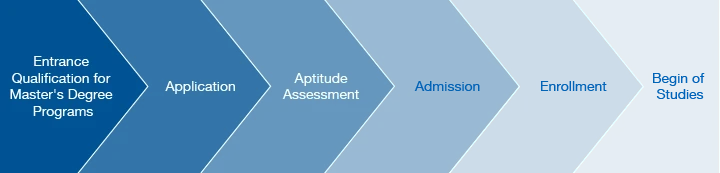
Application via TUMonline: Apply via the TUMonline application portal and upload your documents for admission there.
Assistance: Instructions for applying for a master's program (step-by-step instructions) and Info Portal
Legal Notice: basis is the Academic and Examination Regulations and the Statutes on Aptitude Assessment
Qualification for admission to the Master's degree program in Land Management and Geospatial Science is proven by:
- a qualified Bachelor's degree of at least six semesters from a German or foreign university or at least an equivalent degree in geodesy and geoinformation, geoinformatics, geography, landscape planning, spatial planning, architecture, real estate management, urban planning, law, development economics, land economics, land administration, administrative sciences, political science or comparable courses of study.
- Without a degree, but completed 120 ECTS in the case of a six-semester Bachelor's degree course, 150 ECTS in the case of a seven-semester Bachelor's degree course, and 180 ECTS in the case of an eight-semester Bachelor's degree course, at the time of the application. A Proof that the Bachelor's degree has been passed must be provided within one year of commencing the Master's degree program.
- adequate knowledge of the English language; students whose language of instruction is not English must provide proof of this by means of a recognized language test such as the "Test of English as a Foreign Language" (TOEFL) (at least 88 points), the "International English Language Testing System (IELTS) (at least 6.5 points) or the "Cambridge Main Suite of English Examinations"; furthermore, proof can be provided by a language qualification at C1 level of the Common European Framework amounting to at least 3 credits; if examinations amounting to 12 credits were taken in English-language examination modules in the undergraduate degree program, this also proves adequate knowledge of the English language. If the language of instruction of your bachelor’s degree was in English, it is sufficient to submit the transcript of records or the degree certificate of your bachelor’s degree together with a letter from your university as proof of English proficiency and in which it is stated that you undertook your studies in English.
- passing the aptitude test.
- Degree Certificate and Diploma or Subject and Grade Transcript of Studies to Date
- Transcript of Records
- Statement of purpose (Letter of Motivation)
- Proof of English Language Proficiency
- Complete and Current Résumé
- Passport
- Preliminary Documentation (VPD) if the qualification for graduate studies (e.g. a Bachelor’s) was obtained outside Germany)
We may require additional documents depending on your educational background and your country of origin. Complete the online application to receive a comprehensive list of the required documents.
Please consider the specific requirements for documents for application and enrollment at TUM.
The program is aimed at applicants capable of handling complex land-related problems, which often require customized, contextually relevant solutions. Applicants should have an affinity with land and spatial issues and be able to think spatially. In addition, applicants should demonstrate a strong command of the English language and effective communication skills. Therefore, applicants are subject to an aptitude assessment.
After the required application documents are submitted, an application review is conducted. First, the documents are formally checked by the TUM Enrollment Office for completeness and correctness. Only complete and correct applications are considered for the aptitude assessment using a point system. Each applicant can gain up to 100 points (where 100 points is the best possible result), considering:
- Competence in engineering sciences (up to 40 credits), natural sciences (up to 40 credits), and social sciences (up to 40 credits). The number of points is calculated as no_of_points = sum_of_ECTS - 60, where sum_of_ECTS is the sum of ECTS completed during undergraduate studies in engineering sciences, natural sciences, and social sciences, respectively, that are relevant to land management and geospatial science. For computing competence points, the grades obtained in the relevant courses are not taken into account; only the credits are. Applicants can earn up to 60 points in this part of the assessment.
- Average grade from the transcript of records. The original average grade issued by your home university is converted to the German grading system by the TUM Admission Office. The German system ranges from 1.0 (best) to 4.0 (sufficient). The conversion formula maps your grading system onto this scale. Then, the average grade is converted to a point scheme used for admission to the master's program in Land Management and Geospatial Science. Based on the average grade, applicants can earn a maximum of 30 points. In detail, the points are computed as follows:
- 0 points for grade 3.0 and 30 points for 1.0 (in the German grading system)
- number of points = 3 - grade * 15
- Motivation letter (up to 10 points) and essay.
Based on the total number of points accumulated from 1, 2, and 3 above, applicants are:
- directly admitted if they have at least 70 points,
- rejected if they have less than 50 points,
- are invited to an interview if they have a score between 50 and 69 points.
In the interview, the applicants can get up to 190 points. Applicants with interview points ≥ 120 are admitted; those with interview points < 120 are rejected.
The interview represents the second stage of the procedure and helps determine whether the applicant is capable of successfully completing the desired course of study. Basic geospatial engineering skills, along with familiarity with GIS software and spatial data capture, analysis, and interpretation, are recommended for successful participation in the program. One by one, oral interviews are conducted in person, by telephone, or via Microsoft Teams. The results of preliminary assessments and interviews lead to the ranking of candidates to be presented to a selection committee, consisting of the Dean of Studies, Program Director, and Program Coordinator. It is the committee that determines who is finally accepted or rejected for admission. The target capacity of the master's program in Land Management and Geospatial Science is 20-30 students every year.
- Application for Enrollment (signed)
- Degree Certificate and Diploma (authentic document)
- Transcript of Records (authentic document)
- Most Current Photo (as for ID)
- Digital notification of your health insurance status from a German public health insurance provider (requested by applicant)
We may require additional documents depending on the type of educational background you earned and your country of origin. After accepting an offer of admission in TUMonline, you will receive a list of documents you must submit to TUM in hardcopy for enrollment.
Please consider the specific requirements for documents for application and enrollment at TUM.
Current information
Important current specific information about the degree program could appear here.
Program-specific information
Introductory event
The Chair of Land Management organizes an onboarding session for all new Land Management and Geospatial Science students every year. Usually, the onboarding session takes place the week before the lecture period starts. We also organize a joint welcome event for all new students in the Professional Profile Geodesy (including LMGS students). The dates for onboarding and the welcome event will be announced via email in due course. The Professional Profile Geodesy comprises the following programs:
- M.Sc. Land Management and Geospatial Science
- B.Sc. Land Management
- B.Sc. Geodesy and Geoinformation
- M.Sc. Geodesy and Geoinformation
- M.Sc. Earth-Oriented Space Science and Technology
- M.Sc. Cartography
Where can I find help and contact persons for my degree program?
Legally binding regulations for your degree program can be found in the statutes and regulations of TUM. Answers to frequently asked questions can be found in our Frequently Asked Questions (FAQs). You are also welcome to contact your responsible contact persons (academic advisor, examination board, internship office, etc.) at any time by email and/or make an appointment in person or by telephone. Please also note the general office hours without an appointment.
TUMonline
TUMonline is TUM's campus management system. For example, TUMonline is used to apply and administer your degree program (registration for courses, exams, etc.).
Scripts and lecture notes
Some lecturers offer scripts or other lecture notes for their courses. Lecture notes are often also made available on the Moodle learning platform. You will receive more information from the lecturers directly in the course.
Important from the very beginning: The study progress control!
At the beginning of your studies, please familiarize yourself with the study progress control, which is regulated in §10, paras. 2 and 4 of the APSO of the TUM:
"[…] (2) In Bachelor's and Master's degree programmes, a number of module examinations based on the foundations of the respective degree programme must be completed by the end of the second semester, to be determined in the FPSO.
(4) In four-semester Master's degree programmes, the modules defined in the respective FPSO
1. at least 30 credits by the end of the third semester,
2. at least 60 credits by the end of the fourth semester,
3. at least 90 credits by the end of the fifth semester,
4. at least 120 credits by the end of the sixth semester. […]"
If you do not comply with these requirements, the achievements that have not yet been completed are considered to have been definitively failed, which will lead to disenrollment. Related university degree programmes, in particular Master's degree programmes in a comparable subject area, can no longer be pursued after disenrollment due to a definitive failure in achieving the required standards, at least in Germany. Worried you won't reach the necessary credits? Please contact your contact persons from the Academic Advisory Service or the Examination Board in good time! We are happy to support you where possible!
General information
Fit for TUM service fair
From organizing studies to housing and university life: Learn everything you need to know about general university facilities and offers at the digital service fair "Fit for TUM". This is how you arrive safely at TUM.
Housing
TUM supports you in your search for accommodation with various offers.
Financing
TUM advises you on various options for financing your studies.
Mobility
To reach the various TUM locations in the vicinity of Munich, we recommend using the public transport of MVV and MVG. You can subscribe to a discounted Deutschlandticket for students.
Here you can find the general dates and deadlines at TUM.
Binding examination dates for your degree program can be found in TUMonline.
The exam registration for your degree program usually takes place during the following periods:
- May 15 – June 30 for exams following the summer semester
- November 15 – January 15 for exams following the winter semester
Statutes and Regulations. The English version of the regulations for the Master's program in Land Management and Geospatial Science is available here for reference purposes only. Only the German version of the regulations is legal and valid.
Module handbook from 2024/25
Degree program documentation
Guidelines for safeguarding good scientific practice
Examination Dates
The examination dates for each semester can be viewed in TUMonline.
Winter semester 2025/26:
The dates for the individual examinations will be published in TUMonline until 24 October 2025. Then, you can view them there.
Summer semester 2026:
The dates for the individual examinations will be published in TUMonline until 24 April 2026. Then, you can view them there.
Please also follow TUMonline for possible room and date changes.
Registration and Deregistration for Examinations
| Registration period winter semester 2025/26: | 17 November 2025 - 15 January 2026 |
| Registration period summer semester 2026: | 18 May 2026 - 30 June 2026 |
The cancellation of your participation (de-registration) in an exam is possible until one week before the exam.
In order to take part in examinations, you must register independently via TUMonline. The registration takes place via your study status/curriculum. How to register for an examination in TUMonline.
The de-registration from examinations works the same way.
Please note:
- The examinations office ASG does not register you for exams once the registration period has closed. If you have failed to register for one or more exams, you will not be able to take these exams.
- No exams may be taken for the first time during a leave of absence. An exception is leave on grounds of maternity leave, parental leave or for the care of close relatives.
- However, repeat exams can be taken.
Repeating examinations:
- Module examinations can be repeated as often as required, taking into account the academic progress check (see § 10 (3) and (4) APSO, resp.).
- Only exams that have been previously failed can be retaken. It is not possible to retake an exam that has already been passed for the purpose of improving your grade.
- Please note that you must also register for a retake exam in TUMonline.
Disadvantage Compensation in examinations
Students are entitled to compensation for disadvantages in examinations if they have an impairment that impairs their studies and can be compensated for.
Compensation for disadvantages must be applied for from your board of examiners in good time before the start of the relevant examination phase. The application must be made informally in writing by e-mail to the examinations office ASG: examination.asg@ed.tum.de.
The application must be accompanied by meaningful (specialist) medical certificates or reports stating which impairment is involved and which measures are required to compensate for the disadvantage.
Please note that the board of examiners is not bound by the measures to compensate for disadvantages stated in your application or in the certificate or expert opinion.
The following deadlines apply for the application:
Winter semester and summer semester: By the end of the registration period for the respective semester's examinations at the latest.
Please note: If an application is submitted after this deadline, any approval of compensation for disadvantages will apply from the examination phase of the following semester at the earliest.
You can find further information and information sheets on the subject of "compensation for disadvantages" on the pages of the TUM Center for Study & Teaching.
You will also find an application form that you can use under the link above.
Withdrawal from an Examination
Withdrawal from an examination is only possible for valid reasons for which the student is not responsible. Such reasons include illness, accident, death in the family etc.
Please be sure to read the TUM's information on withdrawal regulations in the event of illness.
If you cannot participate in an examination, a written withdrawal application must be submitted immediately to the responsible examination board. This notice should be submitted by e-mail to: examination.asg@ed.tum.de
You can download the withdrawal application form here.
In addition to the application, proof of the reason preventing your participation in the examination must also be submitted without delay, e.g. a medical certificate in the event of illness.
The certificate must meet the following criteria:
- It must be issued by a qualified doctor.
- Generally, it must be based on an examination carried out on the day on which you claim to be unable to take the exam.
- It must state the start and end dates of your inability to take the exam due to illness.
- It must clearly state why you are unable to take the exam so that the board of examiners can determine whether you were actually unable to take the exam on the day of the exam (e.g., necessary bed rest or inability to travel to the exam location and/or take the exam there without significant discomfort).
Important:
- Confirmation of inability to take the exam alone is not sufficient.
- The certificate does not need to contain a medical diagnosis.
- If you are being treated as an inpatient in a hospital on the day of the exam, a certificate from the hospital must be submitted.
- Certificates of incapacity for work (Arbeitsunfähigkeitsbescheinigung) are not sufficient.
Academic progress (hardship application)
If you can prove (with a valid medical certificate or other supporting documentation) that you were unable to complete your studies properly over a long period of time (possibly even an entire semester) for reasons beyond your control (illness, etc.), you can apply for an extension or suspension of the deadline of the academic progress check (§ 10 para. 7 APSO).
The reasons must be reported to the responsible board of examiners immediately. If you fail the academic progress check, you cannot retroactively cite long-term illness or other reasons if you did not report these to your board of examiners immediately.
As a rule, the study progress check can only be suspended once.
If the restrictions continue, you must inquire with the TUM Center for Study and Teaching - Application and Enrollment Department about the possibility of taking a leave of absence or interrupting your studies. You can also seek advice from the student advisory service or the secretary to the board of examiners of your degree programme.
The immediate notification of valid reasons has to be be sent informally to the ASG Examination Office: examination.asg@ed.tum.de
Important:
Medical certificates must comply with TUM's legal requirements. Information on the formal and substantive criteria for certificates can be found above under “Withdrawal from an examination.”
If a certificate does not meet these criteria, a corresponding hardship application must be rejected.
Please note that you can only apply for a suspension or extension of the deadline if you were actually unable to meet the requirements of the academic progress check. You can see this by the notification “DF” in your study tree in TUMonline.
In this case, please send the appication informally by e-mail together with all necessary supporting documents (see above) to the examinations office ASG: examination.asg@ed.tum.de.
The board of examiners responsible for your degree program will decide on your application at its end-of-semester meeting. The decision will then be communicated to you in writing by the examinations office ASG as soon as possible.
Please refrain from making any prior inquiries regarding the status of your application.
Boards of Examiners Aerospace and Geodesy
According to § 29 APSO, the boards of examiners are responsible for conducting the examination procedure. They make all necessary decisions, unless the general academic examination regulations of TUM have assigned this responsibility to the respective examiners.
The boards of examiners' decision-making authority includes, in particular, applications for withdrawal from examinations, applications for suspension and extension of deadline, applications for recognition of credits as well as applications for compensation of disadvantages in examinations.
The degree programmes of Aerospace and Geodesy has the following boards of examiners with their respective responsibilities:
| Board of examiners | degree program | secretary to the board |
| Aerospace | B.Sc. Aerospace M.Sc. Aerospace M.Sc. Aerospace Engineering (TUM Asia) | Ms. Pema Mauser-Sherpa Mr. Daniel Hartenstein Mr. Daniel Hartenstein |
| ESPACE | M.Sc. Earth Oriented Space Science and Technology | Mr. Daniel Hartenstein |
| Geodäsie und Geoinformation | B.Sc. Geodesy and Geoinformation M.Sc. Geodesy and Geoinformation B.Sc. Land Management (partial degree) M.Sc. Land Management and Geospatial Science | Mr. Daniel Hartenstein |
If you have completed parts of or an entire degree program at a university other than TUM, you can apply for recognition of credits. A prerequisite for the recognition of credits that were not achieved at TUM is the equivalence of the gained competences. This means that the knowledge and skills acquired outside of TUM must not be fundamentally different from the knowledge and skills conveyed in the corresponding modules at the TUM (basis for this is Art. 86 BayHIG and § 16 APSO).
Procedure of the recognition process:
- Submit the completed recognition form to the examinations office ASG. All additional documents required must be enclosed in accordance with the form (page 1) and checked for completeness by the student. Only complete documents can be processed.
- Your application with the documents will be forwarded to the module coordinator/subject examiner. They will decide on the equivalence of the already achieved credits with the credits to be achieved in your degree pgroamme at TUM.
You can find the recognition form in the wiki of your degree programme under "Documents and Forms".
Please note:
- You can apply for recognition of credits only after you have enrolled.
- An application for recognition of credits can only be made once and must be made within the first academic year. In order to ensure an appropriate planning of your studies, you should submit your application as soon as possible.
- In the case of credits from a semester abroad, recognition must be applied for within the semester following the stay abroad.
- The recognition procedure ends with the signing of the application by the responsible module coordinator. Information on recognition or rejection will be sent by e-mail. Applications cannot be re-submitted after the recognition procedure has been completed.
- Once recognition has taken place, a new application for recognition of credits claiming equivalence with a module other than the recognized competences is no longer possible. If the student claims equivalence of the competences to multiple different modules, this must be checked in the same application/recognition process. In this case, please use a separate form for each recognition process.
- If at least 30 credits are recognized as equivalent, you will be upgraded by one semester. If 52/82 credits are recognized, you will be upgraded by two/three semesters respectively.
Grade conversion:
If the grading system of examinations completed at universities or equivalent institutions of higher education and recognized by TUM does not match the TUM grading system, the grades of the other institution will be converted according to the so-called "Bavarian Formula". If such a conversion is not possible, the examination board will determine a corresponding ratio for the grade conversion.
Contact for credit recognition: examination.asg@ed.tum.de
Registration:
For final theses (= Bachelor’s thesis und Master’s thesis) registration and all administration take place in the ED portal at https://portal.ed.tum.de/en/Theses/
You find all important information in the wiki of the ED portal.
The supervising chair will register you for the thesis. You will then receive an e-mail asking you to confirm the registration of the thesis and the data provided in the portal. Only then will the registration be reviewed by the examination board and you will then receive the approval or rejection of the topic by e-mail.
All e-mails from the portal will be sent to your TUM e-mail address.
Submission:
The Bachelor's/Master's thesis is handed in digitally via the ED portal. For more information, see wiki of the ED portal.
Extension:
In the event of valid reasons for which you are not responsible (e.g. longer waiting time for technical equipment or software), you can apply to the respective examination board for an extension of the processing time. This is also done via the ED portal. For more information, see wiki of the ED portal.
Suspension due to illness:
The processing time is suspended for the duration of an illness. You are obliged to report an illness to the respective board of examiners immediately and to provide credible evidence of this in the form of a medical certificate. The report is also made via the ED portal in the same way as when applying for an extension (see above).
Please send the medical certificate in PDF format to examination.asg@ed.tum.de. The certificate must meet the same criteria as those set out above under “Withdrawal from an examination.”
Important: If the illness is not reported immediately—i.e., as soon as you realize that you are ill—the respective board of examiners must reject the suspension of the processing time.
When the grading process is complete, you can view the grade in TUMonline.
As soon as the assessment has been finally confirmed by the examiners, you receive the grade by e-mail. The grade and other details are then transferred from the School Office to TUMonline.
According to § 18 (11) APSO, the thesis has to be graded within two months.
Please note: You may not be on leave of absence during the entire time you are working on the thesis and must be duly enrolled by the time you hand in your thesis.
Important: Please read the guidelines for ensuring good scientific practice at TU München. Their knowledge is assumed when registering the thesis.
Prerequisite:
A prerequisite for admission into the Master's Thesis module is that at least 90 credits of the program have been achieved. In justified cases, a student may be admitted into the Master's Thesis with less than 90 credits, subject to the approval of the Examination Board. Generally, we do not recommend starting your thesis with more than 5 outstanding coursework credits.
Important: Before you start to search for a thesis topic, read the Thesis Guidelines and Formalities for the Master's program in Land Management and Geospatial Science. Use the following template cover and declaration.
Additional requirements for master's thesis for students who enrolled in the Master's program between WS2020 and SS2025 (FPSO 2020):
The Master's Thesis module comprises the scientific write-up of the Master's Thesis (24 credits) and a Master's Colloquium (6 credits). In addition to the registration of the Master's Thesis in ED Portal, students must also register themselves for the Master’s Colloquium in TUMonline, irrespective of which Chair they are writing their thesis with. The Master Colloquium is offered at the end of every semester, as with any exam at TUM. Once you register for the Master Colloquium, you are expected to participate in the Master Colloquium organized at the Chair of Land Management by way of a presentation of your research proposal or preliminary findings, or prove (with grading) that you have participated in a similar colloquium organized by your supervising Chair. This presentation is not the same as your Master's Thesis defence, which applies to all students in the master's program in Land Management and Geospatial Science. The additional requirement to register for the master's colloquium does not apply to students who started the program in WS2025/26 or changed to the new curriculum (FPSO 2025)
Scope:
The workload of an academic thesis is reflected in the number of credits awarded. The Master’s Thesis (including the Master's Colloquium) in the Land Management and Geospatial Science program comprises:
- 30 credits = 900 working hours = 6 months of full-time work
- A Master’s Thesis may be submitted no earlier than four months after the thesis has been registered.
The TUM School of Engineering and Design offers many opportunities for a study-related stay abroad. Good reasons for studying abroad are to broaden your horizons, to have a personality-building effect, to improve your language skills, and to get to know other (professional) cultures and ways of life.
Professor Chigbu is committed to fair land use in Africa

Prof. Uchendu Eugene Chigbu is using the knowledge gained from 13 years at TUM to promote fair land use in Africa - for more justice, planning security and prospects in rural regions. Image: Private
50 Years Chair of Land Management - 50 Years Commitment for a more just World

On the occasion of its anniversary, the Professorship of Land Management highlighted its central importance for academia, politics, and professional practice by bringing together national and international stakeholders as well as alumni from around the world. Image: TUM