

Urbanism – Urban and Landscape Studies and Design M.Sc.
How do we want to live tomorrow – and how do we shape our cities and landscapes accordingly? How can we respond to the current challenges facing urban living environments? The interdisciplinary Master’s program M.Sc. Urbanism at TUM prepares professionals to understand and actively shape spatial transformation processes in Germany, Europe, and around the world. At its core is the sustainable and design‑driven redevelopment of urban systems, based on close collaboration between disciplines such as architecture, landscape architecture, urban planning, as well as the humanities and natural sciences.
The program is aimed at all those who want to advance the social, ecological, and design-oriented development of urban spaces. With interdisciplinary perspectives and a high degree of creative freedom, the program prepares students for the complex challenges of urban transformation processes – from climate change to digitalization.
| Type of Study | Full Time | Main Locations | Munich |
| Standard Duration of Studies | 4 Semester | Application Period | Winter semester: 01.04. – 31.05. |
| Credits | 120 ECTS | Required Language Proficiency | German |
| Start of Degree Program | Winter Semester | Costs | Student Fees, Tuition fees for international students |
The Master’s program in Urbanism addresses the complex challenges posed by global urbanization. Its focus lies on interdisciplinary approaches that shape urban transformation processes in sustainable, socially just, and future‑oriented ways.
Students learn, among other things, to:
- analyze urban spaces – from megacities to culturally shaped rural landscapes
- develop spatial strategies through design, for example in the areas of neighborhood development, mobility, housing, climate adaptation, and participation
- work collaboratively across disciplines with stakeholders from politics, planning, and civil society
The program combines theory and practice and prepares graduates for a wide range of professional fields in urban planning, research, and international organizations.
As a graduate of the Master’s program in Urbanism, you possess strong methodological, technical, personal, and social competencies for spatial planning and design at the urban scale.
You are able to:
- integrate disciplinary knowledge from (landscape) architecture, urban planning, and the social and environmental sciences in a methodical way
- develop innovative approaches for sustainable spatial design
- design spatial strategies for complex future challenges within the framework of legal regulations
- apply academic methods such as research by design, cultural studies, and mapping
- professionally present your results using both analogue and digital representation techniques
These abilities make you a highly sought‑after professional in planning, research, consulting, and international project work.
As a graduate of the Urbanism program, you are qualified to take on positions in public construction and planning authorities as well as in private architecture, engineering, and planning offices. You may also work in companies within the construction planning sector or the real estate industry. In addition, the degree qualifies and encourages you to pursue a doctorate and opens up opportunities in various fields of research.
You will complete a 4‑semester, full‑time Master’s program comprising 120 credits. At the core of the program is project‑based work, which is accompanied by elective modules. This means:
- You will work on one‑ or two‑semester design and research projects.
- You will write a master’s thesis on a self‑developed academic research question.
- You will shape your own academic focus by selecting elective modules and project topics, or you may choose from the topics offered by the participating professorships.
The program is complemented by:
- compulsory foundational modules
- freely selectable advanced modules – for example from architecture, landscape architecture, civil engineering, and the social and environmental sciences
The flexible study model encourages independent work, the development of individual areas of focus, and interdisciplinary thinking. It enables several possible study pathways:
- A project‑oriented pathway based on predefined assignments offered by the various professorships involved in the program.
- A pathway built around a self‑selected thematic and geographical specialization.
- A pathway with a strong focus on independent academic work addressing spatial research questions.
Combinations of these pathways are also possible.
For details: Program Documentation

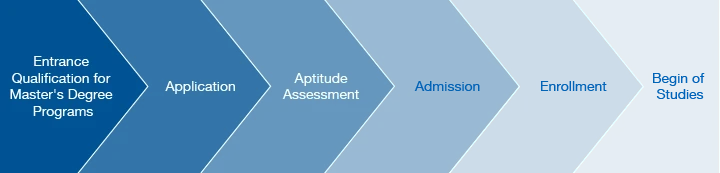
Application for the Winter Semester
- You obtain your Entrance Qualification for Master's Degree Programs.
- By May 31: You apply for the program
- July to September: You take part in the aptitude assessment.
- July to August: If applicable, you will take part in an aptitude interview – interview period: 1 July to 31 August.
- Mid-July to September: You receive your admission.
- By October at the latest: You accept your study place and complete enrollment.
- Early October: You begin your studies.
Application via TUMonline: Apply easily via the user-friendly TUMonline application portal and upload your documents for admission there.
Support: step-by-step instructions for applying to a master's program and Application Info Portal.
Legal Notice: The basis is the program-specific Academic and Examination Regulations (FPSO) (link to follow).
Application for the Summer Semester
You can only apply for the summer semester if you are already studying in a subject-specific Master’s program at another university. Applications for the summer semester are only possible for transfer students (Application to a higher subject semester). You will then start in at least the second semester and must bring a corresponding number of credits from the first semester. Applications can be submitted until January 15.
The assessment interviews take place in February and March.
Further information on Application to a higher subject semester.
Please notice: You can apply for the Master’s program in Urbanism and participate in the aptitude assessment process a maximum of two times. If you cancel your application, it does not count toward this limit. Cancellation is possible by emailing studium@tum.de and providing your applicant number.
1. Entrance Qualification for Master's Degree Programs
- A qualified bachelor’s degree in Architecture, Landscape Architecture and Planning, Urban, Regional and Spatial Planning, Geography, Civil Engineering, Transport Planning, Urban and Architectural Sociology, Environmental Sciences, or a comparable degree program (minimum of 6 semesters).
- Applicants who have not yet completed their bachelor’s degree may also apply if they have already completed the majority of their coursework (for 6‑semester bachelor’s programs: at least 140 credits; for 7‑semester programs: 170 credits; for 8‑semester programs: 200 credits)
Proof of completion must be submitted no later than one year after the start of the Master’s program.
2. Professional Experience or International Experience
- Relevant practical experience (in Germany or abroad) in fields related to the profession — including urban design, urban planning, urban development, landscape architecture, or architecture with a focus on large‑scale spatial contexts — totaling at least six months,
or one semester of study abroad with a minimum of 20 credits. - The internship must be completed at the time of application; submitting documents later is not possible.
3. German Language Proficiency
4. Program‑Specific Requirements / Eligibility Criteria
- Competencies in both empirical‑analytical and design‑based methods
- Existing subject knowledge from the bachelor’s degree in a spatially oriented discipline (see qualified bachelor’s degree)
- Ability to work in an interdisciplinary academic environment
Your suitability for the Master’s program will be assessed in a two‑stage aptitude assessment, which evaluates whether you meet the above‑mentioned program‑specific requirements.
Further information on the aptitude assessment and selection process.
- Degree Certificate and Diploma or Subject and Grade Transcript of Studies to Date.
- Transcript of Records with the following minimum achievements:
- 140 ECTS for a 6‑semester bachelor’s program
- 170 ECTS for a 7‑semester bachelor’s program
- 200 ECTS for an 8‑semester bachelor’s program
- If a transcript with more than 140 ECTS is submitted, the 140 best‑graded credits must be listed in the application. Proof of the completed bachelor’s degree must be submitted no later than one year after the start of the Master’s program.
- Proof of internship in the relevant professional field or proof of study abroad
- Internships related to the field, e.g. in urban design, urban planning, urban development, landscape architecture, or architecture with a large‑scale focus — totaling at least six months, completed in Germany or abroad. Multiple internships may be combined to reach the required duration.
or - Additional study abroad, at least one semester at a foreign university or institution with subject relevance — with a minimum of 20 ECTS credits.
Note: The compulsory study‑abroad semesters in the bachelor’s programs in Architecture and Landscape Architecture/Planning at TUM fulfill this requirement.
- Internships related to the field, e.g. in urban design, urban planning, urban development, landscape architecture, or architecture with a large‑scale focus — totaling at least six months, completed in Germany or abroad. Multiple internships may be combined to reach the required duration.
- Statement of purpose (Letter of Motivation)
- Explanation of the reasons for choosing the Master’s program, as well as the specific skills and interests that qualify the applicant for the program (max. two A4 pages).
- Complete and Current Résumé
- Portfolio with work samples
- Maximum ten pages in A3 format, or the bachelor’s thesis (maximum A3 format).
- Submission as a PDF file, max. 20 MB, uploaded to the TUM applicant portal.
- Important: The use of AI in preparing the portfolio is only permitted for translation and text correction.
- Essay
- An academic‑standard essay on an urbanism topic (max. 10 pages, German or English).
- This essay may also take the form of an exposé on a self‑chosen urbanism topic.
- Important: The use of AI in preparing the essay is only permitted for translation and text correction.
- Passport
- Proof of German Language Proficiency
- Preliminary Documentation (VPD) by uni-assist - for international applicants only
We may require additional documents depending on the type of educational background you earned and your country of origin. After accepting an offer of admission in TUMonline, you will receive a list of documents you must submit to TUM in hardcopy for enrollment.
Please consider the specific requirements for documents for application and enrollment at TUM.
Selection is conducted through an aptitude assessment.
This is a two‑stage process in which the TUM School of Engineering and Design evaluates, after the official application has been submitted, whether you meet the specific requirements for the Master’s program.
Stage 1
In the first stage, the bachelor’s degree grade (max. 60 points), the portfolio / bachelor’s thesis (max. 20 points), and the essay (max. 20 points) are assessed using a points-based system.
Based on the total number of points achieved, applicants are either directly admitted, rejected, or invited to an interview. In Stage 1 you can achieve a maximum of 60 points:
- Up to and including 42 points: direct rejection
- 43 to 59 points: invitation to the aptitude interview (Stage 2)
- 60 points and above: direct admission
Stage 2
In the second stage, you will be invited to an in‑person aptitude interview.
The interviews take place between 1 July and 31 August.
You will receive the official invitation at least one week before the interview by email.
Please confirm the appointment upon receipt. The date is binding and can only be postponed in urgent exceptional cases (upon request and with documentation).
In Stage 2, the points from the interview (maximum 28 points) are added to the points obtained in Stage 1.
Admission is granted from a total of 70 points.
Detailed information on the aptitude assessment.
Are you already studying at a university and would now like to continue your studies at TUM? A transfer to this degree program is generally possible; be sure to clarify in advance with the Departmental Student Advisor (Studies & Application) whether you meet the required qualifications for lateral entry into the program.
We recommend applying for the first semester in either the summer or winter semester. Depending on the number of recognized credits, you will then be placed in a higher semester. Applications for recognition can only be submitted after enrollment at TUM.
You must submit a semester placement certificate (preliminary process) in addition to the other application documents. Please contact the Departmental Student Advisor (Examinations) by email for this purpose. Include the following information in your email:
- Your applicant number
- The estimated number of credits you will bring
- The name of the university where the credits were earned
If you can provide proof of at least 30 credits from your previous degree program, entry in the summer semester is possible.
- Application for Enrollment (signed).
- Degree Certificate and Diploma (authentic document).
- Transcript of Records (authentic document).
- Most Current Photo (as for ID).
- Digital notification of your health insurance status from a German public health insurance provider (requested by applicant).
- For applicants to a higher subject semester: semester placement certificate (see Application to a higher subject semester).
We may require additional documents depending on the type of educational background you earned and your country of origin. After accepting an offer of admission in TUMonline, you will receive a list of documents you must submit to TUM in hardcopy for enrollment.
Please consider the specific requirements for documents for application and enrollment at TUM.
Further information on accepting your study place.
Current Information
The Project Market M.Sc. Urbanism will be open for the summer semester 2026 from March 27 to March 29.
You can select your projects using the following link: Project Market.
At the beginning of the winter semester, an official orientation event is held for all newly enrolled Master’s students in Urbanism.
Information for the winter semester 2026/2027 will follow.
A general overview of the four‑semester curriculum is provided in the study plan.
Further information on the structure of the program can be found here.
For questions regarding confirmations (e.g., credit confirmations for BAföG applications, orphan’s pension, program‑related documentation, standard period of study, etc.), please contact your Departmental Student Advisor (Examinations).
The Architecture Student Council (Fachschaft Architektur) represents the interests of TUM students in the Department of Architecture. It acts as the voice of the student body and represents students in university committees and commissions.
During the semester, the Student Council also organizes various events — large and small — to strengthen the community among students across different cohorts. It is the first point of contact for requests, problems, and questions.
Academic and Examination Regulations
All students are subject to the General Examination and Study Regulations (APSO) of TUM, which:
- Regulate the structure of the degree program
- Define how examinations are conducted
- Determine deadlines and procedures
Specific information is provided in the respective program-specific Academic and Examination Regulations (FPSO). Here you can find the current FPSO 2026. For older versions, please click here.
The FPSO is supplemented by the module catalog, which is updated each semester:
- Current Module Catalog M.Sc. URB for FPSO 2026 (link to follow).
- Current Module Catalog M.Sc. URB for FPSO 2021
Studienfortschrittskontrolle
Study progress monitoring is regulated in the APSO and, for program-specific rules, in the FPSO 2026. Please note the deadlines listed in §38 FPSO in conjunction with §10 APSO:
- By the end of the 2nd semester, at least one of the module examinations listed in Appendix 1 of the FPSO from the compulsory modules of the first semester must be completed.
- The following minimum credit totals must be achieved on time:
- After 3rd semester: at least 30 credits
- After 4th semester: at least 60 credits
- After 5th semester: at least 90 credits
- After 6th semester: at least 120 credits
Notification of Examination Results
Students receive Notification of Examination Results after each semester from the Graduation Office and Academic Records – either via email informing them that the notice is available for download in TUMonline, or directly by post.
The notice lists all examinations taken so far with grades and credits; it serves as a control document. It also informs students about the resulting legal consequences. For questions regarding examination notices, please contact your Departmental Student Advisor (Examinations).
Examination Board
The Examination Board is responsible for all matters related to examinations. It oversees the implementation of all examination procedures and makes necessary decisions unless these are assigned to examiners by APSO or required during the examination process. It also decides on requests such as deadline extensions or hardship cases during the course of study. The board meets once per semester.
Composition:
- Prof. Benedikt Boucsein (Vorsitz)
- Prof. Mark Michaeli (stv. Vorsitz)
- Prof. Lindsay Howe
- Prof. Regine Keller
- Dr. Nadia Alaily-Mattar
>> Contact: Secretary Julie Strickland
Disadvantage Compensation
A disability or chronic illness can affect your studies. To ensure you receive appropriate support, we consider both the requirements of your program and your individual needs. Please contact the Departmental Student Advisor (Examinations).
Disadvantage Compensation helps to offset study and examination difficulties caused by impairments:
- They are determined individually and based on the situation, not applied generally.
- The arrangement depends on your impairment and the program.
- Important: Compensation for disadvantages is not a simplification – the performance objectives of the examination and study regulations remain unchanged.
- Please apply for compensation as early as possible!
All important and up-to-date information on semester scheduling, lecture periods as well as lecture-free periods, key deadlines (e.g., application, leave of absence, enrollment, and re-registration), as well as public holidays and student council meetings can be found under Dates and Deadlines on the TUM website.
Review the modules listed in your subject-specific examination regulations (FPSO). Modules that have already been successfully completed cannot be taken again. This also applies if the course is offered under a different topic or subtitle. If you re-enroll in modules you have already completed, no credits will be awarded.
Please check your exam details regularly in TUMonline, especially shortly before the exams, to see if there are any changes.
Exact registration dates are published in TUMonline and must be strictly observed. You will receive an email from your program advisor before the start and shortly before the end of the registration period.
Exam Registration
A guide for exam registration can be found in the Wiki for central IT topics and generally for TUMonline at: https://www.it.tum.de/it/tumonline/studieren/
Register for all exams for courses you attend in the respective semester. Only if you are properly registered in TUMonline can the Professor access your account and enter your exam results.
If you encounter problems with exam registration, contact the Departmental Student Advisor (Examinations) by email promptly (within the registration period).
Exam Deregistration
Deregistration is only possible in TUMonline up to seven days before the exam date. Weekdays and weekends are treated equally.
Repeat Exams
Repeat exams usually take place in the following semester. However, always check with the responsible chair. For all repeat/make-up exams – whether for compulsory or elective modules – you must register independently via TUMonline.
Leave of Absence
If you are on leave for a semester, you cannot take exams for the first time. However, you may retake failed exams.
Exception: If you are on leave due to maternity protection, parental leave, or caring for close relatives, you may take exams for the first time.
Further information on leave of absence.
General Information
- The Master’s thesis is normally scheduled for the 4th semester.
- The thesis topic is developed and prepared within the compulsory seminar Reflection.
- The period from the assignment to the submission of the Master’s thesis must not exceed six months.
- The Master’s thesis should represent the final requirement of the degree program.
- To be admitted to the Master’s thesis, students must have completed at least 85 credits.
- The Master’s thesis is credited with 30 ECTS.
- You are required to give a presentation on your Master’s thesis.
Dates
These dates are recommendations; individual timelines may vary.
- Thesis assignment: 1 October or 1 April
- Thesis submission: March or September
- Thesis presentation: April or October
- Graduation ceremony for Master’s students: April or October
Specific information about the Master’s thesis — in particular regarding the start, process, and submission — is communicated via email at the beginning of each semester.
The preparation of an individual thesis topic is handled individually by each chair. Research questions for individual theses are developed within the Reflection seminar and coordinated with the respective supervisors.
Please make sure to inform yourself in advance about the procedures and deadlines of the individual chairs:
Credits can be recognized provided there is no significant difference in the competencies acquired. The review is carried out by the respective module coordinator. Recognition can only be granted for modules/exams for which no examination process has yet begun in the current program at TUM (i.e., no exam has been registered).
According to the Enrollment Regulations § 4 (5) dated 06.02.2023, the semester level will be increased by one semester for every 30 recognized credits; for an additional 22 credits beyond that, the level will be increased by another semester.
Recognition of Credits Earned Prior to Studying at TUM
- After enrollment, contact your Departmental Student Advisor (Examinations) and send the transcript of your previous degree program. The transcript will be reviewed, and you will then receive instructions on how to complete the recognition process.
- Additional modules (credits) from the Bachelor’s program can only be recognized if they are listed as additional achievements in your BA transcript.
- The prerequisite for recognizing credits earned outside TUM is equivalence. This means that the acquired knowledge, skills, and credits must not differ significantly from the content of the corresponding TUM modules (§16 APSO). The review is carried out by the respective module coordinator.
- To apply for recognition, please use the following form: Recognition Form.
- Important: The application for recognition of examinations completed before the start of the current program can only be submitted once, and within the first year of study.
Recognition of Credits Earned During a TUM Study Abroad Program
- You should compare TUM modules with those of your host university and select a corresponding TUM module that could be recognized. Check your study structure in TUMonline and identify the subject area where you want to enter the recognition.
- Please send your fully completed recognition form to the responsible chair. For approval, the chair requires copies of the following documents: transcript, module description, and proof of achievements.
- Once you have received approval from the chair (including signature and/or stamp), please send the completed form and a copy of your transcript to your Departmental Student Advisor (Examinations).
- Modules completed abroad whose content corresponds to Urbanism modules in the module category “Fachliche Vertiefungen” (FPSO 2021) or “Angrenzende Fachgebiete” (FPSO 2026) may be recognized as subject-specific elective modules within a container recognition module (up to a maximum of 9 credits).
General Information
- Important reasons are required for a leave of absence during your studies. Here you can find recognized reasons and further important information on leave of absence.
- The application for leave must be submitted no later than the first day of lectures of the semester in which you wish to take leave. Supporting documents, such as an internship contract, can be submitted later.
- A leave of absence is usually granted for one semester and should not exceed two semesters per person during the entire course of study.
- During a leave semester, students remain enrolled; however, the semester counts only as a university semester and is not included in the standard period of study. First-time exams are not permitted, but repeat exams may be taken.
- During a leave of absence, theses cannot be registered or submitted. An exception applies for a second attempt. Interrupting the thesis processing period with a leave semester is also not possible (exception: parental leave).
Internship (Voluntary)
- Neither the Bachelor’s nor the Master’s program in Architecture includes a mandatory internship in the curriculum.
- Completing a voluntary internship is still possible.
- To obtain a leave of absence for an internship, the internship must cover at least half of the lecture period (see TUM Leave of Absence Information). The Admissions and Enrollment Office also requires written approval from the School Office. Please send your request to the respective Departmental Student Advisor (B.A. Architecture, M.A. Architecture, M.A. Landscape Architecture und M.Sc. Urbanism). The statement will be issued once a copy of the internship contract or confirmation of the required duration is provided.
Study Abroad (Master)
Studying at a university abroad is a recognized reason for a leave of absence at TUM. We strongly recommend taking a leave of absence for a study abroad semester in the Master’s program to avoid conflicts with study progress monitoring.
In the Bachelor’s program in Architecture, no leave of absence is required for the mandatory study abroad semester.
We encourage you to think globally during your studies. On the TUM ED Wiki pages, you will find important information for planning your stay abroad.
In the Master’s program in Urbanism, studying abroad is not mandatory.
Statutes & Regulations
- General Examination and Study Regulations (APSO)
- Program-Specific Academic and Examination Regulations (FPSO 2026)
- Current Module Catalog M.Sc. URB for FPSO 2026 (link to follow)
- Program-Specific Academic and Examination Regulations (FPSO 2021)
- Current Module Catalog M.Sc. URB for FPSO 2021
- Current Aptitude Assessment Procedure M.Sc. URB (Appendix 2, FPSO 2026)
- Older Regulations
Program Structure
Additional Information
The handbook “Raumpilot:in” designs the inclusive city

TUM students developed the handbook “Raumpilot:in: New Perspectives on Urban Development. Gender-Responsive Planning for Livable Cities". Image: Nadine Reisen
Landsberg am Lech - Ready for 2055?

Students from the master's programs in urban planning and architecture worked for several months on the long-term development of the city of Landsberg. The goal was to design a long-term spatial strategy. Image: TUM