
Engineering Science B. Sc
One degree, many possibilities!
Are you looking for a broad methodological and scientific basic education without wanting to commit yourself to one of the traditional engineering subjects at the start of your studies? This Bachelor´s program Engineering Science is a well-founded and, compared to the usual engineering courses, significantly more in-depth mathematical and scientific education.
Equal emphasis is placed on theory and method orientation as well as on the integration of practice-relevant content from industrial application. Students are given the opportunity to specialize individually in engineering sciences or in new interdisciplinary subject areas.
| Type of Study | Full Time | Main Locations | Garching |
| Standard Duration of Studies | 6 Semester | Application Period | Winter semester 15.05. – 15.07. |
| Credits | 210 ECTS | Required Language Proficiency | German |
| Start of Degree Program | Winter Semester (October) | Tuition Fees | Semester fee, Fees for Students from Non-EU Countries |
The degree program in Engineering Science is geared toward students seeking a broad foundational education and training in the sciences and associated methodologies, without having to commit to traditional engineering subjects. The course specifically addresses those who are interested in pursuing a professional career on the interfaces between the classic disciplines. Examples are mechatronics, process engineering, biomedical engineering, materials science, mechanics of materials, and software engineering. However, students can also pursue a classic degree in the engineering departments at the Technical University of Munich, such as mechanical engineering, electrical engineering, and computer engineering.
The central concern that drives the degree program is to convey the broad methodological foundations of the discipline, as required to work in engineering, without bringing a specific applied field to the fore. In addition, students receive a sound vocational education and training in mathematics and the natural sciences that is clearly more advanced than that offered by conventional degree programs in engineering. Here, equal emphasis is placed on theoretical and methodological orientation, as well as on the integration of content that is relevant to practical application in industry. During the course of their studies, students are given the opportunity to specialize in engineering sciences or in new interdisciplinary fields.
For a comprehensive description of the program, please refer to the degree program documentation for the Bachelor’s program in Engineering Science (PDF, German).
Click here for experience lectures.
TUM Open Campus Day in Garching on Friday, March 27, 2026, for Prospective Students
The Student Office and the MSE Student Council at the information booth in the MW building.
Take the opportunity to learn about study programs and research projects, and engage in conversations with experts.
Further information can be found at: https://www.tum.de/studium/von-der-schule-zur-universitaet/angebote-fuer-studieninteressierte/tum-open-campus
As a graduate you possess a broad, method-oriented vocational education and training in general engineering science, the natural sciences, mathematics, and informatics. In addition, you will have created your own profile within the broad field of engineering science in accordance with your choice of specialties.
Based on your individual focus on a specific area of specialization during the degree program, you have the opportunity to successfully complete an associated TUM master's program.
Should you decide to enter into professional employment upon successfully completing the bachelor's program, numerous opportunities arise in many different areas. In addition to mechatronics and process engineering, these also include biomedical engineering, materials science, mechanics of materials, and software engineering.
The first four semesters provide in-depth basic knowledge in engineering and natural sciences as well as mathematics and computer science. This is supplemented by coursework.
In the 5th and 6th semesters, students have the opportunity to focus on specific subjects, also with a view to a possible Master's degree. For this purpose, students have a module catalog from which they can choose individually. These modules help to develop an engineering profile in greater depth.
A special part of the study program is the large number of modules from the elective area "Focusing" based on the sample curriculum. Here, students can include modules that may qualify them for a Master's degree course.
The Bachelor's thesis, worth 12 ECTS credits, is the final project of the degree program and is the first independent academic work on a specialist topic, which is set, supervised and assessed by university lecturers.
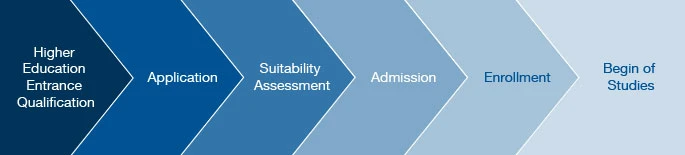
Apply easily via the user-friendly TUMonline application portal and upload your documents for admission there.
Support: step-by-step instructions for applying to a bachelor's program and Application Info Portal
Legal Notice: The basis is the program-specific Academic and Examination Regulations (FPSO) and the Statutes on Aptitude Assessment
Application deadlines
- Application period for the winter semester (WiSe): May 15 to July 15 of the respective year
- Application period for the summer semester (SoSe)*: November 15 to January 15
*Applications for the summer semester are only possible if you have recognized prior achievements that can be used as a basis for placement in a higher semester! To apply for the second semester, you must have earned at least 35 credits. When applying, you must submit a request for semester classification. After admission, you must submit a request for recognition of credits. Please upload the completed semester classification by 15th January. Your application will only be processed if all application documents have been received by the deadline. Otherwise, you must expect your application to be rejected.
Aptitude interviews
- For the winter semester: mid-July to early September
- For the summer semester: late February to late March
The invitation to the aptitude interview will be sent by email at least one week before the interview date.
Enrollment
After successfully completing the application process and receiving admission, all documents required for enrollment must be submitted
- by August 15 (for the winter semester) or
- by February 15 (for the summer semester).
If you do not have all the documents required for enrollment by this date, they can be submitted up to five weeks after the start of lectures at the latest.
Please note that enrollment will only take place once all the necessary documents have been received in full.
Suitability for the bachelor's degree program in engineering must be demonstrated by:
University entrance qualification obtained at a school in Germany or abroad
Prospective students with an international university entrance qualification (foreign students) must generally request preliminary examination documentation from uni-assist in advance.Applicants with an Austrian university entrance qualification must include proof of successful completion of the subject “Descriptive Geometry” with their application (document relevant for admission!) and provide evidence of this by the application deadline at the latest. Please check whether the subject “Descriptive Geometry” is recognized as proof in your university entrance qualification (or write to studium@tum.de and attach your certificate). The regulations can also be found here.
- English and German language skills
Foreign applicants who did not obtain their university entrance qualification at a German-speaking educational institution require a recognized language certificate. Information about recognized language certificates can be found here.
Applicants who cannot provide proof of English proficiency in their high school diploma must demonstrate their technical language skills in an aptitude assessment interview.
Your high school GPA plays a major role in your admission to this interdisciplinary intensive degree program. The conversion formula can be found in Appendix 2 of the statutes on aptitude assessment for the B.Sc. in Engineering.
You can also use the points calculator to calculate your chances of admission yourself for level 1 for applicants with the German HZB (please download the document in Excel first, delete the example and enter your values).
Example slide 1 with formula
Example slide 2 with formula
Additional qualifications or extracurricular qualifications can have a positive influence on your application in the aptitude assessment procedure. Completion of relevant vocational training or an apprenticeship, a minimum of four weeks of full-time internship in a relevant field, a certificate of successful participation in the MINT study program, or successful participation in competitions such as “Jugend forscht” (Youth Researches) or the “Mathematik-Olympiade” (Mathematics Olympiad) (at least at the state level) can contribute to a more positive impression. The decision on the recognition of the extracurricular qualifications/additional qualifications listed above is made by the admissions office. Mathematics Olympiad (at least an award at state level) contribute to a more positive impression. The commission decides on the recognition of the extracurricular qualifications/additional qualifications specified. Information on additional qualifications can be found in the statutes on aptitude assessment in §5 (1).
- Higher Education Entrance Qualification
- Proof of German Language Proficiency
- Statement of purpose (Letter of Motivation) (optional)
- Complete and Current Résumé
- if applicable: Proof of Internships or Professional Experience (optional)
- Preliminary Documentation (VPD) by uni-assist - for international applicants only
- Passport
* semester classification. and transcript (when application for summer semester)
Please upload the all documents by the deadline. Your application will only be processed if all application documents have been received by the deadline. Otherwise, you must expect your application to be rejected.
We may require additional documents depending on your educational background and your country of origin. Complete the online application to receive a comprehensive list of the required documents.
Additional qualifications or extracurricular qualifications can have a positive influence on your application in the aptitude assessment procedure. Completion of relevant vocational training or an apprenticeship, a minimum four-week full-time internship in a relevant field, a certificate of successful participation in the MINT study programme, or successful participation in competitions such as ‘Jugend forscht’ or the ‘Mathematics Olympiad’ (at least at the state level) will contribute to a more favourable impression.
Please note that the documents submitted online must be verified by paper documents (if necessary), i.e. even if you have already received direct admission (first stage), you must submit the application for admission and the required application documents by the deadline.
Please consider the specific requirements for documents for application and enrollment at TUM.

Selection takes place through an aptitude assessment procedure. Aptitude assessment is a two-part procedure evaluating your ability to successfully manage the particular qualitative requirements of the bachelor’s program.
First stage
In the first stage, your overall secondary school grades, your grades in subject-specific courses, and any relevant practical experience or additional qualifications will be evaluated using a point system. Depending on the amount of points accumulated, applicants are either immediately admitted, rejected or invited to an admissions interview.
Letter of motivation (optional)
You may submit a written letter of motivation explaining your choice of study programme and your decision to attend the Technical University of Munich. This letter of motivation should not exceed two A4 pages. As you confirm with your signature on the application form, it must have been written independently and without the help of third parties. Among other things, you should also explain why you consider yourself particularly suited to the desired degree programme at TUM based on your skills, special talents, interests and career aspirations. Additional information about your personal background or special qualifications, such as extracurricular activities, may also be helpful (please include relevant supporting documents).
Additional qualifications (see admission requirements) may have a positive effect on your application.
Second stage
In the second stage of the EFV, applicants are invited to a 20-minute selection interview (in German or English, currently online). Applicants' suitability is determined in equal parts by their grade point average in their university entrance qualification and the result of the selection interview. The results are announced no later than the following day.
Students who earned their higher education entrance qualification in a non-German language school in another country and whose native language is not German must take part in an admissions interview to assess their subject-specific language skills.
The aptitude assessment interviews take place:
- for applications for the winter semester usually take place between the end of July and the beginning of September,
- and for applications for the summer semester usually between the end of February and the end of March.
Invitations to the aptitude assessment interview will be sent to you directly by email by the examiners from mid-July, one week before the appointment.
- Application for Enrollment (signed)
- Higher Education Entrance Qualification (authentic document)
- Most Current Photo (as for ID)
- Digital notification of your health insurance status from a German public health insurance provider (requested by applicant)
We may require additional documents depending on the type of educational background you earned and your country of origin. After accepting an offer of admission in TUMonline, you will receive a list of documents you must submit to TUM in hardcopy for enrollment.
Information about the enrollment process
Please consider the specific requirements for documents for application and enrollment at TUM.

Current information
We have moved - you will find our offices here https://nav.tum.de/building/5515
Provision of Matrikel Number in Your Inquiries
Please provide your Matrikel number when making inquiries so that we can quickly locate your online record.
Please use your TUM email address!
Modules on ‘Academic Writing’
Wissenschaftliches Schreiben für Studierende der Ingenieurwissenschaften (Prof. Torgersen)
Engineer Your Text! (Aniko Balzs)
Einführung in das wissenschaftliche Arbeiten (Aniko Balazs)
Seminar für wissenschaftliches Arbeiten für Studenten und Doktoranden (Prof. Blombach)
Seminar für wissenschaftliches Arbeiten für Studenten und Doktoranden (Prof. Sieber)
Einführung in das Forschungsdatenmanagement für Studierende der Ingenieurwissenschaften (nur im SoSe)
The e-learning course “Academic Work in Engineering Studies” guides you step by step through your writing and research process – from identifying a topic to presenting your results. (No credits and no academic recognition available!)
What you can expect:
📖 Good academic practice & time management
🧪 Experimental design, analysis & academic writing
🧠 Dealing with writer’s block & motivation
💬 Live talks with experts
👉 Go directly to the Moodle course “Academic Writing”
Entrepreneurial Idea Development WiSe 25/26
The Entrepreneurial Idea Development module will also be offered on Fridays on five dates in the 2025-2026 winter semester. You can voluntarily include this module in the area of academic achievements - interdisciplinary supplements. See Curriculum 2024
Introduction to Wind Energy Course Not Offered in Winter Semester 2026-27
The course "Introduction to Wind Energy" (elective) will not be offered in the Winter Semester 2026-27. Please consider this when selecting courses for your individual curriculum.
Design Methods for Integrated Circuits will be offered for the last time in the Spring 2026 semester!
The course EI43811, “Design Methods for Integrated Circuits,” will be offered for the last time in the Spring 2026 semester. The exam will be offered as a make-up exam in the Fall 2026–2027 semester.
International Students-for-Students Center of the ED offers:
For International Students: If you are a first-semester international TUM degree student or an international exchange student, and would like a TUM student to help you settle in.
For TUM Students: If you want to support international students while gaining intercultural experience.
For more information and to sign up, please check this link: https://collab.dvb.bayern/spaces/TUMedschoolofficeintern/pages/610703667/ED+International+Buddy+Program
You will be invited to an Introductory event before the lecture period starts.
The preparatory course in advanced mathematics for students of the TUM School of Engineering and Design, also for B.Sc. Engineering Science, took place from September 29 to October 10, 2025.
The Mach's Mit Tage 2025 took place on October 10 and 11, 2025. The event is organized by the student council.
Further information:
- Lecture series on the topic of housing (German and English), no registration required. Further information DE+EN
- First Steps Info Sessions (Welcome Winter) (in English) cover topics such as enrollment, health insurance, finding accommodation, financing, and KVR. More information: TUM First Steps - TUM
- TUM Buddy Programs
- Checklist study start

Der Umfang der zu erbringenden Leistungen beträgt 210 Credits, die modular erbracht werden und sich aufteilen in:
Required Modules (1. - 4. Academic Semester): 130 Credits'
MA9801 Basic Mathematics (5/2 (2) SWS, 8 Credits)
NAT9021 Physics (5/3 SWS, 9 Credits)
CH1204 Chemistry (4/2 SWS, 7 Credits)
MW1406 Engineering Mechanics I for Engineering Science (3/2 (2) SWS, 6 Credits)
ED140019 Engineering Mechanics II for Engineering Science (3/2 SWS, 6 Credits)
IN8011 Engineering Informatics I (⅔ SWS, 5 Credits)
IN8012 Engineering Informatics II (3 SWS, 5 Credits)
EI10014 Principles in Electrical Technology I (2/2 (2) SWS, 5 Credits)
EI10010 Principles in Electrical Technology II (4 SWS, 5 Credits)
MW2417 Computer-Aided Modeling of Products and Processes 1 (1/1/1 SWS, 3 Credits)
EI10011 Electromagnetics (2/1 SWS, 5 Credits)
EI5183 Control Theory (3 SWS, 4 Credits)
CH1205 Material Science I (4/1 SWS, 6 Credits)
BGU64009 Material Science II (4/1 SWS, 6 Credits)
MA9802 Differential and Integral Calculus(5/2 SWS, 8 Credits)
MA9803 Modeling and Simulation with Ordinary Differential Equations (2/2 SWS, 5 Credits)
MA9804 Numerical Treatment of Partial Differential Equations (3/1 SWS, 6 Credits)
MW1408 Engineering Thermodynamics (3/1 SWS, 5 Credits)
BGU41026T2 Fluid Mechanics for Engineering Science (3/2 SWS, 6 Credits)
MW2292 Structural Mechanics Modeling (2/1 SWS, 5 Credits)
MW1410 Heat Transfer (2/1 SWS, 5 Credits)
MW2374 Introduction to Bioengineering: Bio-inspired Material Design (3 SWS, 5 Credits) (to be discontinued in the 2026 summer semester; to be replaced by Biotechnology for Engineers)
MW2086 Modeling of Uncertainty and Data in Engineering Sciences (2/1 SWS, 5 Credits)
Elective Modulses 1 "Specialization" (5. - 6. Academic Semester): 20 Credits'
MW2416 Computational Fluid Mechanics (2/1 SWS, 5 Credits)
MW2418 Computational Solid Mechanics (2/1 SWS, 5 Credits)
MW1694 Machine Elements - Basics, Manufacturing, Application (2/3 SWS, 7 Credits)
MW1925 Numerical Methods for Engineers (3 SWS, 5 Credits)
MW2142 Biotechnology for Engineers (2/1 SWS, 5 Credits)
EI10012 Electrical Power Engineering (5 SWS, 5 Credits)
MW2450 Physics-Informed Machine Learning (2/1 SWS, 5 Credits)
MW0003 Methods of Product Development (3 SWS, 5 Credits)
IN8015 Systems Engineering (3 SWS, 5 Credits)
PH9027 Nanotechnologies (2/1 SWS, 5 Credits)
Elective Modules 2 "Focusing" (5. - 6. Academic Semester): 33 Credits'
based on the sample curriculum or freely chosen
Coursework (1st–6th Semester): 15 Credits'
ED150035 Engineering Ethics ED150035 (2 SWS, 3 Credits)
ED100050 Research/Industrial Internship (6 Credits)
SE0007 World of Engineering SE0007 (1 SWS, 2 Credits)
Elective area Interdisciplinary supplement (4 credits) Elective catalogue with modules on scientific work, soft skills, entrepreneurial topics. No language course!
Bachelor's Thesis: 12 Credits
35 credits must be earned each semester. The modules Mathematical Foundations MA9801 and Technical Mechanics 1 MW1406 must be successfully completed after the second semester at the latest.
The electives area 2 serves to focus on a subsequent master's programme. You can select modules from a large range of modules . The sample curriculum provides assistance in selecting modules. If you wish to study mechanical engineering please refer to this document. (new modules highlighted in yellow)
The module selection for elective area 1 and elective area 2 is communicated via the application for an individual curriculum. Please send the application to ic.bsces@ed.tum.de, ideally at the beginning of the 5th semester. Changes regarding module selection can be communicated in a new application. An information event on this topic is offered annually and communicated in good time.
FAQ: modules and sample curriculum

The program consists of 210 credits, which are completed in modules and are divided into:
Required Modules (1. - 4. Academic Semester): 129 ECTS'
MA9801 Basic Mathematics (5/2 (2) SWS, 8 Credits)
NAT9021 Physics (4/2 SWS, 7 Credits)
CH1204 Chemistry (4/2 SWS, 7 Credits)
MW1406 Engineering Mechanics 1 (3/2 (2) SWS, 6 Credits)
ED1409 Engineering Mechanics 2 (3/2 SWS, 6 Credits)
IN8011 Engineering Informatics I (2/3 SWS, 5 Credits)
IN8012 Engineering Informatics II (3 SWS, 5 Credits)
EI10014 Principles in Electrical Technology I (2/2 (2) SWS, 5 Credits)
EI10010 Principles in Electrical Technology II (4 SWS, 5 Credits)
MW2417 Computer-Aided Modeling of Products and Processes 1 (1/1/1 SWS, 3 Credits)
BGU65013T2 Computer-Aided Modeling of Products and Processes 2 (2/1/1 SWS, 5 Credits)
EI10011 Electromagnetics (2/1 SWS, 5 Credits)
EI5183 Control Theory (2/1 SWS, 4 Credits)
CH1205 Material Science I (4/1 SWS, 6 Credits)
BGU64009 Material Science II (4/1 SWS, 6 Credits)
MA9802 Differential and Integral Calculus (5/2 SWS, 8 Credits)
MA9803 Modeling and Simulation with Ordinary Differential Equations (2/2 SWS (Änderung: statt 3/2 ab WS 21-22), 5 Credits)
MA9804 Numerical Treatment of Partial Differential Equations (3/1 SWS (Änderung: statt 2/1 ab SS 2021), 6 Credits)
MW1408 Engineering Thermodynamics (3/1 SWS, 5 Credits)
BGU41026T2 Fluid Mechanics (4/1 SWS, 6 Credits)
MW2292 Structural Mechanics Modeling (2/1 SWS, 5 Credits)
MW1410 Heat Transfer (2/1 SWS, 5 Credits)
MW2374 Introduction to Bioengineering: Bio-inspired Material Design; Biomimetics (2/1 SWS, 5 Credits) (untill SS 2022)
Elective Modulses 1 "Specialization" (5. - 6. Academic Semester): 25 ECTS'
IN2026 new: Visual Data Analytics old: Geometric Modeling and Visualization (4 SWS, 5 Credits) (untill SS 2022)
IN8014 Embedded Networked Systems (2/1 SWS, 5 Credits)
IN8015 Systems Engineering (2/1 SWS, 5 Credits)
BGU43014 Engineering Models in Structural Dynamics and Vibroacoustics (2/1 SWS, 5 Credits)
MW2086 Uncertainty Modeling in Engineering (2/1 SWS, 5 Credits)
MW2149 Introduction to Wind Energy (2/1 SWS, 5 Credits)
MW2416 Computational Fluid Mechanics (starts winter 21/22) (2/1 SWS, 5 Credits)
MW2418 Computational Structural Mechanics (starts winter 21/22) (2/1 SWS, 5 Credits)
MW2142 Biotechnology for Engineers (2/1 SWS, 5 Credits)
EI43811 Design Methods for Integrated Circuits (2/1 SWS, 5 Credits)
EI10012 Electrical Power Engineering (2/1 SWS, 5 Credits)
EI10013 Signal and pattern processing (2/1 SWS, 5 Credits)
PH9027 Nanotechnologies (2/1 SWS, 5 Credits)
PH0016 Introduction to Nuclear, Particle, and Astrophysics (German / English) (2/1 SWS, 5 Credits)
PH0019 Introduction to Condensed Matter Physics (German / English) (2/1 SWS, 5 Credits)
Elective Modules 2 "Focusing" (5. - 6. Academic Semester): 28 ECTS'
based on the sample curriculum or freely selectable
Coursework (1. - 6. Academic Semester): 16 ECTS'
WI100809 Entrepreneurial Idea Development WI100809 (1/1 SWS, 4 Credits)
SE0004 Introduction to Scientific Research SE0004 (4 SWS, 6 Credits) Suggested Modules
SE0007 World of Engineering SE0007 (1 SWS, 2 Credits)
SE0006 Soft Skills (2 SWS, 2 Credits) Suggested Modules
ED150035 Engineering Ethics (2 SWS, 3 Credits)
Bachelor's Thesis: 12 Credits
35 credits must be earned each semester. The modules Mathematical Foundations MA9801 and Technical Mechanics 1 MW1406 must be successfully completed after the second semester at the latest.
The electives area 2 serves to focus on a subsequent master's programme. You can select modules from a large range of modules. The sample curriculum provides assistance in selecting modules. If you wish to study mechanical engineering please refer to this document. (new modules in yellow)
The module selection for elective area 1 and elective area 2 is communicated via the application for an individual curriculum. Please send the application to ic.bsces@ed.tum.de, ideally at the beginning of the 5th semester. Changes regarding module selection can be communicated in a new application. An information event on this topic is offered annually and communicated in good time.
FAQ: Personalized curriculum, choice of modules
1st Semester FPSO 2024 - Compulsory modules
| LV-Title | Lecture Title | Mod.Nr. | V/Ü/P | SWS | ECTS | Semester |
|---|---|---|---|---|---|---|
| Chemie I | Chemistry I | CH1204 | V/Ü | 2/1 | WS + SS | |
| Computergestützte Modellierung von Produkten und Prozessen I | Computer Aided Modeling of Products and Processes I | MW2417: MW2384 & MW 2205-1 | V/ZÜ/P | 1/1/1 | 3 | WS |
| Grundlagen der Elektrotechnik I | Principles in Electrical Technology I | EI10014 | V/ZÜ (T) | 2/2 (2) | 5 | WS |
| Informatik I für Ingenieurwissenschaften | Engineering Informatics I | IN8011 | V/Ü | 2/3 | 5 | WS |
| Technische Mechanik I | Engineering Mechanics I | MW1406 | V/ZÜ (T) | 3/2 (2) | 6 | WS |
| Experimentalphysik I | Physics I | PH9021 | V/Ü | 2/2 | WS + SS | |
| Mathematische Grundlagen | Basics Mathematics | MA9801 | V/Ü | 5/2(+2) | 8 | WS |
| Welt der Ingenieurwissenschaften | World of Engineering | SE0007 | V | 1 | 2 | WS und SS |
Study plan 1., 3., 5. FS WS 2025-26
2nd Semester FPSO 2024 - Compulsory modules
| LV-Title | Lecture Title | Mod. Nr. | V/Ü/P | SWS | ECTS | Semester |
|---|---|---|---|---|---|---|
| Chemie II | Chemistry II | CH1201 | V/Ü | 2/1 | 7 | WS + SS |
| Differential- und Integralrechnung | Differential and Integral Calculus | MA9802 | V/Ü | 5/2 | 8 | SS |
| Technische Mechanik II | Engineering Mechanics II | ED140019 | V/Ü | 3/2 | 6 | SS |
| Grundlagen der Elektrotechnik II | Principles in Electrical Technology II | EI10010 | VI | 4 | 5 | SS |
| Experimentalphysik II | Physics II | NAT9021 | V/Ü | 3/1 | 9 | WS + SS |
| Informatik II für Ingenieurwissenschaften | Engineering Informatics II | IN8012 | V | 3 | 5 | SS |
| Welt der Ingenieurwissenschaften | World of Engineering | SE0007 | V | 1 | 2 | WS und SS |
Study plan 2., 4., 6. FS SoSe 2026
3rd Semester FPSO 2024 - Compulsory modules
| LV-Title | Lecture Title | Mod. Nr. | V/Ü/P | SWS | ECTS | Semester |
|---|---|---|---|---|---|---|
| Thermodynamik für Ingenieurwissenschaften | Engineering Thermodynamics | MW1408 | V/Ü | 3/1 | 5 | WS |
| Fluidmechanik | Fluid Mechanics | BGU41026T2 | V/Ü | 3/2 | 6 | WS |
| Materialwissenschaften I | Material Science I | CH1205 | V/Ü | 4/1 | 6 | WS |
| Modellierung und Simulation mit gewöhnlichen Differentialgleichungen | Modeling and Simulation with common Differential Equations | MA9803 | V/Ü | 2/2 | 5 | WS |
| Elektromagnetismus | Electromagnetics | EI10011 | V/Ü | 2/1 | 5 | WS |
| Modeling of Uncertainty and Data in Engineering Sciences | Modeling of Uncertainty and Data in Engineering Sciences | MW2086 | V/Ü | 2/1 | 3 | WS |
| Engineering Ethics | Engineering Ethics | ED150035 | V | 2 | 2 | WS |
| Welt der Ingenieurwissenschaften | World of Engineering | SE0007 | V | 1 | 2 | WS und SS |
4th Semester FPSO 2024 - Compulsory modules
| LV-Title | Lecture Title | Mod. Nr. | V/Ü/P/E | SWS | ECTS | Semester |
|---|---|---|---|---|---|---|
| Introduction to Bioengineering | Einführung ins Bioengineering | MW2374 | V/Ü | 2/1 | 5 | SS |
| Informatik II für Ingenieurwissenschaften | Engineering Informatics II | IN8012 | V/Ü | 2/1 | 5 | SS |
| Modelle der Strukturmechanik | Structural Mechanics Modeling | MW2292 | V/Ü | 2/1 | 5 | SS |
| Grundlagen der Wärmeübertragung | Heat Transfer | MW1410 | V/Ü | 2/1 | 5 | SS |
| Materialwissenschaften II | Material Science II | BGU64009 | V/Ü | 4/1 | 6 | SS |
| Numerische Behandlung partieller Differentialgleichungen | Numerical Treatment of Partial Differential Equations | MA9804 | V/Ü | 3/1(+1) | 6 | SS |
| Regelungstechnik | Control Theory | EI5183 | V/Ü | 2/1 | 4 | SS |
| Welt der Ingenieurwissenschaften | World of Engineering | SE0007 | V | 1 | 2 | WS und SS |
5th Semester FPSO 2024 - Elective area 1 ‘Advanced studies’
| LV-Title | Lecture Title | Mod. Nr. | V/Ü/P/E | SWS | ECTS | Semester |
|---|---|---|---|---|---|---|
| Numerische Strömungsmechanik | Computational Fluid Mechanics | MW2416 | V/Ü | 2/1 | 5 | WS |
| Einführung in die Windenergie | Introduction to Wind Energy | MW2149 | V/ZÜ | 2/1 + 1 | 5 | WS und SS |
| Eingebettete vernetzte Systeme | Embedded Networked Systems | IN8014 | V/Ü | 2/1 | 5 | WS |
| Numerische Festkörpermechanik | Computational Solid Mechanics | MW2418 | V/Ü | 2/1 | 5 | WS |
| Einführung in die Kern-, Teilchen- und Astrophysik (in GER) | Introduction to Nuclear, Particle, and Astrophysics | PH0016 | V/Ü | 2/1 | 5 | WS |
| Modellierung von Unsicherheiten in den Ingenieurwissenschaften | Uncertainty Modeling in Engineering | MW2086 | V/Ü | 2/1 | 5 | WS |
| Einführung in die Physik der kondensierten Materie (in GER) | Introduction to Condensed Matter Physics | PH0019 | V/Ü | 2/1 | 5 | WS |
| Nanotechnologies | Nanotechnologies | PH9027 | V/Ü | 2/1 | 5 | WS |
| Biotechnologie für Ingenieure | Biotechnology for Engineers | MW2142 | V/E | 2/1 | 5 | WS |
| Visual Data Analytics | Visual Data Analytics | IN2026 | V/Ü | 4 | 5 | WS |
| Welt der Ingenieurwissenschaften | World of Engineering | SE0007 | V | 1 | 2 | WS und SS |
6th Semester FPSO 2024 - Elective area 1 ‘Advanced studies’
| LV-Title | Lecture Title | Mod. Nr. | V/Ü/P/E | SWS | ECTS | Semester |
|---|---|---|---|---|---|---|
| Modellbildung für strukturdynamische und vibroakustische Fragestellungen | Engineering Models in Structural Dynamics and Vibroacoustics | BGU43014 | V/Ü | 2/1 | 5 | SS |
| Elektrische Energietechnik | Electrical Power Engineering | EI10012 | V/Ü | 2/2 (+1) | 5 | SS |
| Entwurfsverfahren für integrierte Schaltungen | Design Methods for Integrated Circuits | EI43811 | V/Ü | 2/1 | 5 | SS |
| Systems Engineering | Systems Engineering | IN8015 | V/Ü | 2/1 | 5 | SS |
| Introduction to Nuclear Particle and Astrophysics (in ENG) | Introduction to Nuclear, Particle, and Astrophysics | PH8016 | V/Ü | 2/1 | 5 | SS |
| Introduction to Condensed Matter Physics (in ENG) | Introduction to Condensed Matter Physics | PH8019 | V/Ü | 2/1 | 5 | SS |
| Einführung in die Windenergie | Introduction to Wind Energy | MW2149 | V/Ü | 2/1 (+1) | 5 | WS + SS |
| Welt der Ingenieurwissenschaften | World of Engineering | SE0007 | V | 1 | 2 | WS + SS |
Summer semester 2026 // 01.04.2026 - 30.09.2026
- Lecture Period: 13.04.2026 – 17.07.2026
- Lecture-Free Period: 01.04.2026 – 12.04.2026 und 18.07.2026 – 30.09.2026
- Exam registration: 18.05.2026 bis zum 30.06.2026
- Final grades: 30.10.2026
Please see exam dates under exam.
Winter semester 2025/26 // 01.10.2025 - 31.03.2026
- Lecture Period: 13.10.2025 – 06.02.2026
- Lecture-Free Period: 01.10.2025 – 12.10.2025 und 07.02.2026 – 31.03.2026
- Exam registration: 17.11.2025 - 15.01.2026
- Final grades: 01.05.2026
Please see exam dates under exam.
You can find information regarding leave of absence and re-enrolment in the Leave of Absence FAQ.
Study progress monitoring
The standard period of study for a B.Sc. in Engineering is 6 semesters. According to the Study Regulations, FPSO § 38, students have a maximum of 8 semesters to complete their studies. The following requirements must be met by the end of each semester:
2. Semester - Module: Mathe 1 und Technische Mechanik 1
3. Semester - 35 Credits
4. Semester - 70 Credits
5. Semester - 105 Credits
6. Semester - 140 Credits
7. Semester - 175 Credits
8. Semester - 210 Credits
If you are unable to meet the study progress requirements due to health problems, please contact the examination board immediately at olga.marini@ed.tum.de.
If you do not comply with the study progress monitoring you risk exmatriculation.
Study regulations and statutes
- TUM-wide documents
General Academic and Examination Regulations (APSO)
TUM Regulations on Enrollment, Re-enrollment, Leave of Absence, and Withdrawal
Statutes on the collection of fees for international students dated February 12, 2024
- Study specific regulations
Academic and Examination Regulations (FPSO) for the Bachelor program Engineering Science at TUM from May 31, 2024 (Start of studies from winter semester 2024/25)
Academic and Examination Regulations (FPSO) for the Bachelor program Engineering Science at TUM from August 5, 2019 (Start of studies from winter semester 2019/20 until summer semester 2024)
Current program documentation for the Bachelor's program in Engineering Sciences
- Module handbook
Module handbook of B.Sc. Engineering Science GER_2019
Module handbook of B.Sc. Engineering Science GER_2024
Individual Curriculum / Sample Curriculum
- Application for an individual curriculum FPSO 2019
- Application for an individual curriculum FPSO 2024
- Suggestions for sample curricula for the focus phase:
- Sample Curricula for the focus phase (as of January 2026)
- Module recommendations for master's programs in mechanical engineering(new modules in yellow)
Recognitions:
- Application form for recognition of credits
- Application form for supplementary credits for courses completed at TUM (double degree program)
- Guide to the recognition of credits
Late exam registration:
Withdrawal fom examination:
- Application form for withdrawal from examination
- https://www.tum.de/studium/im-studium/das-studium-organisieren/pruefungen-und-ergebnisse
Academic achievement
Coursework Research Internship / Introduction to Scientific Work (SE0004) - FPSO 2019
Guide to research internships
Suggested catalog Module SE0004 Introduction to Academic Work SS 2024 (updated on July 26, 2024)
Suggested catalogue Module SE0006 Key Qualifications SS 2024 (updated on July 16, 2024)
Coursework World of Engineering (SE0007)
Guideline for the report in the World of Engineering Sciences module
Industrial/Research Internship (ED100050) - FPSO 2024
- Guidelines for the Industrial Research Internship (from the start of studies in winter semester 24/25)
- Form
Bachelor's thesis
- Application form for extending the Bachelor's thesis (ONLY for bachelor's theses that were NOT registered via the ED portal)
Diploma Supplement:
The "World of Engineering Science" module (SE000) (1 SWS/2 ECTS) gives students the opportunity to find out about potential areas of work and career paths in engineering science at an early stage of their studies. Please refer to "Leitfaden zum Bericht im Modul Welt der Ingenieurwissenschaften". This course requirement can be completed in two ways:
- by attending specialized lectures in the context of the lecture series "World of Engineering" or external lectures* from the field of engineering.
- by completing an engineering-related industrial internship.
* External lectures
- Ringvorlesung Umwelt
- Einführung in aktuelle Aspekte wissenschaftlicher Forschung at TUM NAT
Lecture Series summer semester 2026
The lecture series takes place mondays (see program below), at 5:45p.m, room Interims II (5416.01.003).
| Day | Speaker | Company | Topic |
| 04.05.2026 | Jens Bold | Boeing Deutschland GmbH | Flugzeugbau – gestern, heute, morgen Aircraft design – yesterday, today, tomorrow |
| 18.05.2026 | Simon Rolshoven | Hilti Corporation | Entwicklung von Holzverbindern |
| 01.06.2026 | Arne Roth | Fraunhofer Institute for Interfacial Engineering and Biotechnology IGB, Straubing | "Green" chemicals and fuels from CO2: Catalytic pathways for a sustainable production |
| 15.06.2026 | Julian von Lautz | MTU Aero Engines AG | Auslegung und Zulassung von Triebwerkskomponenten |
| 22.06.2026 | Prof. Petra Mela | LS für Medizintechnische Materialien und Implantate | Künstliche kardiovaskuläre Implantate aus dem 3D Drucker |
(please note, that the program can change)
Former Lecture Series
The peer-tutor and mentor program offers every student assistance in finding their way around their studies. We will provide you with information about the tutor program at SET 2025. Further information can be found on the Mentoring - B.Sc. ES page.
Throughout your studies, the head of degree program will be available to you as a mentor. In consultation with the mentor, you will put together your personal timetable (compulsory elective modules) to ensure a meaningful, qualifying study plan.
- Mentors'
The mentors of the BSc engineering program are scientists from the School of Engineering and Design as well as from the School of Natural Sciences and the School of Computation, Information and Technology. The mentors are available to answer any questions you may have about the Individual Curriculum, topic of the thesis and consecutive master.
School of Engineering and Design
| Prof. Dr.-Ing. Nikolaus Adams | Lehrstuhl für Aerodynamik und Strömungsmechanik Chair of Aerodynamics and Fluid Mechanics | nikolaus.adams@tum.de | |
| Prof. Dr.-Ing. Michael Gee | Professur für Mechanik auf Höchstleistungsrechnern Associate Professorship of Mechanics and High Performance Computing | gee@tum.de | |
| Prof. Ph.D. Faidon-Stelios Koutsourelakis | Professur für Data-driven Materials Modeling Associate Professorship of Data-driven Materials Modeling | p.s.koutsourelakis@tum.de | |
| Prof. Dr.-Ing. habil. Fabian Duddeck | Professur für Computational Mechanics Associate Professorship of Computational Mechanics | duddeck@tum.de |
School of Computation, Information and Technology
| Prof. Dr.-Ing. Ulf Schlichtmann | Lehrstuhl für Entwurfsautomatisierung Chair of Electronic Design and Automation | ulf.schlichtmann@tum.de | |
| Prof. Dr. rer. net. habil. Hans-Joachim Bungartz | bungartz@tum.de | ||
| Prof. Dr. rer. nat. Elisabeth Ullmann | Research Group Scientific Computing & Uncertainty Quantification | elisabeth.ullmann@tum.de |
School of Natural Sciences
| Prof. Dr. rer. nat. Peter Müller-Buschbaum | muellerb@ph.tum.de | ||
| Prof. Dr. Tom Nilges | Professur für Synthese und Charakterisierung innovativer Materialien Associate Professorship of Synthesis and Characterisation of Innovative Materials | tom.nilges@tum.de | |
| Prof. Dr. Bernd Reif | Professur für Festkörper-NMR-Spektroskopie Reif group - Biological Solid-State NMR | reif@tum.de |
- Peer Mentoring'
The student council offers a peer mentoring program in which students provide assistance to students during their studies.
Topics are for example:
- Study organization in general
- Semester abroad
- Working during the degree program
- Internships
- Bachelor's Thesis
Online Consultation hours of the peer mentoring during the lecture period of the Winter semester 2025-2026: Wednesday 9.30 p.m.
Felix Zhang /(7. FS BSc Ingenieurwissenschaften) and Sanjit Srinivasan (8. FS BSc Ingenieurwissenschaften) oversee the consultation hours
Please write a short/informal mail to peermentoring@fsmse.de. You will be allocated a time slot during office hours and can access the agreed video meeting via the following link.
List of exam dates for the 2026 summer semester
Exam registration for the 2026 summer semester: 18 May 2026 – 30 June 2026
Deadline for submitting marks for the 2026 summer semester: 30 October 2026
Please note the following exam dates for the SS 2026:
| Forschungspraktikum für FPSO 2019 | SE0004-1 | Abgabe Bericht oder Poster bis Prüfungstermin: 30.09.2026 (Anmeldung zur Prüfung bis 15.09.2026) | 4 |
Welt der Ingenieurwissenschaften für alle FPSOs | SE0007 | Abgabe Bericht (über Vortragsreihe oder Praktikum) bis zum Prüfungstermin: 30.09.2026 als Upload im Moodle-Kurs (vorher zur LV anmelden) (Anmeldung zur Prüfung bis 15.09.2026) | 2 |
List of exam dates for the 2025/26 winter semester.
Deadline for grades winter semester 2025/26: 01.05.2026
Please note the following exam dates for the WS 2025-26:
| Forschungspraktikum für FPSO 2019 | SE0004-1 | Abgabe Bericht oder Poster bis Prüfungstermin: 31.03.2026 (Anmeldung zur Prüfung bis 15.02.2026) | 4 |
Welt der Ingenieurwissenschaften für alle FPSOs | SE0007 | Abgabe Bericht (über Vortragsreihe oder Praktikum) bis zum Prüfungstermin: 31.03.2026 als Upload im Moodle-Kurs (vorher zur LV anmelden) (Anmeldung zur Prüfung bis 15.02.2026) | 2 |
Important: Please check TUMonline regularly for exam dates, especially shortly before the exam, to see if there have been any changes.
All students must register for the exams themselves via TUMonline. The exceptions are: exams "Mathematical Foundations" (MA9801) and "Engineering Mechanics I" (MW1406). The Office for Study and Teaching registers You obligatory.
General information regarding examination matters (links below)
Late registration for exams is only possible in exceptional cases. To do so, please contact pa.bsces@ed.tum.de up to one week (7 days) before the exam date, stating your matriculation number, module number, and exam date.
Withdrawal from examinations
Withdrawal from examinations is permitted in cases of acute illness. Chronic illnesses do not entitle you to withdraw from examinations. To do so, please email a medical certificate to pa.bsces@ed.tum.de. The medical certificate must include the following:
- Medical certificate from a doctor, medical examiner or public health officer (exception: hospitalisation, in which case a certificate from the hospital must be submitted).
- It must state the start and end dates of the illness-related inability to take the examination. It must clearly state why the student is unable to take the examination. A confirmation of the inability to take the examination (yes/no) alone is not sufficient.
- The medical certificate must describe the health impairment and specifically state what effects it has on the student's performance in a specific examination or a specifically named period of time.
Application form for exam withdrawal
Guide to deregistration/withdrawal from exams
Examination board
The Examination Board is responsible for all matters relating to examinations and meets once per semester. If you have any questions, please contact the secretary at olga.marini@ed.tum.de.
TUM offers help regarding Exam anxiety/academic coaching
Examination results
The Graduation Office and Academic Records Department in Garching will inform you by email that you can access your official examination results via TUMonline. The results are deemed to have been delivered three days after dispatch! The one-month appeal period begins on the date of delivery.
You can apply for recognition of academic achievements for parts of your studies that were completed outside of TUM. The prerequisite for the recognition of academic achievements that were not completed at TUM is their equivalence. You can find guidelines on how to carry out this process and an application form here.
- Application form for recognition of academic achievements
- Application form for the supplementary entry of credits earned at TUM
- Guidelines for the recognition of credits
- FAQ Recognition of credits
You can only apply for recognition of credits after you have enrolled. An application can only be submitted once and must be done within the first year of study.
Once the credits have been recognized by the Office of Student Affairs, you will automatically be upgraded. The upgrade is for one semester for 35 credits and then for another full semester for 26 credits above that.
Internship - FPSO 2024
A 4-week internship must be completed as part of the ED100050 course. The internship serves to provide general insights into future professional life and technical, economic and organisational contexts. Further information can be found here.
Please submit the form together with your internship report and the relevant documents.
If you would like to extend the internship, for example to 8 weeks, you can take a leave of absence. Please submit an application to the Admissions and Enrolment Office in good time.
If you are aiming for a master's degree in mechanical engineering, an 8-week internship is advantageous, for which you will receive 5 points in the aptitude test
Voluntary internship – FPSO 2019
Internship credits can be earned as follows:
Industrial internship
For the module ‘World of Engineering’ SE0007, a 280-hour industrial internship involving engineering-related activities can be substituted for the reflection report on 8 specialist lectures attended, see guidelines.
Research internship
The voluntary research internship (FP) is offered in cooperation with professors teaching at TUM from the chairs of the schools and faculties involved in teaching the engineering programme.
During the internship, which should be completed no earlier than the third semester and must comprise 120 working hours (including at least 80 hours of actual research work and approximately 40 hours spent writing a research report or creating a poster), students in the Bachelor's programme in Engineering Sciences have the opportunity to gain insight into specific TUM research fields under the guidance of experienced research assistants.
The FP (SE0004-1) offers a combination of research support activities and an introduction to scientific work. The FP (4 ECTS) can be counted towards the course ‘Introduction to Scientific Work’ (SE0004, 6 ECTS). To participate in this activity, students must have an interest in scientific work in a specific field of research.
Detailed information about the FP process can be found in the guide.
The examination date for FP (SE0004-1) can be found on the Examinations page.
Job postings research internship TUM School of Engineering and Design (19.02.2024)
| Institute | Research activity | Contact person | Useful links |
|---|---|---|---|
| Specialist area for mechanics on high-performance computers | A Wide Range of Topics from Biomechanics and Computational Mechanics | Prof. M. W. Gee | https://www.epc.ed.tum.de/mhpc/ education/research-internship-bsc-engineering-science-various-msc/ |
| Chair of Aerodynamics and Fluid Mechanics | Research internship at the Chair of Aerodynamics and Fluid Mechanics: various numerical or experimental topics | Prof. N. Adams | Download the call for entries |
| Chair of Biochemical Engineering | A wide range of topics from bioprocess engineering (select research page and inquire) | Prof. D. Weuster-Botz | https://www.epe.ed.tum.de/en/biovt/research |
| Chair of Computational Mechanics | Biomechanics, Numerical Mechanics | Prof. W. A. Wall | https://www.epc.ed.tum.de/en/lnm/ teaching/numerical-biomechanics-lab/ |
| Chair of Thermodynamics | Research internship in the field of acoustic excitation of RQL combustion chambers | Julian Renner | Download the call for entries |
| Associate Professorship of Thermo-Fluid Dynamics | Integration of physical and data-based models for analyzing instabilities in thermoacoustics | Prof. W. Polifke | https://www.epc.ed.tum.de/en/tfd/ research/vacancies/theses |
| Chair of Computing in Civil and Building Engineering | Modeling and simulation of diverse problems in the built environment (in particular, processing of point clouds, model reconstruction, handling of data models and heterogeneous representations, geometric modeling, additive manufacturing for construction, etc.) | Sebastian Esser | https://www.cee.ed.tum.de/cms/teaching/ theses/research-internships/ |
| Chair of Non-destructive Testing | Research activities of the department | Isabelle Stüwe | https://www.mae.ed.tum.de/en/zfp/lectures-and-classes/student-bachelors-and-masters-thesis/ |
| Chair of Renewable and Sustainable Energy Systems | Diverse topics from the field of research | Prof. Thomas Hamacher | Jobs - Chair of Renewable and Sustainable Energy Systems |
| Institute for Machine Tools and Industrial Management | Various topics related to battery production | Felix Diller | Download the call for entries |
| *Further job postings in the fields of robotics, assembly technology, and battery production can be found on the student council website. | |||
School of Computation, Information and Technology
| Institute | Research activity | Contact person | Useful links |
|---|---|---|---|
| Computer Science 5 - Chair of Scientific Computing | FP on request on the topics of HPC, parallelization, hardware-oriented programming, efficient numerical algorithms, high-dimensional numerics, data analysis, numerical fluid mechanics, or molecular dynamics | Prof. M. W. Gee | https://www.cs.cit.tum.de/en/sccs/job-offers-student-projects |
| Chair of Electronic Design Automation | Research internships in the chair's various research areas, including: Electronic System Level (machine learning on microcontrollers, virtual prototyping, etc.), Neural Network Accelerators, Emerging Technologies (microfluidic biochips, optical networks-on-chip, etc.) | Philipp Fengler | https://www.ce.cit.tum.de/en/eda/theses-jobs/open-positions |
Note
University internships cannot be counted as research internships in the Bachelor's programme in Engineering. University internships are modules designed to teach students practical skills (e.g. experimental work, use of special software, etc.) in order to expand their knowledge. However, they are less related to research activities and more to practical engineering activities. Therefore, the tasks within the framework of university internships do not meet the requirements for research internships in the Bachelor's programme in Engineering. Of course, university internships are open to all students in the Bachelor's programme in Engineering who wish to integrate them into their choice of subjects as courses
During your studies at TUM, you have the opportunity to study abroad for up to two semesters or complete an internship abroad. You can find more information about the various programs on the TUM Global website. You should also attend the information events announced on the TUM Global & Alumni Office website, on social media, or via email invitation.
In the BSC-E program, you can study abroad at several partner universities in various European countries as part of the Erasmus+ program. Information can be found here.
With the TUMexchange program, you can study for one semester at one of the partner universities outside Europe in Africa, Asia, Australia, North America, or South America.
You can also choose from a joint course catalog offering numerous courses at partner universities – see EuroTeQ network.
The ATHENS program offers TUM students and doctoral candidates the opportunity to spend a short period abroad at one of 24 partner universities in Europe. Twice a year—in mid-March and mid-November—one-week intensive courses on topics in engineering, natural sciences, mathematics, computer science, political science, and economics are held at one of the ATHENS partner universities.
International Research Opportunities Programme (IROP) – Imperial College
IROP is an approximately eight-week student exchange program that takes place in the summer (usually in August). Selected bachelor's students (at least in their second year of study, preferably in their third year) work on a research project of their choice under the supervision of a researcher at Imperial College London.
Contact at TUM: amanda.gesang@tum.de
Information and considerations regarding the semester abroad
The bachelor's thesis is usually completed in the sixth semester after successfully passing all module examinations as an independent scientific paper on a topic from the field of engineering under the supervision of an examiner from one of the faculties involved in the degree program.
The thesis can be written abroad, but must be supervised by an examiner authorized by TUM. Regular contact must be ensured – this must be agreed in advance.
The writing period of the bachelor's thesis is a maximum of 6 months. If you wish to return the topic of your thesis during this time or need to apply for an extension or suspension of your work, you can do so via the ED portal. Returning the topic is only possible during the first third of the writing period. The writing time can be extended by a maximum of 3 months.
The administrative process takes place in the ED portal at portal.ed.tum.de. There you can clearly view all information and submit the written thesis digitally.
Application form for extending the Bachelor's thesis (ONLY for Bachelor's theses that were NOT registered via the ED portal)
In addition, you can find the contents and contributions of the information event on “Bachelor's thesis and graduation” on Fri. 16.01.2026 under the following link: Presentation
Diploma Supplement
In the TUM Diploma Supplement, students can have their individual additional activities, such as stays abroad or special projects, officially documented in addition to their course of study.
Application for inclusion of individual activities in the Diploma Supplement