
Geomaterials and Geochemistry M.Sc.
The “Geomaterials and Geochemistry” degree course, which is offered jointly with the LMU, enables students to analyze, explain, and make use of complex chemical and structural laws in a wide range of geoscientific fields.
| Type of Study | Full Time | Main Locations | Campus Munich |
| Standard Duration of Studies | 4 Semester | Application Period | Prospective students apply via LMU |
| Credits | 120 ECTS | Required Language Proficiency | English |
| Start of Degree Program | Winter Semester | Tuition Fees | Semester fee, Fees for Students from Non-EU Countries |
The research-oriented joint Master’s degree course “Geomaterials and Geochemistry” at LMU and TUM imparts in-depth knowledge and interrelationships from the sub-disciplines of Mineralogy, Petrology, Crystallography, Materials Science, Geochemistry as well as complementary fields, and enables students to research and recognize complex chemical and structural laws from these sub-disciplines and to illustrate their interrelationships.
The flexibility in the choice of modules allows for individual specialization within the Geosciences and innovative networking of different scientific disciplines. As a result, this Master’s degree program is also aimed at students who have completed a Bachelor’s degree in other fields of the natural sciences. The Master's exam determines whether students have an overview and can critically assess the interrelationships of the subject, are able to apply its scientific methods and findings and have acquired the in-depth specialist knowledge required for the transition to professional practice.
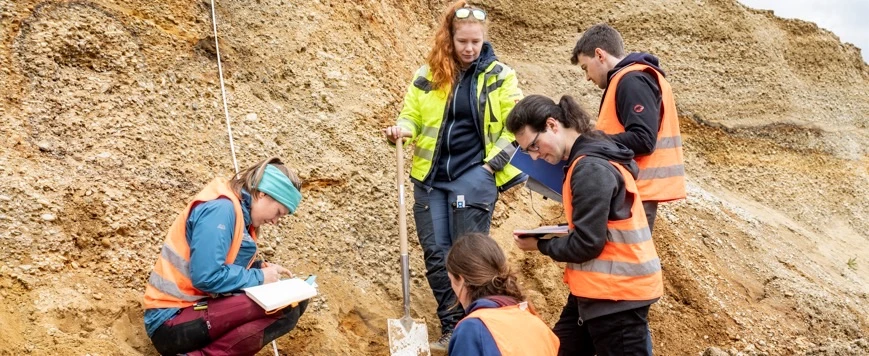
During the four semesters, students will gain detailed knowledge of physical and chemical properties of materials. In specialized elective modules, students will receive training in both, in state-of-the-art analytical and experimental lab methods as well as in field-based methods. The program allows students to explore challenging scientific projects and to learn innovative approaches for solving problems in Earth and materials sciences. Various practical laboratory and field courses will provide students with an overall quantitative understanding in state-of-the-art analytical, numerical and experimental techniques that ideally prepare for a successful future career.
Altogether, the Master´s program Geomaterials and Geochemistry provides students with professional skills required to compete on the international job markets in cutting-edge PhD research programs, general academia, and industry successfully.
A broad scientific education and a wide range of instrumental analytical methods enable graduates to deal with a wide variety of scientific and technical issues. Graduates are qualified to work in the public sector – for example at universities, state research institutes and public offices ( in the fields of environment, preservation of historical monuments, or geology), or materials research and testing institutes – as well as in industry, for example in the glass, glass ceramics and ceramics industry, crystal growing industry, refractory industry, building materials and binders industry, stone and earth industry, chemical industry, electrical and electronics industry, optical industry, waste and recycling industry, paper industry, fertilizer industry, pharmaceutical industry, jewelry industry, or analytical services.
Study structure & Course contents
The structure of the M.Sc. program Geomaterials and Geochemistry enables specialization in a cross-disciplinary range of designed modules encompassing applied mineralogy, crystallography, geochemistry, materials sciences, petrology, and volcanology. While the program comprises a series of mandatory modules, it also provides various ways for individual specialization via a large variety of elective modules.
During the four semesters, students will gain detailed knowledge of physical and chemical properties of materials. In specialized elective modules, students will receive training in both, in state-of-the-art analytical and experimental lab methods as well as in field-based methods. The program allows students to explore challenging scientific projects and to learn innovative approaches for solving problems in Earth and materials sciences. Various practical laboratory and field courses will provide students with an overall quantitative understanding in state-of-the-art analytical, numerical and experimental techniques that ideally prepare for a successful future career.