

Mechanical Engineering B. Sc.
Do you want to make a significant contribution to creating a sustainable, inclusive, and future oriented society through multidimensional approaches? The core undergraduate engineering program prepares students for careers in the fields of health, nutrition, energy and raw materials, environment and climate, information and communication, and mobility and infrastructure.
Through innovative solutions, you will take into account both ecological sustainability and social requirements: technologies for sustainable energy production such as more efficient wind turbines, solar technologies, advanced drive systems for electric vehicles, but also assistance systems and robots for production, in the service sector, and in nursing and medical technology.
| Type of Study | Full Time | Location | Garching |
| Standard Duration of Studies | 6 Semester | Application Period | 15.05. – 15.07. |
| Credits | 180 ECTS | Required Language Proficiency | German |
| Start of Degree Program | Winter semester | Tuition Fees | Semester fee, Fees for Students from Non-EU Countries |
In the basic part of the course, students are introduced to mathematics, mechanics and technical electricity. Students should be able to independently describe processes both qualitatively and mathematically and quantitatively and apply laws and formulas to defined problems.
This is supplemented by basic subjects specific to mechanical engineering: technical mechanics teaches students the ability to independently formulate and solve mechanical problems at an abstract mathematical level. As part of the fundamentals of machine drawing and machine elements, this knowledge is transferred to complex technical drawings so that students can develop solutions for the production-, load- and assembly-oriented design of components, select suitable machine elements and represent them using CAD systems. In addition to elementary basics of information technology such as computer architecture, the analysis of real-time systems for given control systems and the C programming language are also part of the course.
The ability to model engineering problems taking uncertainties into account is trained on the basis of probability theory. The foundation course is completed with the modules materials science, control engineering, fluid mechanics, thermodynamics and heat transfer. With this sound knowledge of scientific principles, theories and methods, students are able to successfully work on specific problems in mechanical engineering with a clear solution path. For example, students are able to make a pre-selection of suitable materials based on specific material requirements, describe a machine as a thermodynamic system and design dynamic, actively influenced systems.
More Information: Degree program documentation
After completing the foundation course, you will be able to
- understand essential basic concepts of mathematics, physics, chemistry and electrical engineering, describe processes both qualitatively and mathematically-quantitatively and apply laws/formulas to defined problems
- use your knowledge of mechanical engineering-specific basic subjects such as technical mechanics, machine drawing, machine elements and information technology to independently formulate and solve questions in engineering problems (e.g. determination of real-time systems for given control systems, design of components suitable for production, load and assembly, modeling of uncertainties)
- apply the methods and concepts of materials science, thermodynamics, heat transport phenomena, fluid mechanics and control engineering (e.g. development of material properties, analysis of heat transport and technical flows, design of dynamic actively influenced systems)
After completing the individually selected subjects in the 5th and 6th semesters, depending on your specialization, you will be able to apply the methods you have learned there and, if necessary, independently developed solutions in practice (e.g. application of mechanisms of industrial real-time bus and operating systems, characterization of novel electrified concepts in motor vehicles, development and evaluation of thermal solar collectors and photovoltaic systems).
Study Structure
The standard period of study for the bachelor's degree in mechanical engineering is six semesters. This is divided into basic studies (1st to 4th semesters) and specialized studies in the 5th and 6th semesters. In the basic studies, there is a fixed timetable for each semester with lectures and exercises, which can be extended by tutorials – small learning groups with individual support. The contents of the individual basic modules are linked within the framework of connecTUM and the application of mechanical engineering is explained from the beginning of the course on the basis of a real technical application – an urban cable car system.
In the 5th and 6th semesters, students choose their courses from an extensive catalog according to their interests and inclinations. The path to the desired specialization or to a broad engineering education is now open. From a catalog of subjects, they choose industry-specific courses according to their interests or put together a fundamentals-oriented, cross-industry schedule of classes:
- Energy and process engineering
- Development and design
- Vehicle and drive technology
- Aerospace engineering
- General mechanical engineering
- Theoretical mechanical engineering
- Management in mechanical engineering
- Mechatronics and robotics
- Medical technology and assistance systems
- Nuclear engineering
- Production and Logistics
Course Content
The 1st semester builds on school knowledge that will be expanded throughout the academic year:
- Mathematics (e.g., systems of linear equations, vectors and matrices, differential and integral calculus, matrix factorizations, multidimensional calculus).
- Chemistry (e.g., atomic structure, bonding, chemical reactions, metals, nonmetals, organic chemistry)
- Physics (e.g. mechanics, electricity, optics)
Parallel to this, students delve into the fundamentals of
- Electricity theory (basics of drive technology as well as electronics)
- Engineering mechanics (bodies at rest in statics and elastostatics, time-independent deformations and stresses)
- Information technology (linking the fundamentals of electrical engineering with those of computer science to solve problems in mechanical and plant engineering)
- CAD and mechanical drawing (creation, understanding and analysis of technical drawings)
- Modeling uncertainties and data in mechanical engineering (probability theory, performing statistical tests, describing engineering problems in the presence of uncertainties)
- Soft skills in the student environment (workshops on how to start studying and how to organize the daily study routine in a goal-oriented way.
In the 3rd and 4th semesters, the following knowledge is taught on the basis of these fundamentals:
- Mathematics (Fourier series as well as Fourier and Laplace transforms, differential equations and integral transforms)
- Technical mechanics (kinematic systems)
- Control engineering (application of mathematical knowledge to the description of stability or damping as well as amplitude and phase frequency responses)
- Materials science (e.g. classification of materials, properties of materials)
- Machine elements (e.g. strength and design calculations, design of a gearbox)
- Fluid mechanics (e.g. behavior of liquid and gaseous media, conservation laws for mass, momentum and energy)
- Thermodynamics (e.g. main laws of thermodynamics, descriptions of states, circular processes)
- Heat transport phenomena (e.g. heat transport mechanisms, calculation of heat flows).
While the four-semester basic studies consist of compulsory modules, only elective modules are offered in the 5th and 6th semesters with the exception of the modules "Mathematical Tools" (translation of engineering problems into mathematical problems and their solution by application-oriented modeling) and "Bachelor's Thesis with scientific papers".
More Information: Curriculum

Apply easily via the user-friendly TUMonline application portal and upload your documents for admission there.
Support: step-by-step instructions for applying to a bachelor's program and application info portal
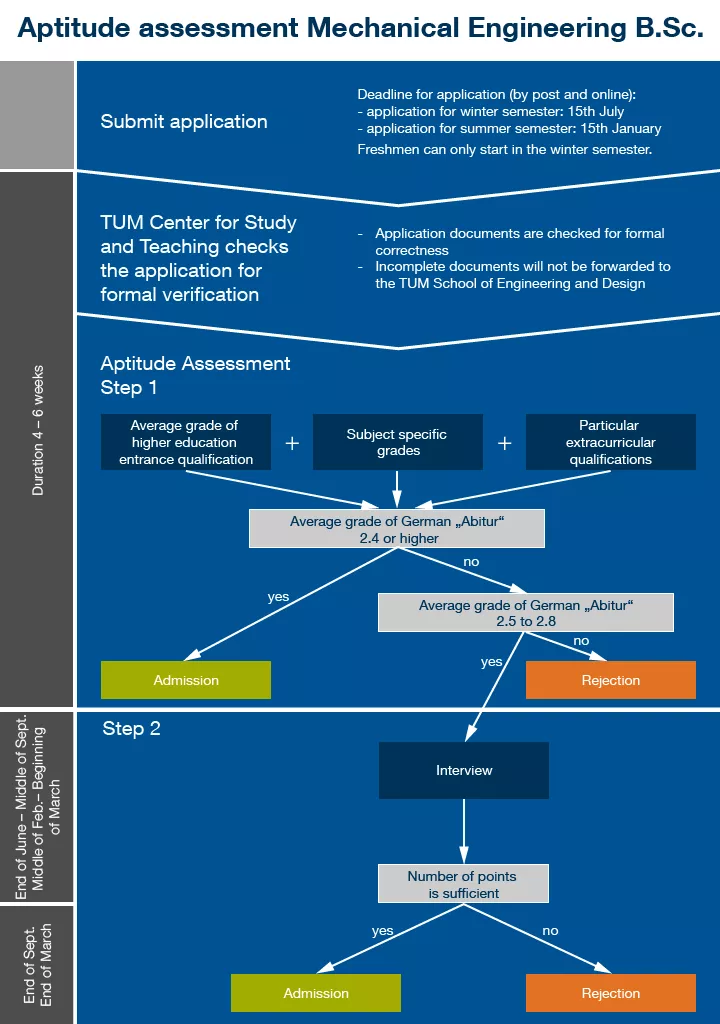
All applicants who can demonstrate their suitability will be admitted to the degree program. The criteria for suitability are:
- the overall grade of the higher education entrance qualification (e.g. Abitur),
- subject-specific individual grades (Mathematics, German, and at least one natural science or computer science subject pursued until obtaining the Abitur),
- extracurricular qualifications (e.g. vocational training, internships, participation in competitions).
→ Applicants with very strong qualifications will be admitted directly.
→ All applicants who have passed the Abitur with an overall grade of approximately 2.5 to 2.8 (guideline values) will be invited to a selection interview. In the course of this interview, candidates have the opportunity to convince the interviewers of their suitability for the Mechanical Engineering degree program.
→ Applicants with an overall grade above approximately 2.8 (guideline value) will be rejected directly.
Please note: If one or more subject-specific individual grades are not listed on the transcript, you will be invited to an interview despite having a very good Abitur grade.
Motivation Letter
A key component of the application for the suitability assessment is your written justification for choosing the degree program and for choosing the Technical University of Munich as your university. This motivation letter must not exceed two DIN A4 pages and must be written in German. As you confirm with your signature on the application form, it must be written independently and without assistance from others. Among other things, you should explain which skills, specific talents, interests, and career aspirations make you particularly suitable for the chosen degree program at TUM. Additional information about your personal background or special qualifications, such as extracurricular engagement, may also be included (please attach supporting documents).
Selection Interview
In the second stage of the suitability assessment, you will be invited to a 20-minute interview with a professor from the TUM School of Engineering and Design. Information on the interview procedure will be provided with the invitation. The interview is intended to determine whether you are able to independently and responsibly achieve the objectives of the degree program, with its research-oriented focus, on a scientific basis.
The interview covers:
- mathematical knowledge that can be applied to solving engineering-related problems,
- knowledge in the fields of engineering and natural sciences and the ability to apply common concepts and terminology to engineering problem areas,
- the ability to combine knowledge from methodologically very different academic cultures into an interdisciplinary problem-solving strategy,
- degree-relevant extracurricular qualifications,
- language proficiency.
TUM will notify you of the mandatory interview date by email. There is no entitlement to rescheduling the assigned appointment.
The interview will take place on the following days:
- 28.07.2026
- 29.07.2026
- 30.07.2026
- 04.08.2026
- 05.08.2026
- 06.08.2026
- 01.09.2026
- 02.09.2026
- 03.09.2026
Legal Notice: The basis is the program-specific Academic and Examination Regulations (FPSO) and the Statutes on Aptitude Assessment.

All applicants who prove their eligibility will be admitted to the program. Criteria for suitability are:
- the average grade of the university entrance qualification, e.g. Abitur (high school diploma)
- subject-specific individual grades (mathematics, German and at least one science or computer science continued until the Abitur)
- extracurricular qualifications (e.g. apprenticeship, internships, participation in competitions)
- Higher Education Entrance Qualification
- Proof of German Language Proficiency
- Statement of purpose (Letter of Motivation)
- Complete and Current Résumé
- Passport
- if applicable: Proof of Internships or Professional Experience (optional)
- Preliminary Documentation (VPD) by uni-assist - for international applicants only
An essential part of the application for aptitude testing is your written statement of reasons for choosing the course of study and for choosing the TUM as your university. This letter of motivation should not exceed two DINA4 pages and must be written in German. It must – as you confirm with your signature on the application form – be written independently and without the help of others. Among other things, you should explain in it which skills, specific talents, interests and career ideas make you particularly suitable for the intended course of study at TUM. Additional information about your personal background or special qualifications such as extracurricular activities can also contribute to this (please enclose supporting documents).
We may require additional documents depending on your educational background and your country of origin. Complete the online application to receive a comprehensive list of the required documents.
Please consider the specific requirements for documents for application and enrollment at TUM.
Selection takes place through an aptitude assessment procedure. Aptitude assessment is a two-part procedure evaluating your ability to successfully manage the particular qualitative requirements of the bachelor’s program.
In the first stage, your overall secondary school grades, your grades in subject-specific courses, and any relevant practical experience or additional qualifications will be evaluated using a point system. Depending on the amount of points accumulated, applicants are either immediately admitted, rejected or invited to an admissions interview.
- Very good applicants are admitted directly.
- All those who have passed the Abitur with an overall grade of approximately 2.5 to approximately 2.8 (guiding values) are invited to a selection interview. During this interview, candidates have the opportunity to convince their interview partners of their suitability for studying mechanical engineering.
- Applicants with an overall grade above approx. 2.8 (guiding value) will be rejected directly.
Students who earned their higher education entrance qualification in a non-German language school in another country and whose native language is not German must take part in an admissions interview to assess their subject-specific language skills.
If one or more subject-specific individual grades are not shown on your transcript, you will be invited for an interview despite having a very good Abitur.
In the second stage of the aptitude test, you will be invited to a 20-minute selection interview with a professor from the TUM School of Engineering and Design. You will receive information about the procedure via the invitation. It is intended to show whether you can independently and responsibly achieve the goal of the degree program with its research-oriented orientation on a scientific basis.
The interview covers
- mathematical knowledge that can be applied to solve engineering problem areas
- knowledge from the fields of engineering and natural sciences and the ability to apply common concepts and terms to engineering problem areas
- the ability to combine knowledge from methodologically fundamentally different subject cultures for an interdisciplinary problem-solving strategy
- extracurricular qualifications relevant to the course of study
- language competence
TUM will notify the mandatory date of the interview by e-mail. There is no right to postpone the fixed date.
- Application for Enrollment (signed)
- Higher Education Entrance Qualification (authentic document)
- Most Current Photo (as for ID)
- Digital notification of your health insurance status from a German public health insurance provider (requested by applicant)
We may require additional documents depending on the type of educational background you earned and your country of origin. After accepting an offer of admission in TUMonline, you will receive a list of documents you must submit to TUM in hardcopy for enrollment.
Please consider the specific requirements for documents for application and enrollment at TUM.
Current information
During the open office hours listed here, you can come by or call without an appointment. Please expect waiting times. If you have a complex matter or your required contact person is not listed here, please send an email to arrange an individual appointment (contact Student counseling).
Student Counseling
Martina Sommer
Tue 2-3 pm in MW0012a and Wed 2-3 pm by phone
Change in Office Hours
In-person office hours have been rescheduled from November 3, 2026, to November 4, 2026.
Telephone office hours have been rescheduled from November 4, 2026, to November 5, 2026.
Application
Monique Elvers
Tue 10-12 am in MW0012
Internship
Monique Elvers
Tue 10-12 am in MW0012 and Thur 10-11 am by phone
Examination Management
Elisabeth Uhlig
Tue 9.30-10.30 am in MW0011 and Tue 2-4 pm and Thu 9.30-11 am by phone
No telephone consultation hours on Thursday, 29 October 2026.
No in-person consultation hours on Tuesday, 17 November 2026. The telephone consultation hours on Tuesday, 17 November 2026 from 2:00 p.m. to 4:00 p.m. will take place as scheduled.
Secretary Examination Board
Heike Kudlich
Mo 2.30-3.30 pm in MW0011 and Wed 2.30-3.30 pm by phone
No consultation hours on Monday, 26 October 2026.
Preliminary math course
For your degree program, the lecturer of the Higher Mathematics 1 lecture offers a preliminary math course together with the student council at the beginning of your studies (end of September/beginning of October, usually two weeks before the start of lectures). Here you have the opportunity to make initial contacts with fellow students, review the math material from school and get to know the first aspects of higher mathematics. You will be informed about the date and registration by e-mail during the admission procedure.
Introductory event for Bachelor students - SET (SemesterEinführungsTage)
The introductory event SET usually takes place on the first two lecture days in the winter semester in lecture hall MW0001. Students from higher semesters and Study Office staff will explain the most important points you need to know for your studies (timetable, examination and study regulations, contact persons, etc.).
You will find the lecture hall after the main entrance on the left on the first floor of the faculty building, Boltzmannstraße 15, 85748 Garching, see map. Information from previous years can be found on the student council website.
POWER - Personal Orientation Week for first semester students of the student council:
During the preliminary course, the student council's Personal Orientation Week for first-semester students POWER takes place for you. This program is intended to give you the opportunity to get to know nice people, Munich and the university before the official start of lectures and to have a lot of fun at the same time. The student council hopes that a large part of the events can/will take place in Munich as usual. If not, there will definitely be an online alternative program. Registration is not required, the current planning status can be found on the student council website.
Additional helpful information can be found on the website for the start of your studies.
Tip for planning your studies: connecTUM – The cable car that connects your studies
In your studies, central contents of the basic studies can be experienced using a real technical application – an urban cable car system. They deepen their knowledge through practical demonstrators, excursions to industrial partners and contextual guest lectures in the lectures. Using the example of the urban ropeway system, you will be guided through all phases of the product development process – i.e. from the basics of production, design and material selection to the application of basic knowledge in product development methods. At connecTUM, several professorships and chairs are involved in order to enable networked and application-oriented education. Further information can be found on the connecTUM website.
Here you can find the general dates and deadlines at TUM.
Binding examination dates for your degree program can be found in TUMonline.
The exam registration for your degree program usually takes place during the following periods:
May 15 – June 30 for exams following the summer semester
November 15 – January 15 for exams following the winter semester
Here you will find all relevant documents relating to your degree program:
- General Academic and Examination Regulations
- Program-Specific Academic and Examination Regulations
- Aptitude Assessment
- Internship Guidelines:
- Degree Program Documentation: Select degree program → Information on Degree Program → Program Profile
- Information Session for First‑Semester Students - Starting in the Winter Semester 2025/2026
- Module Catalog
- Timetable for the 1st subject semester
- Timetable for the 2nd subject semester
- Timbetable for the 3rd subject semester
- Timetable for the 4th subject semester
- Timetable for the 5th and 6th subject semester: For these subject semesters there is no fixed timetable. You choose your modules according to your own preferences from the current offer in TUMonline.
- Presentation for the specialized studies (For enrollment, including the summer semester 2024)
- Presentation for the specialized studies (For enrollment, starting winter semester 2024/25)
- Recommendations for the choice of Bachelor Modules
- Guidelines for Safeguarding Good Scientific Practice and for Dealing with Scientific Misconduct (only available in German)
Here you will find all relevant forms for your degree program:
Recognitions
(Recognition of Achievements from Previous Studies / Semester Abroad)
Application for Recognition of Study and Examination Achievements
Letter of justification for the inclusion of a module in the Engineering Flexibilisation pillar
Transfer of Study and Examination Achievements by Parallel Studies within TUM
Modules
Application by Students for the Integration of a Module
Internships
Examinations
Application for withdrawal from the examination
Written work
Minimum requirements for academic theses (formatting, cover page and declaration of independence)
Certificate documents
Activity list and routing slip (for recording special activities during the studies for documentation in the Diploma Supplement)
Exam Registration
All relevant times around exam registration can be found under Dates and Deadlines.
Exam Deregistration
Deregistration from an exam can usually be carried out independently in TUMonline up to 7 days before the respective exam date.
Withdrawal from exams
- Only reasons beyond the student's control will be accepted. The reasons for missing an exam must be substantiated by appropriate documentation. In the event of illness, a medical certificate must be submitted.
- The withdrawal request must be submitted immediately via email at bpa.me@ed.tum.de (Bachelor's Examination Board MW) or mpa.me@ed.tum.de (Master's Examination Board MW).
- The form for withdrawal from an examination can be found in the forms section.
- Important: A withdrawal from an exam for approved reasons is equivalent to a deregistration from the exam. According to the Bavarian Higher Education Innovation Act, only failed exams may be retaken during a leave-of-absence semester. If you have been granted an approved exam withdrawal for a particular exam, this exam is not considered a repeat exam in the following semester and therefore cannot be taken as a repeat exam during a leave of absence semester.
Medical Certificate
What information must the medical certificate contain?
Please note that certificates of incapacity for work or confirmations stating merely "fit to sit the examination: yes/no" are not sufficient.
- The certificate must state the date of issue and, where this differs, the date on which the patient first presented for examination.
- The certificate must clearly name the symptoms or consequences of the illness (the functional impairments) that, from a medical point of view, prevent you from sitting the examination.
- Please note that the certificate need not contain a medical diagnosis. Should a diagnosis substantiate the incapacity to sit the examination more convincingly than a description of the symptoms alone, you are of course free to have the diagnosis included in the certificate.
- The certificate must state the onset and the expected end of the symptoms or consequences of the illness (the functional impairments) that prevent you from sitting the examination. The Examination Board can recognise the grounds for the incapacity only for the period for which they have been credibly demonstrated and evidenced.
- Whether an incapacity to sit the examination in fact exists is determined by the competent Examination Board on the basis of the medical certificate.
- Should you receive inpatient treatment in a hospital on the day of the examination, you must submit a certificate issued by the hospital.
Interruption of an Exam / Retroactive Withdrawal
- If an exam must be interrupted due to sudden illness during the exam, this must be reported to the supervisory staff, and a withdrawal request, along with a medical certificate issued on the day of the exam, must be submitted immediately to the Bachelor’s/Master’s Examination Board of Mechanical Engineering.
- If the exam is completed regularly, a withdrawal cannot be approved afterward.
- If a student takes an exam despite being aware of health issues or other performance-impairing circumstances, they cannot claim these impairments retroactively. See also the Academic Progress Check regulations.
When does it make sense to withdraw from an exam?
At TUM, there is usually no limit on the number of exam attempts or the repetition of individual exams - as long as you are within the permissible study progress (credit limits) according to § 10 of the General Academic and Examination Regulations. However, when is it necessary or sensible to withdraw from an examination?
- Basic examinations HM1 and TM1 in the Bachelor's degree program in Mechanical Engineering: Participation in the two basic examinations, Higher Mathematics 1 and Technical Mechanics 1,hanics 1 is mandatory. They only have one retry at a time. The exams must be passed by the end of the second semester at the latest! An exam that has been registered but not taken will be considered a failed attempt. Accordingly, if you are unable to attend an examination date at short notice (e.g., due to illness or other valid reasons), you must immediately withdraw from the examination (with the submission of appropriate proof). This is how you prevent a failed attempt due to "no-show".
- Problems with the study progress check in the Bachelor's or Master's degree: If you only just reach the credit hurdle of the study progress review, you should immediately apply for a withdrawal from the exam in question in the event of illness or other valid reasons in order to meet the immediacy of the valid reasons according to §10 General Academic and Examination Regulations. Valid reasons can only be given if the report is made immediately.
Please note that even in the case of recognized exam withdrawals, this does not automatically trigger an extension of the deadline. You must apply for this separately. The examination board decides on the granting of an extension of the deadline and § 10 General Academic and Examination Regulations applies.
Examination Notices
You will be informed by the Graduation Office and Academic Records Garching by e-mail that you can retrieve the official examination notice via TUMonline. Three days after dispatch, the notice is deemed to have been delivered! The objection period of one month runs from the date of service. An objection must always be filed in writing with the TUM Center for Study and Teaching - Studium und Lehre - Recht. If you have any questions about the decision, please contact the examination board responsible for you first.
Exam results
You can find out your exam results in the following ways:
- Account statement from TUMonline: All results are listed here (for your own check).
- Transcript of Records from TUMonline: Only the passed exams are listed here.
Audit review
If students are unable to attend the examination for reasons beyond their control, they can apply for an alternative date. To do this, an informal application must be submitted immediately to the responsible examination board. The application must be accompanied by copies of the reason for the impediment (e.g. stay abroad, internship, illness, etc.). After receipt of the documents by the Examination Board, they will be reviewed and, if the subsequent inspection is approved, forwarded to the responsible examiner. For the purpose of scheduling an appointment with the responsible examiner, please give the Examination Board your consent to forward your personal data (e-mail address). Please note: Private reasons (e.g. holiday trips) cannot be taken into account. Inspection by an authorized representative is not possible (except in the case of pending opposition proceedings or legal disputes). review.
Repeat examinations
Repeat examinations are failed examinations for which you were registered and did not pass (grade 5.0) or were registered and did not appear (X n.e.). Withdrawing from an examination for recognized reasons is equivalent to deregistering from an examination. You will not be automatically registered for repeat examinations. All students must register for all exams independently in TUMonline via the study tree.
As a rule, examinations can be repeated as often as desired until passing, provided that the required academic progress to APSO § 10 is maintained.
Exceptions are:
- For Bachelor's students: According to § 38 para. 2 FPSO, the basic examinations HM 1 and TM 1 must be passed by the end of the 2nd semester and may only be repeated once within this period. The final thesis may only be repeated once within the required study progress.
- Bachelor’s thesis and Master’s thesis: The final thesis may only be repeated once within the required academic progress.
Compensation for disadvantages
APSO § 19 defines:
"If a student credibly demonstrates that he or she is unable to take the examination in whole or in part in the intended form due to a long-term or permanent physical disability or chronic illness, this can be compensated for by a corresponding extension of the working hours or a different design of the examination procedure."
The application for compensation for disadvantages must be submitted immediately at the beginning of the lecture period, but no later than 15 November in the winter semester and 15 May in the summer semester. The application for disadvantage compensation must be submitted to the responsible examination board. The application for compensation for disadvantages must be accompanied by a medical certificate. After receipt of your application for compensation for disadvantages, the examination board will examine with appropriate proof whether and, if so, in what form the compensation for disadvantages can be granted. You will receive a notification from the examination board.
Further information about disadvantage compensation (including the application form) can be found on the central TUM page on the topic.
Compensation for disadvantages will not be granted in the case of acute, temporary illnesses or injuries. If necessary, please apply for a withdrawal from the examination due to severe restrictions.
If you have any further questions, please also check our Frequently Asked Questions (FAQ).
Recogniton
Recognition of academic achievements is only possible if there are no “substantial differences in the acquired competencies (learning outcomes)” (see BayHIG Art. 86; Lisbon Recognition Convention, Art. VI.1). If you have completed courses and examinations at a recognized university in Germany or abroad, for example during previous studies or a study abroad period, and these are relevant to your current degree program, you may submit an application to check whether recognition is possible.
Please submit an application for recognition only if the examinations you have successfully completed demonstrate substantial correspondence with the respective module description of the module/the modules in your curriculum. The final decision on recognition rests with the competent Examination Board. As a rule, the module coordinators assess whether equivalence can be established.
Recognition of Study and Examination Achievements
For Starting the Study Programme till including Summer Semester 2024 (Study and Examination Regulations-Version 20171 and Study and Examination Regulations-Version 20201),
the following applies:
There are two ways to apply for recognition of courses or credits.
The recognition of examination achievements is only possible if the maximum credits to be earned in the individual elective sections (within the area of elective modules), as defined in Annex 1 of the FPSO, have not yet been fulfilled.
1. Previous studies:
You can submit an application for 1:1 recognition of examination and study achievements. You can find further information in our recognition guide.
2. Semester abroad:
You can submit an application for 1:1 recognition of examination and study achievement (s.a.) or/and apply for a maximum of two supplementary subjects for general recognition. In the case of recognition of supplementary subjects, there has to be an engineering-related connection to the degree program and the work completed abroad has to correspond to at least 3 ECTS credits each. For supplementary subjects from the semester abroad, 3 ECTS are credited (even if you have completed more than 3 ECTS abroad).
Important notes:
- Only recognitions for achievements, that are part of your curriculum, can be recognized (exception: recognition as a general supplement).
- A recognition as an additional subject is not possible.
When Starting the Study Programme from Winter Semester 2024/2025 (Study and Examination Regulations-Version 20241),
the following applies:
There are different ways to apply for recognition of courses or credits.
The recognition of examination achievements is only possible if the maximum credits to be earned in the individual elective sections (within the area of elective modules), as defined in Annex 1 of the FPSO, have not yet been fulfilled.
1. Previous studies:
You can submit an application for 1:1 recognition of study and examination achievements. You can find further information in our recognition guide.
Please also note the point number 3 “Area of general education / interdisciplinary skills”.
2. Semester abroad:
You can submit an application for 1:1 recognition of study and examination achievements.
Please also note the point number 3 “Area of general education / interdisciplinary skills”.
3. Area of General Education / Interdisciplinary Skills:
Individual recognition is possible for modules from the Pre-study program as well as for modules from the semester abroad.
Exception: If you have previously studied the same or a related degree program at another university and are continuing your studies in the Bachelor's degree program in Mechanical Engineering at the Technical University of Munich, this study is not valid as Pre-study program.
Individual recognitions and language courses (not German as a foreign language, not English with level A1+A2) can be recognized from 2 ECTS after appropriate verification. A maximum of 3 ECTS can be recognized for a module from the Pre-study program or the semester abroad.
Important notes:
- Only recognitions for achievements, that are part of your curriculum, can be recognized (Exception: Recognition as a general supplement in the area of individual recognitions in the elective section General Education / Interdisciplinary Skills).
- A recognition as an additional subject is not possible.
Submission Deadlines:
Previous Studies:
Pursuant to APSO § 16 paragraph 4, sentence 3, an application for recognition of examination achievements from previous studies may be submitted only once within the first year of study to the responsible Examination Board.
Semester Abroad:
Pursuant to APSO § 16 paragraph 4, sentence 4, the application for recognition of credits earned during a semester of leave of absence may only be submitted in the semester, which is following the semester of leave of absence for one time.
If you are on leave of absence during your semester abroad, your application for recognition will only be processed after the end of the leave of absence period.
Application Submission
Please send the completed and signed application “Application for Recognition of Study and Examination Achievements” with all relevant documents to the Bachelor Examination Board Mechanical Engineering: bpa.me@ed.tum.de.
Please be sure to note the information and applicable deadlines on the application.
After submitting the application for recognition of study and examination achievements to the Bachelor Examination Board Mechanical Engineering, the module coordinators will check whether the skills and abilities already acquired are equivalent to those required for the module applied for.
After the procedure has been completed, you will receive a notification from the Bachelor Examination Board regarding the outcome of the requested recognition(s) and, where applicable, the resulting semester classification.
Note:
No application for recognition of achievements may be submitted prior to enrolment in the Bachelor’s degree programme. Likewise, no preliminary assessment will be carried out.
Recognition of Internship
Please consult the information provided under Internship.
Classification into a Higher Semester Level
Classification into a Higher Semester Level are calculated in accordance with ImmatSatzung § 4, paragraph 5, sentence 1 of the current version of the university statutes.
For each 30 ECTS earned, one semester is granted. For every 22 ECTS credits above, an additional full semester will be credited.
If repeat examinations were taken during a leave of absence and/or if the industrial internship was recognized after a leave of absence, this ECTS are not included for the Classification into a Higher Semester Level.
Information
- The turnaround time for a recognition application is usually about 12 weeks.
- Approved credits are marked with an *) in the grade report. You can find your approved credits in the corresponding position in your study tree.
Transfer of Study and Examination Achievements by Parallel Studies within TUM
As soon as you are enrolled in two different degree programmes at TUM, achievements that you wish to “transfer” are treated as a credit transfer (Leistungsnachtrag), not as recognition.
- A credit transfer is only possible for achievements completed during the period of parallel enrollment.
- A credit transfer will only be carried out if the respective module is identical in both degree programs, meaning it has the same module number.
- If you commence the second degree program after beginning the first and wish to use achievements from the first program in the second, this constitutes recognition of achievements from previous studies.
- Credit transfers do not result in an upgrade to a higher subject semester.
For submission, please use the form “Application for Transfer of Study and Examination Achivements by Parallel Studies within TUM (Antrag auf Leistungsnachtrag)".
Kindly send the fully completed and signed form to the Bachelor Examination Board for Mechanical Engineering at: bpa.me@ed.tum.de.
If you have any further questions, please check our Frequently Asked Questions (FAQs).
Academic Progress Check
The academic progress check serves to verify whether the degree program is being completed within the prescribed time frame. For exam deadlines and credit requirements, please scroll to the bottom.
Extending or Suspending Deadlines for Requirements
Extending or suspending deadlines for requirements can only be granted for valid reasons in accordance with § 10 of the General Academic and Examination Regulations. Valid reasons are those beyond your own responsibility.
1. Extending or Suspending Deadlines for Requirements Due to Illness
- Extending or suspending deadlines for requirements can only be granted in cases of long-lasting, ongoing illness that prevents proper academic progress and that does not constitute a permanent chronic condition.
- The illness must be reported immediately to the responsible examination board and supported by meaningful medical certificates.
- A retrospective claim of illness after the examinations is not possible if no immediate notification has taken place.
- Anyone who takes exams despite being aware of their illness (including psychological problems) knowingly takes a risk and cannot subsequently claim illness as a reason for failing to meet the credit requirement.
2. Extending or Suspending Deadlines for Requirements Due to Other Reasons
- Extending or suspending deadlines for requirements may be granted in exceptional circumstances that were objectively not self-inflicted.
- Maternity protection or parental leave may also justify extending or suspending deadlines for requirements.
- Even in the case of extending or suspending deadlines for requirements for other reasons, immediate notification to the responsible examination board is required.
3. Reasons That are not Considered Valid
- Working to finance your studies, voluntary activities (including student clubs), caring for sick relatives, searching for accommodation, etc. (according to German examination law) are not considered valid reasons.
Definition of Immediate Notification
In legal terms, "immediately" means "without culpable delay," i.e. as soon as the obstacle occurs or is foreseeable.
Decision on Extending or Suspending Deadlines for Requirements
- Extending or suspending deadlines for requirements are always decided by the examination board in accordance with § 10 General Academic and Examination Regulations.
- The decision is made in the examination board meeting after the end of the semester.
Please Note
According to the regulations of the General Academic and Examination Regulations, the existence of valid reasons does not automatically entitle you to an extension of deadlines. The examination board also considers your entire academic progress in its decision.
Application Process
- An application for extending or suspending deadlines for requirements must be submitted as a single compiled PDF via e-mail to the responsible examination board.
- Relevant supporting documents must be attached to the application, such as a qualified medical certificate or other evidence that credibly demonstrates the valid reason.
- Strongly recommended: Attend the personal office hours of the secretary to the examination board for clarification of your individual situation before submitting the application.
Medical Certificate
- A medical certificate for applying for extending or suspending deadlines for requirements due to long-term illness must describe how the specific impairment affected your studies, i.e. to what extent the illness prevented your participation in or progress in your studies.
- It must state when the initial examination/treatment by the relevant doctor took place and exactly when you were ill.
- If the illness is still ongoing, a health prognosis by the attending physician is also important.
When and How Academic Progress Check Takes Place
- Examination results achieved by the end of the first week of lectures, including the credits awarded for them, are assigned to the previous semester in accordance with § 14 General Academic and Examination Regulations. The relevant date is the date of the examination, not the date of the assessment. Academic Progress Check only takes place after grades have been finalized.
- It is checked that all module examinations are valid at the time of grade finalization and that the corresponding credits have been recorded in TUMonline.
Please note
- Pay attention to the examination date. To which semester will your achievement be assigned?
- Recognition requests (including for the engineering internship in the Bachelor's Degree Programm) must be submitted no later than the end of the first week of lectures if the credits are still needed to meet the credit requirement.
- Term papers/theses, including the presentation, must be submitted or held by the end of the first week of lectures at the latest.
Examination Deadlines and Credit Requirements
The applicable General Academic and Examination Regulations, especially § 10 APSO and § 38 of the Program-Specific Academic and Examination Regulations, are decisive.
Bachelor's Degree Program:
- By the end of the 2nd semester, the basic examinations Higher Mathematics 1 and Technical Mechanics 1 must have been successfully passed.
- By the end of the 3rd semester, at least 30 ECTS must be achieved.
- By the end of the 4th semester, at least 60 ECTS must be achieved.
- By the end of the 5th semester, at least 90 ECTS must be achieved.
- By the end of the 6th semester, a total of 120 ECTS must be achieved.
- By the end of the 7th semester, a total of 150 ECTS must be achieved.
- By the end of the 8th semester, a total of 180 ECTS must be achieved.
Master's Degree Program:
- By the end of the 2nd semester, at least one passed Master's module must be proven. This module may not be from the engineering flexibility pillar (Flexi pillar (§ 38 of the Program-Specific Academic and Examination Regulations).
- By the end of the 3rd semester, at least 30 ECTS must be achieved.
- By the end of the 4th semester, at least 60 ECTS must be achieved.
- By the end of the 5th semester, at least 90 ECTS must be achieved.
- By the end of the 6th semester, a total of 120 ECTS must be achieved.
Your degree program includes a so-called "industrial internship". It is divided into two parts:
1. Manufacturing internship
Eight weeks are mandatory as a production internship, ideally before the start of your studies. In justified specific cases, e.g. stays abroad or Federal Voluntary Service, ..., the placement may be deferred upon request. Just submit your request to the Internship Office Mechanical Engineering, plausibly explaining the reasons preventing you from undertaking the practical before starting your studies. Please be sure to include your student number.
Ideally a major part of the internship should be completed prior to starting your studies, since the semester break is primarily needed for exam preparation.
The aim of the internship is to gain experience in manufacturing and production, in industrial companies, and in working with colleagues and staff.
You can find the required contents of the internship in the internship guidelines (which can be found unter the “Documents” tab).
- The internship does not have to be completed as a continuous 8‑week period in one company; it can also be split (in terms of time and companies).
- Please note that we only recognize full working weeks.
- The recognition of the pre-study internship for all first‑year students takes place starting at the beginning of October.
Proof is provided by submitting the documents listed below to the internship office (by e-mail to praktikumsanerkennungen.me@ed.tum.de with your student number):
- Internship certificate form or a qualified Work/internship reference letter
- Internship report according to internship guidelines
2. Engineering internship or research internship
A nine-week engineering internship can also be completed during the course of study and is rewarded with 12 credits. Alternatively, instead of the engineering internship as part of the elective area "Project Work", a research internship of 12 credits can also be completed.
The Mechanical Engineering Internship Office of the TUM School of Engineering and Design decides on the recognition of successfully completed vocational training or an equivalent performance as an engineering internship. There you will also receive advice on all questions relating to the topic of internships (see contact Student counseling).
You can find the detailed internship guidelines, including all information on deadlines, scope, and required documentation, in the internship regulations applicable to you. These can be found under the ‘Documents’ tab.
Statement for a Leave of Absence Semester
If you wish to take a leave of absence for an internship, you will need a so‑called “Statement from the School.” You can obtain it as follows:
- If it is a mandatory internship, please contact the Mechanical Engineering Internship Office at:praktikumsamt.me(at)ed.tum.de.
- If it is a voluntary internship, please also contact the Internship Office and obtain confirmation that the School approves the internship due to its subject-related relevance to your studies. To verify this relevance, please forward information about the company and your expected tasks to the Internship Office.
- If it is a voluntary internship abroad, please contact the international advising office of your degree program (see contact details: International Exchange).
You can also find further information on the leave-of-absence semester in our Frequently Asked Questions (FAQs).
Practical Research – Working as a Team
During the research internship, you will collaborate with a department on a practical research project, gaining direct insight into current scientific issues and the work conducted at the department.
The research internship can be chosen as an alternative to an Engineering internship. For successful completion, you will receive 12 ECTS credits (10 ECTS for the research project at the department, 2 ECTS for soft skills at the Center for Key Competencies).
Program Structure
The research internship combines specialized project work with the targeted development of project and team skills.
No leave of absence is possible during participation in the project seminar.
Process
The Research Project combines hands-on research experience with the targeted development of project management and teamwork skills.
At the Chair
- Work on a research project as part of a team
- Academic supervision by the chair
- Introduction to relevant methods, machines, and software
- Presentation of project results at the final project day
At the Center for Key Competencies (ZSK)
- eLearning modules on project management and teamwork
- Accompanying workshops and coaching sessions
- Reflection on the project work and individual learning process
Target Group
Bachelor's students in Mechanical Engineering from the 5th semester onwards.
Application
Applications must be submitted directly to the respective chair. The project descriptions provide all relevant information on the application process, required documents, contact persons, and deadlines.
You may apply for multiple projects. Once you have accepted an offer, your decision is binding. Please inform all other chairs to which you have applied that you are withdrawing your application.
Project Topics
The current research projects for the Summer Winter Semester 26/27 can be seen on this page.
Click on the respective project title to open the full project description and all application details as a PDF.
There is the possibility of a stay abroad at a European or non-European partner university. Double degree programmes have been agreed with selected universities. You can find more information about the various options for a stay abroad on the website of the TUM Global & Alumni Office.
At the TUM School of Engineering and Design, there is also a contact person for international affairs who will support you in planning and organization (contact see Student counseling > International Exchange).
Theoretical part
Students complete the theoretical introductory course Basics of Research Data Management (RDM) in preparation for self-study. Registration takes place via self-registration in Moodle. The theory course can be completed at any time before the first (laboratory) seminar. It concludes with an optional self-test to check your own level of knowledge. Knowledge of the content of the Moodle course is a prerequisite for participation in the (laboratory) seminars.
Practical part
A total of three individual (laboratory) seminars with programming and practical laboratory tasks must be completed. The (laboratory) seminars are offered during the semester and during the lecture-free period. Students can choose from a catalogue of (laboratory) seminars. A (laboratory) seminar includes group work in the laboratory, the results of which are documented, evaluated and discussed. Students acquire applied and laboratory skills using practical teaching methods. Teamwork and individually comprehensible contributions are central components of the service.
Examination
The module examination takes place in the form of a laboratory performance (coursework, consisting of three (laboratory) seminars). To pass the module, three (laboratory) seminars from the catalogue of (laboratory) seminars must be completed, each of which must be successfully passed (evaluation: "passed" or "failed"). The results are documented in a laboratory report (approx. 8–15 pages per (laboratory) seminar, which must address the theoretical aspects of research data management.
Workload
The module has a scope of 6 ECTS corresponding to 180 hours of workload, which is composed as follows:
30 hours of self-study for the theoretical introductory course +
5 hours of attendance time in the laboratory + 45 hours of self-study for documentation and reporting per (laboratory) seminar (thus 3x 50 hours)
Dates
The lab sessions are offered throughout the entire semester, including the break between semesters.
You can view the specific lab dates in the respective registration procedures on TUMonline.
Please note that liability insurance may be required for certain labs. For more information, see the respective course description.
Registration
Registration for the module ED140013 Scientific Experiment with Integrated Research Data Management takes place via TUMonline.
There are three registration periods per semester:
• Winter semester: September 15–30, November 15–30, and January 15–31
• Summer semester: March 15–31, May 15–31, and July 15–31
In TUMonline, navigate to “Courses” and search for “ED140013 Scientific Experiment with Integrated Research Data Management.”
Only one spot can be assigned per registration period. We therefore recommend submitting multiple course requests to increase your chances of securing a spot.
Cancellation
If you are unable to attend a reserved seat, please cancel it promptly via TUM Online. In the event of last-minute cancellations, please contact the module coordinator directly by email at versuch.fdm.aer@ed.tum.de.
Students are not permitted to transfer their seats directly to other students.
Further details can be found in the module description.
Bachelor's Thesis
Important links related to the bachelor's thesis:
- Tutorial for Koinon Portal
- Exposé for the Final Thesis
- Log-In in the Koinon Portal: https://portal.ed.tum.de
Admission
For students who started their studies up to and including Summer Semester 2024
(applicable to SPO version 20171 and SPO version 20201)
- In order to be admitted, students must have earned at least 120 credits in their degree program, including at least 105 credits from the compulsory modules of the foundational studies phase (Grundstudium). In addition, the pre-study internship (Fertigungspraktikum) must have been completed and officially recognized.
- If the pre-study internship (Fertigungspraktikum) has been completed and examination results have already been published but are not yet formally valid in the system, students may still be admitted to the Bachelor's Thesis, provided that the published results amount to at least 120 ECTS credits, including 105 credits from the compulsory modules of the foundational studies phase (admission under reserve).
- The Registration takes place via the Koinon Portal. The student must confirm in the Koinon Portal that all admission requirements have been fulfilled.
For students who started their studies from Winter Semester 2024/2025 onwards
(applicable to SPO version 20241)
- In order to be admitted, students must have earned at least 119 credits in their degree program, including at least 99 credits from the compulsory modules of the foundational studies phase (Grundstudium). In addition, the pre-study internship (Fertigungspraktikum) must have been completed and officially recognized.
- If the pre-study internship (Fertigungspraktikum) has been completed and examination results have already been published but are not yet formally valid in the system, students may still be admitted to the Bachelor's Thesis, provided that the published results amount to at least 119 ECTS credits, including 99 credits from the compulsory modules of the foundational studies phase (admission under reserve).
- The Registration takes place via the Koinon Portal. The student must confirm in the Koinon Portal that all admission requirements have been fulfilled.
Thesis Examiner / Thesis Supervisor
The authorization to act as examiner (Themensteller/in) is regulated in the Subject-Specific Academic and Examination Regulations (FPSO) of the respective degree program. For thesis, the relevant provisions can be found in § 46.
The legal provisions set out there may be updated by resolutions of the Examination Board. The currently valid authorization to act as examiner is listed below.
Examiners for the Bachelor's Thesis are:
- qualified examiners from the Departments of
of the TUM School of Engineering and Design, as well as
- Prof. Dr.-Ing. Timo Oksanen (Professorship of Agrimechatronics),
- Prof. Dr.-Ing. Matthias Gaderer (Professorship of Regenerative Energy Systems),
- Prof. Dr.-Ing. Jakob Burger (Professorship Chemical Process Engineering),
- Prof. Dr. phil. Nils Rüther (Chair of Hydraulic Engineering),
- Prof. Dr. Allister Loder (Professorship of Mobility Policy),
- Prof. Dr.-Ing. Claudius Hammann (Professorship of Fire Science and Engineering),
- Prof. Dr. Alexander König (Chair of Robotics and Systems Intelligence),
- Prof. Dr. Michael Zavrel (Chair of Bioprocess Engineering).
Cooperation with a Company – May a thesis be carried out in a company and may it contain a confidentiality clause?
There is no entitlement to supervision of a thesis that is prepared externally. The topic must always be assigned by a qualified examiner of TUM.
If you wish to work on an interesting topic within a company, you must therefore contact the relevant chair or academic unit (= examiner/supervisor) at an early stage to clarify whether the thesis may be carried out externally.
Please note the following examination regulations:
- The topic is always assigned by a qualified examiner in accordance with APSO § 18 (4), sentences 1 and 3.
- Examiners may offer students the option of completing the thesis externally, for example in cooperation with a company.
- Under no circumstances may students approach an examiner with a topic that has already been defined by an external partner and request supervision from the university.
- A thesis is an examination component and is therefore subject to the regular examination procedure. Examiners must be granted full access to the thesis and must be able to assess it without restriction.
- The written thesis may not contain any declaration prohibiting the publication of the thesis or parts thereof. (Confidentiality clauses are not permitted. Resolution of the Faculty Council, valid from Winter Semester 2017/18.)
Provisions regarding copyright and rights of use (contact person: Till von Feilitzsch):
- There is no obligation to publish the thesis. Copyright remains with the student.
Registration
Registration is carried out via the Koinon Portal. You must confirm in the Koinon Portal that the required admission requirements have been fulfilled. The supervising chair registers you for the thesis in the system. You will then receive an email requesting that you confirm the thesis registration and the entered data in the portal. Only after this confirmation will the Examination Board review the registration.You will subsequently receive either approval or rejection of the thesis topic by email. All automated emails from the portal are sent to your TUM email address.
Scope
The workload of an academic thesis is reflected in the number of credits awarded.
A Bachelor's Thesis (including seminar) comprises:
- 12 credits
- Maximum processing time = 6 months
Please note that, as part of the Bachelor's Thesis module, the online seminar Academic Research and Writing in Engineering, including the preparation of an exposé, as well as a presentation on the final thesis, must be completed as mandatory requirements. To the presentation, please note the section “Is my presentation included in the thesis grade?” - see below -.
Information on the Bachelor's Thesis process can be found under: Tutorial for Koinon Portal
Submission
The written thesis must be submitted digitally via the Koinon Portal. For further information, please refer to Tutorial for Koinon Portal.
Please check the Koinon Portal for your individual processing period. Your thesis must be submitted within the specified submission deadline.
If the deadline (submission deadline for the thesis) falls on a Saturday, Sunday, or public holiday, the deadline is extended to the next working day.
Important:
You must be enrolled at TUM at the time of submitting your thesis.
If your enrollment expires on a weekend, the thesis may not be submitted on the next working day unless your enrollment has been extended. This also applies to exchange students.
Information Regarding Enrollment in Connection with the Thesis Presentation
In principle, enrollment is mandatory. However, if the presentation takes place no later than one week after the start of lectures of the following semester, you are not required to enroll for that following semester — provided that the presentation of the thesis is the only remaining requirement in your degree program.
For further questions regarding enrollment, please contact the TUM Center for Study and Teaching – Application and Enrollment Office at studium@tum.de.
Information on Withdrawal of a Registered Thesis
The topic of a thesis may be returned only once, for valid reasons and upon application to the responsible Examination Board, within the first third of the processing period (within the first two months). See: Tutorial for Koinon Portal
Extension of the Processing Period
Extension/Suspension of the Thesis Period:
In the case of illness or other valid reasons that the student is not responsible for, the student can request an extension of the thesis (ref. § 18 para. 6 sent. 2 and 3 APSO).
Medical Certificate for a Suspension of the Thesis Period:
A detailed medical certificate must be attached to the suspension request.
The certificate must clearly describe the impairments caused by the illness and explain how these impairments affect the student’s ability to work and study in relation to the thesis. It must state the date of the initial examination or treatment by the attending physician and specify the exact period during which the illness is ongoing. If the illness persists for a longer period, the certificate must include a medical prognosis issued by the treating physician.
The request for an extension or suspension of the thesis period must be submitted immediately via the Koinon Portal; see: Tutorial for Koinon Portal.
For detailed questions regarding the extension or suspension of the thesis period, please contact your responsible examination board.
May I complete a thesis during a leave of absence?
During the leave of absence, you are generally not permitted to submit a thesis.
This means that you must either submit your thesis before the start of the leave semester or begin the thesis only after the leave semester has ended.
For submission, the provisions of § 14 (1) sentence 4 of the currently valid APSO apply. This means: if you registered your thesis in the previous semester, you may submit it until the end of the first week of lectures of the new semester (= leave semester). If you submit the thesis within this period, the presentation must also take place by the end of the first week of lectures.
Please be sure to also review the information under “Leave of Absence” on the main website and in our FAQs under the point “Leave of Absence”.
Minimum Formatting Requirements
- Language: The language used on the title page (German or English) must correspond to the language in which the thesis is written. For theses written in German, the English title must also be stated.
The minimum formatting requirements can be found here.
You can find information on working with AI (Artificial Intelligence) here.
Please observe the TUM guidelines regarding English spelling in thesis titles..
Confidentiality Clauses
See section Thesis – subsection “Cooperation with a Company – May a thesis be carried out in a company and may it contain a confidentiality clause?”above.
What happens, if the chair or professorship sets requirements that different from those of the Examination Boards?
Please ensure that you comply with the minimum formatting requirements. The cover page of your thesis may be designed in coordination with your supervising chair or professorship as usual.
Is my presentation included in the thesis grade?
The presentation on the thesis is considered as a coursework (Studienleistung) and is obligatory. However, the presentation on the thesis is not included in the assessment of the final grade for the thesis.
The ungraded presentation of your thesis is considered as a coursework (Studienleistung). Therefore, the presentation is important for the final date of your thesis if you have not already given it before submitting your thesis.
Correction Period for the Thesis
In accordance with APSO § 18 (11), the thesis is generally to be assessed by the examiner who assigned the topic within a period of two months.
What happens if I do not complete my thesis by the end of the 8th semester?
Normally, 180 ECTS credits must be completed by the end of the 8th semester.
An exception within the academic progress check is set out in § 10 (6) sentence 1 of the currently valid General Academic and Examination Regulations for Bachelor's and Master’s Programs at the Technical University of Munich (APSO). According to this provision, one additional semester is granted for the final completion of examination components, provided that at least 150 ECTS credits but not yet 180 ECTS credits have been achieved by the end of the 8th semester. However, in this case, all module examinations not yet completed are deemed to have been taken for the first time and failed. Furthermore, if the required 180 ECTS credits have not been achieved by the end of the 9th semester, all outstanding module examinations are considered definitively failed.
If the first attempt of the thesis has not been submitted by the end of the 8th semester, the thesis is deemed to have been failed for the first time. As a result, the first attempt is automatically converted into a second attempt. For this purpose, the end of the semester is defined by the APSO (§ 14 (1) sentence 4): the thesis may be submitted until the end of the first week after the start of lectures of the following semester, since all examination components completed within this period are assigned to the previous semester. It is sufficient that both the written thesis and the presentation are completed within this period. The grading may take place at a later date.
If the continued thesis is not submitted on time or not passed in the 9th semester, the Bachelor's Thesis is considered definitively failed. Consequently, the final examination is also considered definitively failed, as only two attempts are permitted for the thesis.
The additional 9th semester does not need to be applied for. It is sufficient to re-register for the semester in the usual way.
Please also note the information provided at
https://www.tum.de/en/studies/graduation/disenrollment → “Disenrollment on Account of Passed Final Examination”:
You must be enrolled in order to submit the written thesis. For the presentation, an enrollment is not required if it is the final remaining examination or academic component and takes place no later than the first week of lectures of the immediately following semester.
If you have any questions, please make sure to contact the responsible Examination Board or the academic advising service for the Mechanical Engineering programs in good time.
How do I apply for a Bachelor’s Graduation Certificate?
Please refer to the section Graduation Certificate in our Frequently Asked Questions (FAQs).
If you have further questions, please also consult our Frequently Asked Questions (FAQs).
This section refers to your theses, specifically your final thesis and - if required by your degree program - a project study (e.g., research internship, term project, or similar).
The entire process related to your thesis (registration, including approval of eligibility; extension or suspension of the preparation period, if applicable; submission of the written thesis; and grading) takes place via a digital workflow on the Koinon portal. You can find your thesis(es) under the menu items “Theses” and “Project Studies”.
Thesis Registration
As soon as you have agreed on a topic for your thesis with a chair, the chair will apply to register your thesis in the Koinon portal. You must then approve the application. Afterwards, the application will be reviewed and approved by the School Office.
Approval and Confirmation of Registration
You will receive an email notifying you of your thesis registration, containing the details of your thesis.
- If you agree to the registration, please click on the link Please confirm here in the email.
- If you do NOT agree, please contact the chair.
The confirmation link will redirect you to the Koinon portal.
- Click Accept.
- Fill in the information regarding the graduation ceremony and evaluation (only applicable for final theses)
- Fill in the information in the abstract field. You are free to enter a brief summary of your planned project here or to indicate that you do not wish to fill out the field. This is a required field. The abstract is required for the verification option with external parties. (only applicable for final theses)
- Confirm the AI usage conditions.
- Click Confirm.
- You will now see your confirmed thesis registration. The overview includes the start date of your thesis and the submission deadline, and for final theses the latest possible date by which the final thesis topic can be returned without being counted as a failed attempt (see the section “Returning the Topic” for more information).
Changing Thesis Details
Changes to the details of your thesis can be made after registration.
- These changes can only be made by the School Office after you have initially confirmed your thesis.
- Discuss any changes with the Chair, who will then inform the School Office.
- It is not necessary to change the preliminary title during the writing period. You can still adjust the title when you submit your thesis.
Thesis preparation period
Returning the thesis topic (only applicable for final theses)
According to APSO §18, para. 7, the topic of a final thesis may be returned once within the first third of the preparation period without the thesis being counted as a failed attempt.
- In the thesis overview, you will find the specific date by which you can return your thesis topic on time.
- To return the topic, click Return Thesis.
- Provide the reason for your request to return the topic.
- Confirm that you truly wish to return the topic.
- Click Return Thesis.
- You will receive an email confirming the return of the topic.
Suspension or Extension of the Preparation Period
If you are unable to meet the deadline for your thesis due to illness or other reasons beyond your control, you must submit a request for suspension or extension immediately after the reason arises (see §18, para. 6, sentences 2 and 3 of the APSO).
- In the Koinon portal, click Request Extension in the overview of your thesis.
Suspension due to illness
- Briefly explain how the illness is affecting your work on your thesis and attach a medical certificate.
- The medical certificate must include information on the duration of your illness. A suspension due to illness is always granted for exactly the duration of the illness specified in the medical certificate.
- Under requested extension period, enter the duration of your illness in whole weeks, as indicated on your medical certificate. This is the period for which the submission deadline will be suspended following approval of your request.
- The request for suspension will be forwarded directly to the School Office for review.
Extension for Other Reasons
- Briefly explain why you were unable to work on your thesis. In the case of illness, apply for a suspension; see above.
- The chair will be notified about your request via email and asked to provide feedback on it.
- The request for an extension will then be forwarded to the School Office for review.
You will be notified via email once the suspension or extension has been approved. You can also view the new submission deadline in the overview of your thesis in the Koinon portal.
Submission of the Thesis
You must submit your written thesis by uploading it to the Koinon portal.
Submission Deadline
- Your thesis must be submitted within the specified deadline.
- You will not be able to upload your thesis after the deadline has passed. There are no other options for submitting your thesis.
- Your thesis can be uploaded until 11:59 p.m. on the day of the submission deadline.
- Allow a few minutes for the upload process!
Upload
- In the overview of your thesis on the Koinon portal, click Upload Thesis.
- Now select your final document by clicking Select File. The maximum file size is 100 MB.
- Confirm the declaration of originality by checking the box.
- You may additionally share supplementary files via a Sync+Share link. (only applicable for final theses)
- In the final step, you must decide whether you want to submit the upload as a final version or save it as a draft.
- After final submission, the thesis will be forwarded to the School Office and the chair. Changes to the document or uploading a different file or additional files are not possible after the final upload.
Grading
The grading of the written paper and, if applicable, the presentation (please note the program-specific regulations in the FPSO for your program) takes place in the Koinon portal. As soon as the examiners have finalized the grading, you will receive your grade via email. The School Office will then transfer the grade to TUMonline within few days.
Support
- If you have questions regarding examination regulations or program-specific matters, please contact the examination board responsible for your program or your academic advisor.
- If you encounter technical issues with the Koinon portal, please contact support-koinon.ed@ed.tum.de
In your degree program, you are required to submit a exposé in addition to the written thesis.
The Moodle course “Academic Writing” provides all the necessary knowledge for writing the exposé. The course is set up as a self-enrollment course and includes, among other things, an editable template for preparing the exposé.
Information about the Moodle course can be found at https://www.ed.tum.de/en/ed/studies/successful-studying/scientific-work/
The exposé must be submitted at the beginning of the preparation period for your thesis. It is submitted via the Koinon portal on the overview page for your thesis.
The chair can then access the document in the portal and evaluate it.
The exposé is a mandatory component of the Thesis module. Passing the exposé is a prerequisite for passing the Thesis module.
A
Additional Subjects
May I take modules that are not part of my degree program?
Yes. In principle, you may take any module offered at TUM, provided you meet the individual admission requirements. To do so, select the option "Free Registration" when registering for the examination in TUMonline. Such modules are listed separately as additional subjects in the TUMonline transcript. Their grades and credits do not count towards the grade calculation or the total number of credits in your degree program.
Do additional subjects have to be passed?
No. Additional subjects that have not been passed are not listed on the graduation certificate.
Which achievements can be listed as additional subjects on the graduation certificate?
All examination performances completed at TUM that are not used for the degree.
Are additional subjects shown in the graduation documents?
Yes. The Transcript of Records lists all examination performances in a structured form.
D
Disenrollment
Who is the responsible contact person for questions regarding enrollment and disenrollment?
For all questions concerning enrollment and disenrollment, please contact the Admissions and Enrollment Office directly: Arcisstraße 21, 80333 Munich, studium@tum.de.
Information can also be found on the TUM website on disenrollment).
G
Graduation Certificate
You can find important Information to the graduation documents at:
https://www.tum.de/en/studies/graduation/documents
When will I receive my graduation certificate at the earliest?
Once a minimum of 180 credits (Bachelor's degree program) or a minimum of 120 credits (Master's degree program) have been earned in according to the relevant academic and examination regulations (FPSO).
How do I apply for my Bachelor/Master certificate?
After posting the last required successfully passed examination performance to pass the Bachelor's or Master's degree program, the examination management of the examination board will send you within a few working days automatically an e-mail with the following request:
Please review your grade report for correctness and completeness, especially the title of your scientific theses.
If any corrections are required, please return these back to the responsible examination board. We also need positive feedback from you if no corrections are necessary.
How long does it take to complete the graduation documents? When will I receive a preliminary degree certificate?
The issuance of the graduation documents is carried out by the Graduation Office and Academic Records in Garching and typically requires between four and six weeks.
Once you have submitted your positive confirmation to the Examination Board, the request for the preparation of your graduation documents will be forwarded to the Graduation Office and Academic Records within a few working days. You will receive a notification once this has been taken place. Shortly thereafter, you will be issued a preliminary degree certificate within a few working days. You will be informed by email as soon as the preliminary degree certificate has been generated. The document can then be downloaded from your student file.
The preliminary degree certificate, which is secured with an advanced digital seal in accordance with EU Regulation 910/2014, will be available for download in TUMonline under the “Student File” application.
Further information and contact details can be found on the TUM webpage for graduation documents.
To Disenrollment from University: Please consult all information provided on the TUM Website for Disenrollment from University.
Does the graduation certificate show how many semesters I took to complete my degree?
No. The certificate does not indicate how many semesters were required.
The certificate date corresponds to the date of the final passed examination required for your degree. If the thesis constitutes your final requirement, the submission date - or, if the presentation takes place after submission, the presentation date - is considered the certificate date.
In the case of a Bachelor's degree program, the last credit can be the recognition of the industrial internship.
Does the graduation certificate show how many times I have taken an exam?
No.
The certificate itself only lists the grade for your thesis (with the topic of your thesis) and your overall grade.
Assignment of exam results - How will my modules be assigned in my Transcript of Records (ToR)?
TUMonline automatically assigns your best‑graded examination results (in accordance with the relevant academic and examination regulations). If you would prefer other modules to be introduced instead, please contact the examination management of your examination board (contact details can be found in the box on the right side of the screen).
H
Hardship
L
Leave of Absence
How do I apply for a leave of absence semester?
Leave of absence is regulated in §§ 11 and 12 of the Statutes on Enrollment, Re-registration, Leave of Absence and Disenrollment of the Technical University of Munich. There you will find information on reasons for a leave of absence, duration, application deadlines and procedures. Please note that approval is granted per student and not per degree program, meaning that leave-of-absence semesters are also counted towards future degree programs. Further information can be found on the TUM webpage on leave of absence. You can download the application form via TUMonline; it must be submitted to the Admissions and Enrollment Office.
Can I take a leave of absence if I did not earn the required number of credits in the previous semester?
No. The academic progress check pursuant to § 10 APSO always applies at the end of the semester. If a student has not earned the required number of credits by the end of the examination period, disenrollment takes place at the end of the semester in which the final failure notice was issued. In this case, continuing studies or taking a leave of absence is no longer possible; applications for leave of absence already submitted become void due to the disenrollment.
M
Module Catalog Changes
Where and how will I be informed about changes to the module catalog?
Changes to the module catalog are immediately reflected in “My Studies” in TUMonline. Please note that changes only become effective — and therefore visible in TUMonline — at the beginning of the following semester (1 October or 1 April).
Modules Outside Your Degree Program
I would like to include a TUM module from outside my degree program. Is this possible?
See “Forms” -→ Application by Students for the Integration of a Module
I would like to include a module from another German or foreign university. Is this possible?
See “Recognitions” and “Study Abroad”.
R
Ranking
What is a semester ranking and where can I obtain it?
Semester rankings can be accessed via the following link: https://app.srv.nat.tum.de/rnk/student. Login is with your LRZ ID. If you encounter any problems, please contact bpa.me@ed.tum.de or mpa.me@ed.tum.de, stating your name and matriculation number.
Please note the following: The ranking for the winter semester can be retrieved at the earliest at the end of May, and for the summer semester at the earliest at the end of November. Rankings are only generated from the completed second subject semester onwards and up to a maximum of the completed fourth (Master's) or sixth (Bachelor's) subject semester. They cannot be generated during an ongoing subject semester. For the grade calculation in the Bachelor's program, only the compulsory modules are considered up to the end of the fourth semester; in the Master's program, 30 ECTS per semester are used as the basis. Insufficient credits earned are weighted with the grade 4.1. After successful completion of studies, a grading table is automatically generated together with the graduation certificate.
S
Soft Skills
Where can I clarify my questions regarding soft skills?
For questions regarding soft skills, the Center for Key Competencies is your responsible point of contact.
How does the recognition of soft skills work?
Information on this can be found under the section Recognition in these FAQs.
Mechanical engineering students develop prosthetic hand

ED-students are developing a highly individualized hand prosthesis, characterized by a particularly lightweight design and individualized control.
Five questions for mechanical engineering student Marius

Gain fascinating insights into studying Mechanical Engineering at the TUM School of Engineering and Design. In the video “5 Questions @TUMED,” Marius shares his experiences and the challenges he faced during his studies.