


Text: Susanne Hoecht, Images: Susanne Hoecht, Andreas Heddergott / TUM
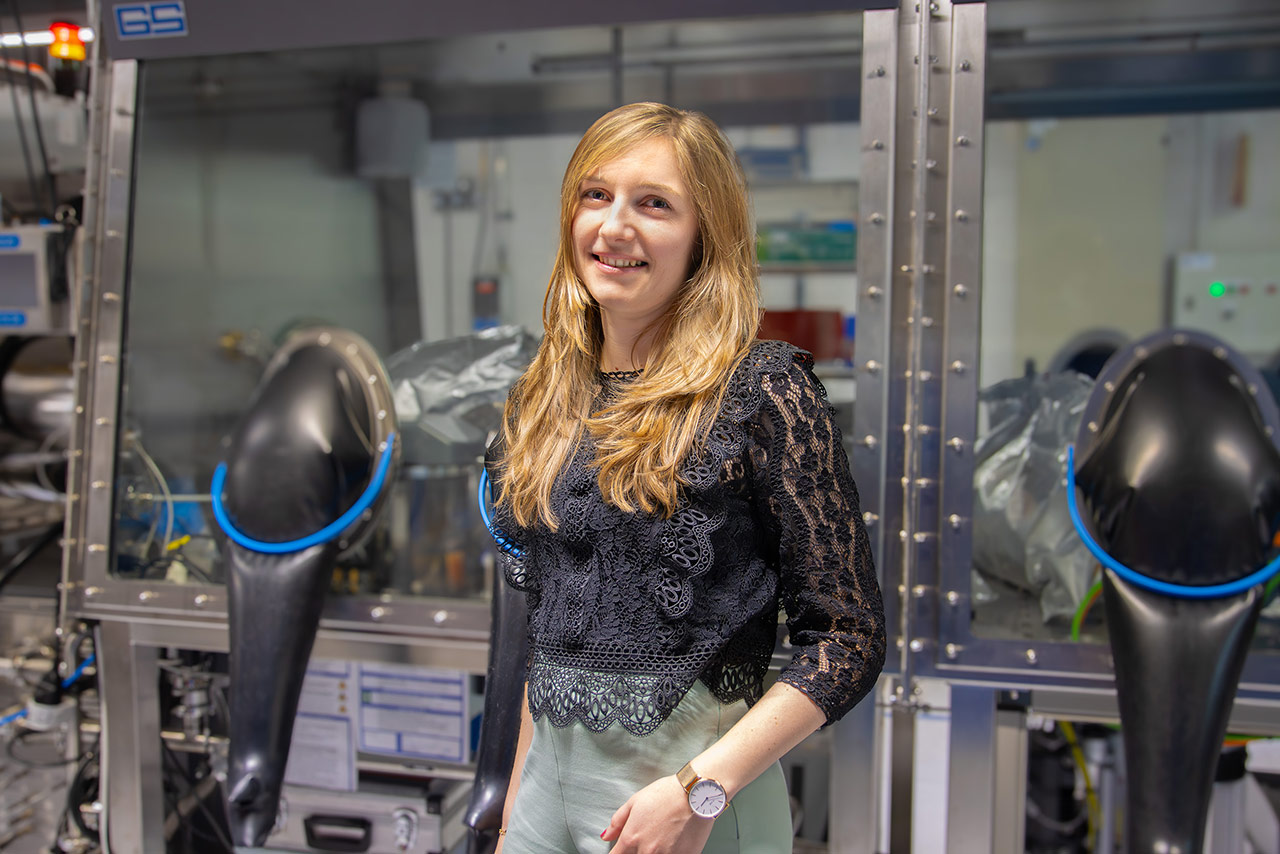
Battery production is a field in transition – technologically sophisticated, economically relevant, and socially highly relevant. Sophie Grabmann is researching one component of this change: laser beam welding for cell-internal contacting. “It's about an alternative joining process to be integrated into battery production,” she explains. Her doctoral thesis aimed to better understand the cause-and-effect relationships between the process parameters and cell quality, thus increasing process reliability.
Her path into this field of research began with a degree in chemical engineering at the Technical University of Munich. In her Master's degree, she switched to mechanical engineering – a step that gave her access to an interdisciplinary environment. “The interplay between different disciplines attracted me,” she says. “In battery production, experts from materials science, electrochemistry, electrical engineering, and mechanical engineering work closely together, making the field particularly exciting.”
Today, Sophie heads a research group at the Institute for Machine Tools and Industrial Management. The entire cell production process chain is covered there, from the powder to the finished and extensively tested pouch cell. The focus is particularly on new processes, the scalability of new materials, and the question of how research results from the laboratory can be transferred to industrial applications.
Innovations, materials, formats – battery production in transition
Battery production has undergone enormous change in recent years. “Ten years ago, the topic was not so present,” says the research associate. “Today, we encounter batteries everywhere – in electric cars, home storage systems, in the public debate.” Cell production, the focus of her research, has become much more critical. New cell formats, materials, and manufacturing techniques are rapidly changing the production of batteries.
One example is the so-called prelithiation of anodes – a process in which excess lithium is introduced to compensate for the initial loss of capacity. “The idea works well in principle,” says Sophie. "But the big question is: In which process step do you introduce the lithium? When is it safe? When does it make economic sense?"
Between quality and costs – a balancing act
Battery production is a complex field. The materials are expensive, the processes are critical to quality, and the requirements are high. “If I make a mistake late in the process chain, the rejects are extremely expensive,” explains the head of department at iwb. “That's why production quality is the be-all and end-all.” At the same time, production costs must be reduced. This is a conflict of objectives that challenges the industry. There are also scaling issues: “What works in the laboratory cannot always be transferred one-to-one to industry.”
Training specialists is also an issue. “We need people familiar with this technology,” Sophie emphasizes. “And we need to bring what we develop here to industry.”
Circular economy and specific use of batteries
Sustainability is playing an increasingly important role in iwb's research. “We try to reduce critical materials and save energy – for example, through dry coating,” she explains. But she thinks further: "In the long term, we have to think of battery production as a cycle. We are still at the beginning, but it won't be long before there are clear concepts and even obligations as to what happens to batteries after they are used."
She expects strong growth and increasing diversification over the next five to ten years. “Cell chemistries will be tailored more specifically to applications – whether for trucks, cars, or home storage,” thinks the research associate.
Links:
Sophie Grabmann
Institute for Machine Tools and Industrial Management