
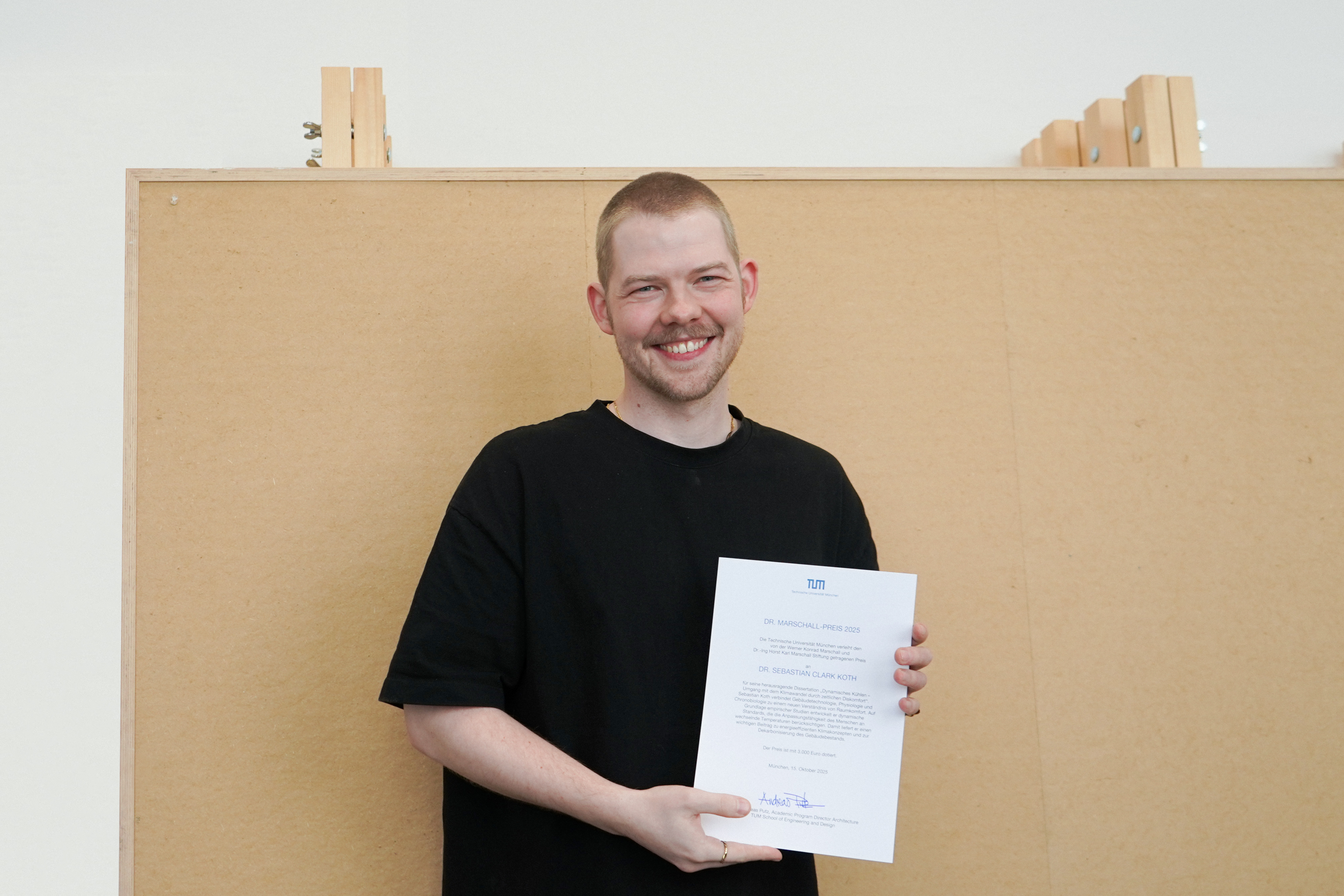
His dissertation, 'Dynamic Cooling – Mitigating Climate Change through Temporal Discomfort', was supervised by Prof. Thomas Auer, at the Chair of Building Technology and Climate Responsive Design. In his work, Koth combines building technology, physiology and chronobiology to create a new understanding of indoor comfort. Based on empirical studies, he develops dynamic standards that take into account the human ability to adapt to changing temperatures. This makes an important contribution to energy-efficient climate concepts and the decarbonisation of existing buildings.
In the context of the growing global use of air conditioning systems and the resulting increase in energy consumption in the building sector, Koth's dissertation proposes a new, sufficiency-oriented approach to building cooling. Rather than ensuring maximum thermal comfort at all times, room temperature is dynamically adjusted to human circadian rhythms, with larger temperature fluctuations deliberately allowed.
Through extensive studies and simulations, Koth demonstrates that this 'dynamic cooling' method can reduce the energy required for mechanical cooling in office buildings by over 50%, with minimal impact on subjective comfort and no adverse effects on users' physiological health.
Koth's research provides practical approaches to reducing the ever-increasing energy demand of existing buildings in a sustainable way. His concept of a dynamic adaptive comfort band, which systematically takes human thermoregulation and temporal sensitivity into account, opens up new perspectives for future indoor climate standards and climate-conscious building design.
He completed his Master's degree in Resource Efficient and Sustainable Building at the Technical University of Munich in 2021, after which he became a research assistant at the Chair of Building Technology and Climate Responsive Design.