
Geosciences B. Sc.
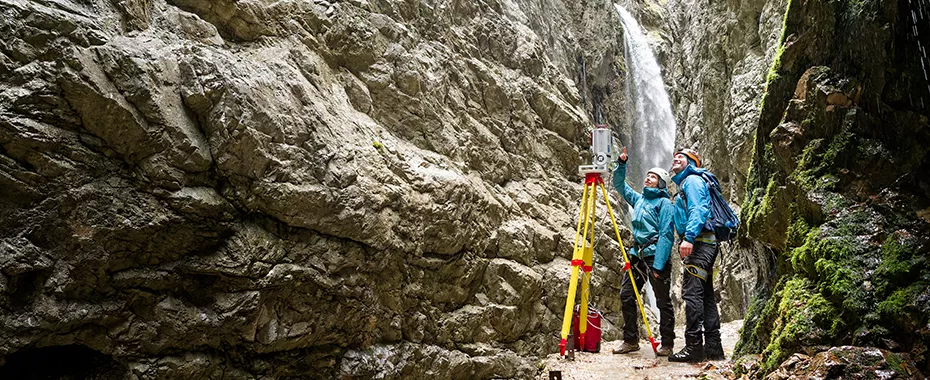
The Bachelor of Geosciences program is a joint program of TUM and Ludwig-Maximilians-Universität München at the Munich GeoCenter (MGC). This means that you can benefit from the expertise and infrastructure of two of the best universities in Germany. As a result, you will have access to a wide range of high-quality lectures, tutorials and field events.
Are you interested in the processes in and on the earth, its evolution and the origin of life on it? Would you like to know what forces lie dormant inside the Earth, how mountains are formed, or how the fauna and flora on Earth have changed over millions of years? Are you fascinated by natural forces such as earthquakes, volcanoes or landslides and want to know how they are created and how we can counter them? Are you interested in minerals, crystals and how new materials are developed? Would you like to learn where humans get their raw materials and clean water from, or how they explore the subsoil for buildings to make sure they will last for many years to come? In all these cases, it is best if you decide to study geosciences at the Munich GeoCenter!
| Type of Study | Full Time | Main Locations | Main Campus Munich |
| Standard Duration of Studies | 6 semester | Application Period | Winter semester: 15.05. – 15.07. |
| Credits | 180 ECTS | Required Language Proficiency | German |
| Start of Degree Program | Winter Semester | Costs | Semester fee, Fees for Students from Non-EU Countries |
Geoscientists deal with the earth in a scientific sense, i.e. with the structure, the development as well as the processes of the system earth. They study the earth's body and surface, the effects of human intervention on the environment and the development of life. The practice of graduates of the Bachelor of Geoscience program includes topics of great societal importance such as:
- exploration and sustainable use of resources (e.g., metallic and non-metallic raw materials, oil, natural gas),
- development and safeguarding of clean drinking water, use of geothermal energy,
- development of new and further development of existing materials,
- investigation of natural hazards such as earthquakes, volcanic eruptions, slope movements and floods,
- preliminary investigations and geological monitoring of major construction projects (such as the Brenner Base Tunnel),
- investigations and forecasts of biodiversity and climate development,
- analysis of material cycles and their effects on the natural environment,
- studies on environmental pollution and remediation, and
- satellite-based observation methods for remote sensing.
More information:
Degree program documentation
As a graduate, you are able to independently formulate and deal with geoscientific questions using the appropriate methods. Your knowledge allows you to develop strategies that yield solutions to discipline-specific problems in various areas. Depending on your study profile, you can draw upon further expertise in environmental and climate protection, energy and natural resources, construction and spatial planning, material development or natural phenomena, biodiversity research in space and time, as well as georisks. In all of your activities you draw upon your interdisciplinary knowledge of mathematics, physics, chemistry, or biology.
Upon completing the program you are familiar with the processes involved in the formation of the Earth. You understand how they work, their physical characteristics, and their material components. In addition, you understand the processes that continuously shape the Earth and the current diversity of life on Earth. You are also able to classify minerals and rocks, as well as document these in geological cross sections and maps. Further, your choice of specialization has resulted in the acquisition of additional specialist knowledge in the relevant discipline.
As a result of the mapping and field exercises accompanying your studies, you are accustomed to applying your skills in practice. Working in a group has provided you with distinctive social competencies, so that you are able to negotiate conflicts and take responsibility for your actions.
If you decide to start your career after completing your bachelor's degree in geosciences, a variety of opportunities will be open to you. In addition to data collection and analysis, possible fields of activity include raw material extraction, environmental consulting, and process and product development. You can also take on positions as a consultant or expert, or work in restoration and information and knowledge management.
Study structure
The first four semesters focus on content from all areas of the geosciences, as well as foundational competencies in the natural sciences, mathematics, physics, biology and chemistry. Geoscience modules embrace general geology, geomaterials and geochemistry, historical geology, rocks, maps and cross-sections, endogenous processes, petrology, paleontology and geobiology, as well as fieldwork.
From the third semester, there is a choice of four specializations: geology, paleontology and geobiology, mineralogy and geophysics. These are complemented by a wide range of elective and compulsory modules, enabling students to create their own individual academic profiles.
The program concludes with a Bachelor’s thesis, where knowledge accrued of the discipline and its methods converges.
Course content
The first four semesters focus on content from all areas of the geosciences as well as fundamental skills from the natural sciences of mathematics, physics, biology and chemistry. Modules from the earth sciences include general geology, geomaterials and geochemistry, earth history, rocks, maps and profiles, endogenous dynamics, petrology, paleontology and geobiology, and terrain education.
Starting the third semester, there is an elective option from three tracks: geology, paleontology & geobiology, and mineralogy. These are complemented by a wide range of elective modules for individual profile building.
For the Geophysics direction, other courses in mathematics and physics are already offered from the first semester.
The Bachelor's Thesis, which brings together the acquired technical and methodological knowledge, forms the final part of the program.
The bachelor's program offers a wide-ranging, interdisciplinary and research-related course of studies in the area of geosciences. It is based on a cooperation between Ludwig-Maximilians-University Munich and the Technical University of Munich, which together with further partners created the Munich GeoCenter (MGC).
Central to the program are the structure and development of planet Earth, as well as the processes that take place within and influence this dynamic system. Further content concerns the development of life as well as the effects that human interventions have on the environment. In the analysis of these themes, the methods of mathematics and the natural sciences play a central role. The program also deals with resource exploration and usage, the study and further development of existing materials, and risk assessment relating to natural hazards. Further topics handled during the course of study include biodiversity, climate change, the geochemical analysis of biogeochemical cycles, environmental pollution, environmental remediation, and satellite-based observational methods.
In addition to foundational competencies, the program allows students to start specializing in one of the core areas of the geosciences: geology, paleontology and geobiology, mineralogy, or geophysics.
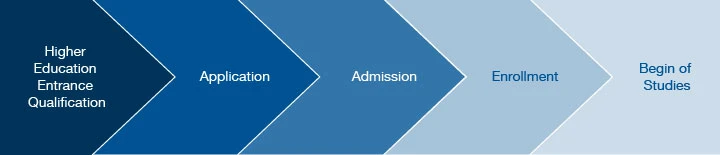
Apply via the TUMonline application portal and upload your documents for admission there.
Instructions for applying for a bachelor's program: Detailed information on the application process (step-by-step instructions)
More information on the application process: Application Info Portal
The legal basis for the application is the Academic and Examination Regulations and the Statutes on Aptitude Assessment
The requirements you must meet for admission and the exact application process depend on your university entrance qualification.
Here you will find detailed information on the documents you need to upload for your application and admission to TUM.
Prospective students with international university entrance qualifications (foreign students) must usually request preliminary review documentation from uni-assist in advance.
In detail:
- Proof of German Language Proficiency
- Complete and Current Résumé
- Passport
- if applicable: Proof of Internships or Professional Experience (optional)
- Preliminary Documentation (VPD) by uni-assist - for international applicants only
We may require additional documents depending on your educational background and your country of origin. Complete the online application to receive a comprehensive list of the required documents.
Please consider the specific requirements for documents for application and enrollment at TUM.
- Application for Enrollment (signed)
- Higher Education Entrance Qualification (authentic document)
- Most Current Photo (as for ID)
- Digital notification of your health insurance status from a German public health insurance provider (requested by applicant)
We may require additional documents depending on the type of educational background you earned and your country of origin. After accepting an offer of admission in TUMonline, you will receive a list of documents you must submit to TUM in hardcopy for enrollment.
Please consider the specific requirements for documents for application and enrollment at TUM.

The Geosciences Contact Point at the Natural Sciences Examination Office in the city center is responsible for exam administration in the Geosciences program.
Recognition of credits can be requested for parts of a degree program completed outside TUM. The prerequisite for the recognition of credits not earned at TUM is their equivalence. This means that the knowledge and skills acquired must not differ significantly from the content of the corresponding modules at TUM (based on Art. 63 BayHschG and §16 APSO). Guidelines on how to carry out this process can be found via the links below.
Geosciences Contact Point at the Natural Sciences Examination Office
We encourage the pursuit of a stay abroad through the various offers at TUM. Contact your study coordinator for an individual counseling.
Further information about exchange programs at the ED can be found on the going on exchange wiki-page.
Information on taking a leave of absence can be found on the corresponding TUM page.
Please keep in mind that the application for the leave of absence has to be handed in latest until the start of the lecture period of the semester you want to take the leave in.