
Human Factors Engineering M. Sc.
Ready for a fascinating journey to the interface between human and technology? The Master's degree program in Human Factors Engineering at the TUM School of Engineering and Design offers a unique education that focuses on the development of user-orientated, sustainable technical systems and ethical justifiability.
Highly interdisciplinary and forward-looking: insights from engineering, computer science, psychology, medicine, design and health sciences are combined here. Students learn to design innovative technologies that are effective, efficient, user-friendly and socially acceptable.
The focus is primarily on engineering sciences, product design, biomechanics and digital human modeling, and movement sciences. The course is characterized by a wide range of fields of application, particularly in the key areas of automotive, manufacturing, logistics and aviation.
| Type of Study | Full Time | Main Locations | Garching, Munich |
| Standard Duration of Studies | 4 Semester | Application Period | Winter Semester: 01.04. – 31.05. Summer Semester: 01.11. – 15.01. |
| Credits | 120 ECTS | Required Language Proficiency | English, German |
| Start of Degree Program | Winter Semester Summer Semester | Costs | Student Fees: 85.00 €, Tuition fees for international students |
Technical systems are becoming increasingly more comprehensive and powerful, and their users more and more heterogeneous. As a result, it is all the more necessary to consistently align technologies with the needs and skills of users. Students in the Master’s degree program Human Factors Engineering learn to design technical systems, products and processes that generate the greatest possible benefit for people.
The role of human factors engineers is to take into account the needs of very different user groups when designing human-technology interfaces, to ensure their acceptance and motivation during use, and to exploit the technological functional scope as effectively as possible. Human factors engineers bring together sometimes competing requirements and contributions from engineering, computer science, psychology, medicine, design, movement and health sciences, and, last but not least, the social sciences, and methodically reconcile them in line with ethical considerations.
This highly interdisciplinary program equips students with the necessary knowledge and skills to develop technical systems that support people effectively and efficiently, are easy to use, have no harmful effects, and inspire widespread social acceptance. They do so in the context of globalization, demographic change and the digital transformation.
Students learn to align requirements from the engineering sciences, informatics, psychology, medicine, design, the movement and health sciences, and the social sciences while always taking their ethical and societal dimensions into account. Here, students may choose their own specialization in the areas of biomechanical human modeling, human-centered systems engineering, or human machine interaction design.
Graduates of the program are experts in human-oriented technology development. They are able to design interfaces between humans and technology and thus living and working environments, industrial products and assistance, information, and communication systems in a way that best meets the needs of different target groups. This makes them highly qualified to work in science and a wide range of industries, particularly in Research & Development.
The following primary areas of potential future employment have been identified along the study specialisations:
Focus on biomechanical human modelling
- as an expert or manager for anthropometric product design in the fields of health and sports (e.g. for orthopaedics, assistive technologies, wearables, motion sensors, etc.)
- as an expert or manager for the collaboration of people and technical systems in complex application areas (e.g. for human-robot interaction, cooperation or collaboration, workplace analyses, etc.)
Focus on human-machine interaction design
- as an expert or manager for the human-centred design and evaluation of user interfaces of technical products (e.g. in the fields of mobility, information technology, telecommunications, health/pharmaceuticals, for vehicle and aircraft cockpits, medical devices, apps, websites)
- as an expert or manager for researching and analysing user needs and user requirements for future product designs and strategies (e.g. for customer and target group orientation, possible applications and ethics of new technologies, etc.)
Focus on human-centred systems engineering
- as an expert or manager for human factors in the development of complex human-machine systems (e.g. in the fields of mobility, transport, aviation, production, health/pharmaceuticals, etc.)
- as an expert or manager in the areas of workplace design or organisational design with a focus on ergonomic aspects (e.g. for production workplaces, HR management and HR development, safety management, etc.)
The scope of the work to be performed amounts to 120 ECTS, which are modular and are divided into 90 ECTS for modules (consisting of courses such as lectures, tutorials, seminars and internships) and 30 ECTS for the Master's thesis. 42 ECTS must be completed in compulsory modules and at least 30 ECTS in the elective area of "Subject Specialization". In addition, at least 10 ECTS must be completed in the elective area of the "Interdisciplinary Project" and at least 8 ECTS in the elective area "Interdisciplinary Supplement". Each semester should ideally comprise 30 ECTS credits.
In the first year of study, methodological foundations are set in the form of compulsory modules and modules to align the different qualification profiles. These can be extended by modules from the areas of "Subject Specialization" and "Interdisciplinary Supplementation".
There are three areas of specialization to choose from:
- Biomechanical modeling
- Human-machine interaction design
- Human-centered engineering
At least 20 credits must be earned in one specialization, which can be supplemented by 10 credits from another specialization. It is also possible to obtain at least 30 credits in only one specialization.
Students who have demonstrated proficiency in exactly three of six subject groups in the aptitude test must complete a module from the remaining three subject groups during their studies. The following modules are available in the “Skill Expansion” module area.
In the second year of study, further modules from the areas of "Specialization" and "Interdisciplinary Supplement" follow, as well as the "Interdisciplinary Project" and the Master's thesis.
The "Interdisciplinary Project" enables students to apply and deepen their knowledge through practice-oriented teamwork on real projects, such as the development, design and conceptualization of school furniture, a cockpit or an exoskeleton. Interdisciplinary collaboration strengthens important skills for the future working environment, including teamwork, project management, documentation and presentation skills.
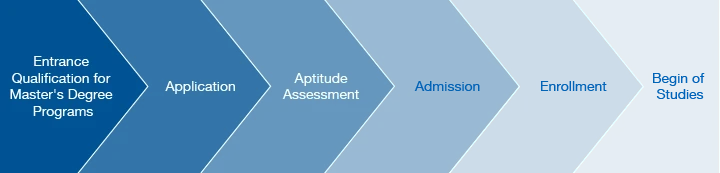
- Application period for the winter semester: 1 April - 31 May
- Application period for the summer semester: 1 November - 15 January
The first step is to apply online via our TUMonline portal. The application assistant guides you step by step through the online application. You upload the documents required for admission in PDF format. Once you have completed your online application, you can check the status of your application on TUMonline at any time. Please note: Your application can only be processed if all necessary documents are submitted before the application deadline.
The aptitude interviews take place at the following times:
- For the winter semester: between June 1 and September 30
- For the summer semester: between January 16 and March 31
The interview date is mandatory and will be communicated to applicants by email at least one week in advance after the pre-selection process.
After successful completion of the application process and receipt of admission, all documents required for enrollment must be submitted
- by August 15 (for the winter semester) or
- by February 15 (for the summer semester)
Application via TUMonline: Apply via the TUMonline application portal and upload your documents for admission there.
Support: Instructions for applying for a master's program (step-by-step instructions) and Application Info Portal
Legal Notice: The basis is the program-specific Academic and Examination Regulations (FPSO)
Suitability for the Master's program in Human Factors Engineering must be demonstrated by:
- a qualified Bachelor's degree (Bachelor of Science) acquired at a domestic or foreign university after at least six semesters of study, or an at least equivalent degree in the fields of engineering, natural sciences, human sciences, or design/art,
- In addition, students who have earned at least 140 credits in one of the above-mentioned bachelor's degree programs may be admitted to the master's program upon request. The bachelor's degree certificate must be submitted within one year of the start of the master's program.
- Applicants who have obtained a bachelor's degree abroad must submit a language certificate by the end of the application period.
- Sufficient German language skills and adequate knowledge of English,
- as well as passed module examinations in at least three of the following six subject groups, each with at least 4 credits: Research methodology, mechanics, design, mathematical fundamentals, fundamentals of programming, fundamentals of cognitive science. (As part of the degree program, performance in a fourth of the above subject groups may be required.)
If you do not meet the qualification requirements due to missing credits in three of the subject groups mentioned, we recommend that you attend the relevant lectures during your bachelor's degree program.
Please understand that we cannot provide any information in advance regarding the recognition of individual modules. You are welcome to enter your academic achievements when applying for the above-mentioned degree program and submit them via the portal. The selection committee will review your achievements and decide on their recognition.
- Degree Certificate and Diploma or Subject and Grade Transcript of Studies to Date
- Curricular Analysis
- Curriculum (e.g. module description)
- Complete and Current Résumé
- Letter of Motivation (optional)
- Passport
- Proof of German Language Proficiency
- Proof of English Language Proficiency
- Preliminary Documentation (VPD) by uni-assist - for international applicants only
We may require additional documents depending on your educational background and your country of origin. Complete the online application to receive a comprehensive list of the required documents.
Please consider the specific requirements for documents for application and enrollment at TUM.
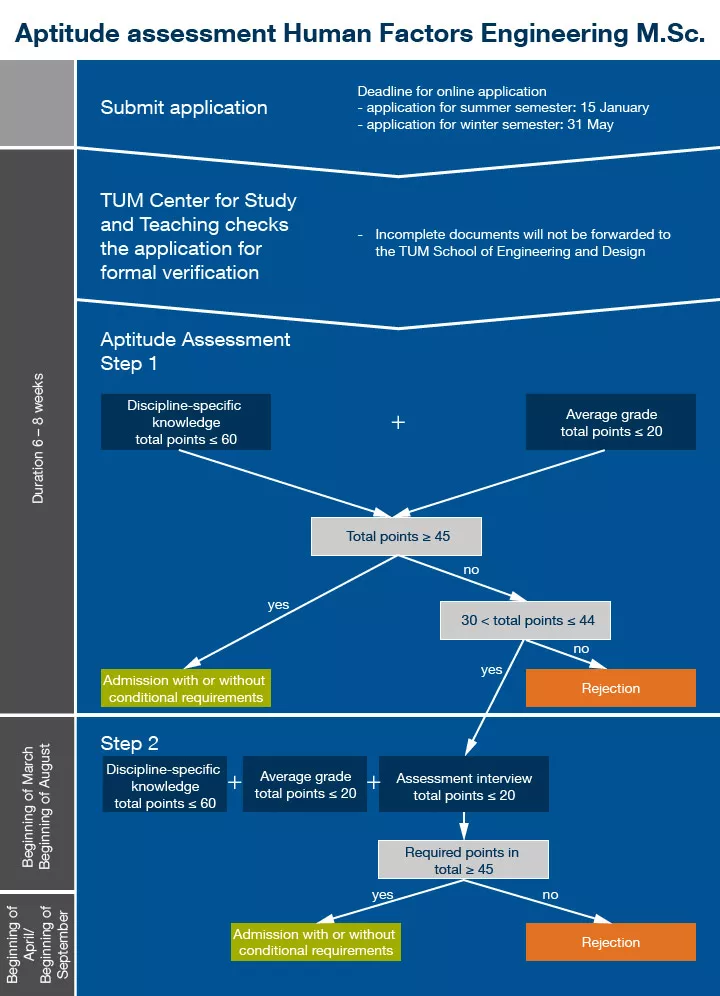
Selection takes place through an aptitude assessment procedure. The aptitude assessment is a two-part procedure after the submission of an official application to a program. In this procedure, the TUM school determines whether you meet the specific requirements for its Master’s degree program.
In the initial stages, the grades you obtained during your Bachelor's program, as well as your written documents, will be evaluated using a point system. Depending on the amount of points accumulated, applicants are either immediately admitted, rejected or invited to an admissions interview.
Points are awarded to assess professional qualifications by comparing the skills of applicants with those of graduates of a comparable degree program at TUM. The learning objectives of the individual modules and their scope (ECTS) are taken into account.
In the second stage, applicants are invited to a selection interview lasting approximately 20 minutes. The final decision on the suitability of applicants is based equally on the average grade of their bachelor's degree certificate and the result of the selection interview.
Further information can be found in Appendix 2 of the FPSO.
- Most Current Photo (as for ID)
- Application for Enrollment (signed)
- Degree Certificate and Diploma (authentic document)
- Digital notification of your health insurance status from a German public health insurance provider (requested by applicant)
- Higher Education Entrance Qualification (authentic document)
- Transcript of Records (authentic document)
We may require additional documents depending on your educational background and your country of origin. Complete the online application to receive a comprehensive list of the required documents.
Please consider the specific requirements for documents for application and enrollment at TUM.
Current information
We have moved - you will find our offices here https://nav.tum.de/building/5515
Please write from your TUM E-Mail (not personal E-Mail address) and state your matriculation number when you contact the study office.
At the beginning of the semester, an introductory event will be held in person for new students. Information will be announced in good time.
TUM First Steps – Infosession covers topics such as enrollment, health insurance, finding accommodation, financing etc.
https://www.tum.de/studium/im-studium/das-studium-beginnen/first-steps
- TUM First Steps | Infosessions, 23. - 26. Februar 2026: Format: Onlinevortrag mit Live-Q&A, auf Englisch, Anmeldung erforderlich
- TUM First Steps | Student Experiences, 27. Februar 2026: Format: Onlinevortrag mit Live-Q&A, auf Englisch, Anmeldung erforderlich
Online events for international first-year students (regular students):
- Lecture series on the topic of housing
No registration required. The maximum number of participants is 300. - TUM Housing Website
- TUM Buddy Programme
Kontakt: hfe@fsmse.de
Student Representatives WiSe 2024-25
- Anne Förster
- Nicole Fritsch
- Linus Hofacker
Student Representatives SoSe 2025
- Selin Gökcen
- Veronica Hartl
- Yannik Struss
Student Representatives WiSe 2025-26
- Pauline Oldemeier
- Susanne Steinweg
Semestersprecherinnen und Semestersprecher SoSe 2026
- tbc
The scope of the required coursework is 120 credits, which are earned in modules and divided into 90 credits for modules (consisting of courses such as lectures, exercises, and internships) and 30 credits for the master's thesis. Students should earn 30 credits each semester.
Students must earn 42 credits in compulsory modules.
The elective area of “Subject Specialisation” serves to deepen the subject-specific methodological competence that has been developed in the compulsory area. It establishes initial links to the fields of application. At least 20 credits must be earned in one of the training specializations, which can be supplemented by 10 credits from related specializations or from modules for expanding competencies.
In the elective area “Interdisciplinary Project” (at least 10 credits), the entire competence profile of the HFE is applied in a field of application chosen by the students.
In the elective area “Interdisciplinary Supplement,” interdisciplinary modules from the entire range offered by TUM or other universities can be freely selected and serve to improve innovation and development skills. Please refere to the curriculum.
Important: At least one compulsory elective module (Appendix 1, FPSO) must be successfully completed by the end of the second semester.
Detailed information on dates relating to the semester structure, deadlines, lecture times, semester breaks, public holidays, and student council meetings.
The general study regulations (APSO) stipulate certain milestones that you must achieve in the corresponding semesters. The following list summarizes the required number of credits that you must have earned after each semester, starting with the third semester:
- at least 30 credits after 3 semesters
- at least 60 credits after 4 semesters
- at least 90 credits after 5 semesters
- at least 120 credits after 6 semesters
This effectively limits the maximum duration of study to 6 semesters. Please also note that at least one of the required modules must be successfully completed by the end of the second semester.
Check TUMonline regularly for exam dates, especially shortly before the exam, to see if there have been any changes.
Please register for all courses you are taking in the semester (including projects/submission of seminar papers, etc.). This is the only way to ensure that your exam results are entered.
Late registration for exams is only possible in exceptional cases.
Information on examination matters
Application form for withdrawal from an exam
Compensation for disadvantages
The Examination Board is responsible for all matters relating to examinations, from applications for a place at the university and the aptitude assessment procedure to the entire administration of grades and examinations during the course of study. It meets once per semester. Applications to the examination board should be sent to mschfe@ed.tum.de.
Recognition of credits can be requested for parts of a degree program completed outside TUM. The prerequisite for the recognition of credits not earned at TUM is their equivalence. Guidelines on how to carry out this process and an application form can be found here.
You can only apply for recognition of credits after you have enrolled. You can only submit one application, and it must be done within your first year of study.
Diploma Supplement
In the TUM Diploma Supplement, students can have their academic record officially documented, along with individual additional activities such as stays abroad or special projects.
Application for inclusion of individual activities in the Diploma Supplement
The elective “Interdisciplinary Project” area provides practical application of the knowledge acquired and an introduction to independent interdisciplinary scientific work. Here, interdisciplinary teams of students work together on a specific problem. This could involve, for example, the development, design, and conceptualization of school furniture (tables and chairs for students), the design of an exoskeleton for manual load handling in a manufacturing industry, or the design of a cockpit (e.g., vehicle, aircraft, etc.). The project serves as preparation for a typical future working environment.
During your Master's degree at TUM, you have the opportunity to study abroad for up to two semesters. You can find more information about the various programmes on the TUM-Global-Webseite.
For this purpose, it is advisable to take modules from the areas of "Specialization" or "Interdisciplinary Project" abroad. Other coursework completed abroad can also be recognized, as long as there are no significant differences to the modules offered in the degree program. The Master's thesis can also be completed at an international research institution.
Study visits abroad are possible, for example, via ERASMUS, with university cooperation partners of chairs, via TUMexchange and EuroTeQ and as internships.
The Going Abroad page of the TUM Global & Alumni Office provides comprehensive information on stays abroad. If you have any further questions, you can find the relevant contact persons for the topic of ‘International Affairs’ on the Wiki page Contacts - IE.
- TUMexchange
The TUM Global & Alumni Office is primarily responsible for organising stays abroad through the TUMexchange programme: https://www.international.tum.de/en/global/tumexchange
- Financial aspects of scholarships (especially Erasmus+)
Scholarships are usually administered by the relevant teams at the central TUM Global & Alumni Office – not by the International Office of the TUM School of Engineering and Design (ED). This applies in particular to the Erasmus+ programme.
https://www.international.tum.de/en/global/going-abroad
- Application documents:
- Letter of motivation (in English or the local language, max. 1 page DIN A4, only for first choice)
- Curriculum vitae with photo (in English or the local language)
- Transcript of grades (B.Sc. & M.Sc., if applicable)
- Study plan for abroad (with non-binding course selection, only for first choice)
- Language certificates (e.g. Abitur, TUM Language Centre, DAAD test)
No TOEFL/IELTS required for the application – however, partner universities may require this later. If applications are made in countries with different languages of instruction:
Upload all language certificates in one PDF file
Local language skills (e.g. Swedish, Dutch) are also an advantage.
If you have any questions, please contact international.ie@ed.tum.de .
- Further information:
Lead time: Please note that lead times can be long – up to 18 months – depending on the university, country and financing model!
Partner universities: A list of all partner universities for the above-mentioned degree programmes can be found on the TUM website.
Detailed information can be found on the corresponding Wiki-Website.
Information on applying for a leave of absence can be found on the relevant TUM page.
Please note that the application for a leave of absence must be submitted no later than the start of the lecture period of the semester in which you wish to take the leave of absence.
The master's thesis is usually completed in the fourth semester after successfully passing all module examinations. It is an independent academic paper on a topic in the field of human factors engineering and is supervised by an examiner from one of the schools participating in the program.
- TUM School of Engineering and Design
- TUM School of Medicine and Health
- TUM School of Computation, Information and Technology
The master's thesis can be started after successfully completing all module examinations (90 credits) – at the earliest after achieving at least 60 credits.
Guidelines for the master's thesis and master's examination
The thesis can be written abroad, but must be supervised by an examiner from TUM. Regular contact must be ensured—this must be agreed upon in advance.
The administrative process takes place in the ED portal at portal.ed.tum.de. There you can clearly view all information and submit the written thesis digitally.
Please also see: https://www.tum.de/en/studies/graduation/theses/formalities