
Information Technologies for the Built Environment M. Sc.
Information technologies such as digital twins, smart cities, geoinformation systems (GIS), urban and building information modeling (UIM/ BIM), design automation, digital fabrication, remote sensing, artificial intelligence, and human-computer-interaction play a crucial role in shaping the liveability of our urban areas. The ever-growing possibilities in the digitalization of the building industry require specialists who can integrate developments in information technologies across different building disciplines and scales.
In this unique program, students acquire knowledge and competencies in information technologies from architecture, civil engineering, and geodesy. They have the skills to capture, generate, interpret, utilize, and adapt data and information at the interface of different digital systems. They work in interdisciplinary teams to manage, consult on, and create digital components of built environment activities at various stages of the construction lifecycle.
| Type of Study | Full Time | Main Locations | Campus Munich |
| Standard Duration of Studies | 4 Semester | Application Period | Winter Semester: 01.01 – 31.05. |
| Credits | 120 ECTS | Required Language Proficiency | English |
| Start of Degree Program | Winter Semester | Costs | Student Fees, Tuition fees for international students |
Do you want to help shape the future of digital planning and construction processes? Are you interested in buildings, city systems, and information technologies and have a bachelor's degree in architecture, civil engineering, geodesy, information technology, or similar? Then the ITBE M.Sc. opens a wide range of opportunities to you. As a BIM expert, a smart cities specialist, a systems analyst and designer, a software developer, a data acquisitionist, and many more, you will be able to work in planning and surveying offices, for municipalities, or in research and development in both the construction and software industries. Alternatively, you can create your own information technology business to solve related built environment challenges. The choice is yours!
As an expert in information technologies for the built environment, you can consult on, develop, and manage information models and systems, utilizing and combining existing information technologies and creating innovative new approaches within built environments.You will have a holistic, interdisciplinary understanding of information technologies and methods in the building industry. You will have knowledge of domain and technology requirements, challenges, processes, and structures at different construction scales in architecture, civil engineering, and geodesy, coupled with a deep understanding of information technologies, computer science methods, data management, and systems architecture. You will be able to identify and analyze information technology issues in the built world and be capable of selecting appropriate digital methods, developing solutions, identifying necessary stakeholders, and working in interdisciplinary teams.
You will have knowledge of the domain and technology requirements, challenges, processes, and structures at different construction scales in architecture, civil engineering, and geodesy coupled with a deep understanding of information technologies, computer science methods, data management, and systems architecture. You will be able to identify and analyze information technology issues in the built world and be capable of selecting appropriate digital methods, developing solutions, and identifying necessary stakeholders.
As an expert in information technologies for the built environment, you can consult on, develop, and manage information models and systems, utilizing and combining existing information technologies and creating innovative new approaches within the built environment. Upon completing the program, you will have a holistic, interdisciplinary understanding of information technologies and methods in the built environment.
Study Structure
The M.Sc. Information Technologies for the Built Environment (ITBE) is a full-time study program with a standard duration of study of 4 semesters and a total of 120 credit points (CP) per the European Credit Transfer System (ETCS). The primary language of the program is English.
The program is structured as shown in Figure 1. Compulsory modules ensure you gain the necessary knowledge, skills, and competencies. A wide range of elective modules offers you the opportunity and flexibility to fill personal knowledge gaps, specialize in a specific area, and learn about cutting-edge technologies within the field. While the built environment as a field lays great value on human-centered engineering and the connection between users and technology are present within many of the modules in this program, the program additionally promotes an active engagement with the topic through the selection of an elective module in the area of "ethics and the human factor."
The first semester builds on your bachelor-level knowledge. You will receive state-of-the-art education on information technologies in different building domains (architecture, civil engineering, geodesy) and at different scales. This affords you an overview of the information technology landscape in the built environment and establishes a common understanding of information technology, methods, and terminology.
Modules in the second and third semesters focus on specific built environment information technology issues from multiple (at least two) domain perspectives, generating a holistic and integrated understanding. In the third semester, you will apply this theory in practice within the ITBE Fusion Lab, where you will work in interdisciplinary teams using digital methods to develop a solution to real-world built environment information technology challenges.
For the master thesis in the fourth semester, you will identify a research question of interest to you and select and develop an appropriate method to address a specific research gap in the built environment. You will carry out a scientific investigation and analyze the results. This work will be documented and communicated in a scientific paper and oral presentation.
Course Contents
The program is structured as shown in Figure 1. Compulsory modules ensure students gain the necessary knowledge, skills, and competencies to become ITBE experts. A wide range of elective modules offers the opportunity and flexibility to fill personal knowledge gaps, specialize in a specific area, and learn about cutting-edge technologies within the field.
Of the 36 credits gained through elective modules, at least 21 credits must be included from the elective module catalog "Cross-Cutting Methods." While the built environment as a field lays great value on human-centered engineering and the connection between users and technology are present within many of the modules in this program, the program additionally promotes an active engagement with the topic through the selection of at least 3 credits in the elective area of "Ethics and the Human Factor." The list of elective modules, depending on what is offered by the chairs, we will published via TUMonline.


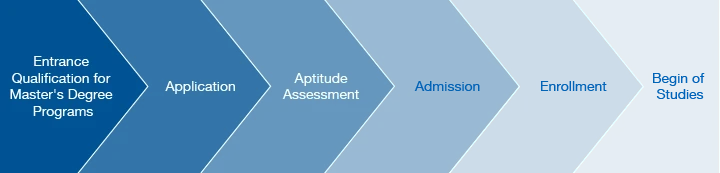
- January to May: You apply for the degree program using the online registration (Aptitude Assessment Phase I). We recommend international applicants apply by 15th of March. Until the end of the application process, all the documents must be provided, complete and correct.
- May to September: If required, you take part in the digital aptitude assessment test (Aptitude Assessment Phase II).
- May to September: You are admitted.
- You accept your study place and are enrolled (by October, at the latest November).
- Beginning of October: You start your studies.
Application via TUMonline: Apply via the TUMonline application portal and upload your documents for admission there.
Support: Instructions for applying for a master's program (step-by-step instructions) and Application Info Portal
Legal Notice: The basis is the program-specific Academic and Examination Regulations (FPSO)
Applicants should have a solid foundation in either the built environment or computer science with a strong interest in the other. This interest must be evident in their previous work and activities. They must also:
- Have at least a bachelor's degree or equivalent in architecture, landscape architecture, urban planning, civil engineering, geodesy, geoinformation, informatics, or a similar degree. A grade of at least 2.0 is asked for.
- Have adequate English language skills.
- Fulfill the requirements of the application process (for further details refer to the ITBE “FPSO Anlage 2: Eignungsfeststellung”).
- Degree Certificate and Diploma or Subject and Grade Transcript of Studies to Date
- Proof of English Language Proficiency
- Letter of Motivation (in English)
- Complete and Current Résumé
- Passport
- Preliminary Documentation (VPD) if the qualification for graduate studies (e.g. a Bachelor’s) was obtained outside Germany)
Please apply early for a VPD. If you do not receive the VPD before the application deadline, please attach your VPD application.
We may require additional documents depending on your educational background and your country of origin. Complete the online application to receive a comprehensive list of the required documents.
Please consider the specific requirements for documents for application and enrollment at TUM.
Proof of English language proficiency must be submitted when applying.
We accept
- a TUM recognized English Language Certificate, e.g., "Test of English as a Foreign Language" (TOEFL) (min. 88 Points), "International English Language Testing System" (IELTS) (min. 6,5 Points), or "Cambridge Main Suite of English Examinations".
- if the language of instruction in a bachelor's degree program was English – by submitting your transcript of records or your degree certificate as evidence. The language of instruction needs to have been English in at least 50% of the program. If the language of instruction is not stated in these documents, you can submit an official confirmation issued by your prior university.
- current TUM students can meet the English language requirement by successfully completing one of the TUM Gateway to English Master's courses.
If you have alternative proof of English language proficiency that is not TOEFL, IELTS, or “Cambridge Main Suite of English Examinations", and would like to know if your certificate qualifies you for admission, please check TUM Website or contact the Student Advising and Information Services at studium@tum.de (please observe the e-mail etiquette).
For more information on language certificates, please check the TUM Website.
If you still have questions regarding the proof of English language proficiency, please contact the TUM Student Advising and Information Services at studium@tum.de (please observe the e-mail etiquette).
Selection takes place through an aptitude assessment procedure. Aptitude assessment is a two-part procedure after the submission of an official application to a program. In this procedure, the TUM school or department determines whether you meet the specific requirements for its master’s degree program.
In phase I, suitability will be judged on:
- Technical qualification (max. 60 points),
- Bachelor’s degree grade (max. 10 points),
- Motivation letter (max. 30 points).
Applications achieving
- more than 70 points are accepted.
- less than 60 points are rejected.
- between 60 and 70 points enter phase II.
In phase II, suitability will be judged on:
- Technical qualification (max. 60 points),
- Bachelor’s degree grade (max. 10 points),
- Digital test (max. 60 points).
The digital test consists of basic and application-related questions in the area of built environment (max. 30 points) and information technologies (max. 30 points).
Applicants achieving
- more than 105 points are accepted.
- less than 105 points are rejected.
Bachelor's degree grade
We ask for a minimum of 2.0 GPA. You may apply with a grade lower than 2.0 GPA, as the grade only makes up one of a number of parts of the aptitude assessment. However, while a grade lower than 2.0 GPA does not automatically lead to the rejection of an application, the application will receive no points for the related part of the aptitude assessment.
Letter of Motivation
A significant part of your application for the aptitude assessment will be a written statement giving your reasons for choosing the M.Sc. ITBE degree program, choosing the Technical University of Munich, and why you consider yourself particularly suitable for the program.
Please comment on the following:
- Your reasons for choosing the M.Sc. ITBE program and why you wish to study at TUM.
- Your abilities, particular talents, interests, career ambitions, and related previous work that make you particularly suited to the M.Sc. ITBE program. Please include evidence of your built environment and information technology interests.
- Program-specific and non-program-specific extra-curricular and related activities or additional qualifications. What do you bring to the program?
Please include proof of your statements within your application. The letter of motivation should be no longer than two A4 pages and must be written in English. The statement must be written by yourself without help; your signature on the application form will confirm this.
Electronic entrance exam
The 60-minute electronic entrance exam consists of basic and application-related bachelor-level questions in areas of the built environment (max. 30 points) and information technologies (max. 30 points). The types of questions include short and long text answers, dropdowns, drag-drop, single-choice, and code runner questions. Questions can include built environment scenario evaluations, critical assessments of structures in the built environment, basics of geometric modeling, awareness of the pros and cons of digitalization, understanding of basic IT concepts, and basic knowledge of connected systems and data acquisition. The entrance exam takes into consideration that applicants come from a diverse range of technical backgrounds with differing levels of knowledge related to the built environment and information technologies.
For details please refer to:
- Aptitude Assessment for Master
- Description of the Aptitude Assessment (appendix 2, German) (PDF 334 KB)
- FAQ Application ITBE
Timeline:
Please note that we select our students carefully and that this process will take some time. The times below represent the latest dates by which you can expect an answer based on your submission date; however, individual applications may receive an answer sooner.
Complete applications handed in by the 15th of March:
- will receive an answer or be invited to the electronic admissions exam (PHII-1) by the end of May.
- Should you be invited to the electronic admissions exam (PHII-1), you will receive your answer by the end of July.
The remaining applications
- will receive an answer or be invited to the electronic admissions exam (PHII-2) by the end of August.
- should you be invited to the electronic admissions exam (PHII-2), you will receive your answer by the end of September.
Please note that depending on the number of applications, these are only rough estimates.
Applicants who enter phase II of the aptitude assessment must take a digital exam. You will be notified at least two weeks in advance of the test date as to whether you need to take the test. Further information regarding the digital exam will be provided at this time.
There are two dates for the digital test:
- aptitude assessment exam 1 (PHII-1) will take place in July (results will be communicated by the end of July)
- aptitude assessment exam 2 (PHII-2) will take place in September (results will be communicated by the end of September)
In special cases, a test can be offered at the TUM City Campus.
- Application for Enrollment (signed)
- Degree Certificate and Diploma (authentic document)
- Transcript of Records (authentic document)
- Most Current Photo (as for ID)
- Digital notification of your health insurance status from a German public health insurance provider (requested by applicant)
We may require additional documents depending on the type of educational background you earned and your country of origin. After accepting an offer of admission in TUMonline, you will receive a list of documents you must submit to TUM in hardcopy for enrollment.
Please consider the specific requirements for documents for application and enrollment at TUM.
TUMonline is TUM's campus management software, which you already know from your application. Through TUMonline, you can manage and organize your studies at TUM.
For example, you can use TUMonline to:
- Download your student documents
- View information on tuition fee payments (tuition fee account)
- View your personal schedule and semester plan
- Register for and deregister from courses and exams
- View exam results, view and download transcripts and exam certificates
- Set up your TUM e-mail address
- Change the password for your TUM account
- View your personal calendar
- Search for a person, room, or organization at TUM
- View the degree programs offered by TUM
TUMonline information and manuals for students
Moodle
Moodle is TUM's e-learning platform. Lecturers will usually provide their supporting material, such as lecture notes or task sheets via moodle. You can log in to moodle using your TUM-Email-address and TUMonline password. Registration for courses is automatically transferred from TUMonline.
Language Courses
Fit for TUM
Fit for TUM is a service fair for newcomer students at TUM. It usually takes place in the same week as the welCOME week.
Relevant dates and deadlines like lecture periode, lecture-free days, exam registration, re-enrollment etc., can be found here.
Exam Registration
Please check TUMonline regularly for exam dates, especially shortly before the exam, to see if there are any changes.
Please register for the examination for all courses you are taking this semester (including projects/seminar papers etc.). Only if you are properly registered in TUMonline, the chair has access to your account and can enter your examination results.
We recommend doing all registrations via your curriculum to avoid wrong registrations. Please pay attention to further information given by your lecturers and teaching staff.
Some exams are not already planned in TUMonline. Please ask the respective lecturers to plan the exam in TUMonline, so that you can register.
Exam deregistration is possible until 7 days before the exam via TUMonline. If you have problems with the registration, don't hesitate to get in touch with Ms. Römpp before the deadline expires.

Should you retreat from an examination due to illness, you must inform the examination board (examinations administration) immediately. A medical certificate (not the yellow “Arbeitsunfähigkeitsbescheinigung”) must state the beginning and the end of the inability to take an examination. What sort of information must be included in the medical certificate you can find here: https://www.tum.de/en/studies/during-your-studies/organizing-your-studies/examinations/withdrawing-from-examinations-medical-certificates
Study Progress Monitoring
TUM uses Study Progress Monitoring to track study progress according to the number of ETCS achieved at the end of a specific semester. The General Academic and Examination Regulations (APSO) regulate the thresholds. Not meeting these credit thresholds may have serious consequences, and ultimately leads to the irreversible failure of a degree program (disenrollment).
The following number of credits is required:
at least 30 credits by the end of the third semester
at least 60 credits by the end of the fourth semester
at least 90 credits by the end of the fifth semester
at least 120 credits by the end of the sixth semester
The study plan provides for 30 credits per semester in order to complete the degree programme within the standard period of study.
Recognition of credits can be requested for parts of a degree program completed outside TUM. The prerequisite for the recognition of credits not earned at TUM is their equivalence. This means that the knowledge and skills acquired must not differ significantly from the content of the corresponding modules at TUM (based on Art. 63 BayHschG and §16 APSO). Guidelines on how to carry out this process can be found via the links below.
Recognition of academic achievements
You can apply for credit recognition if:
- You’ve already completed the course in a previous Master’s program
- You completed extra courses during your Bachelor’s program (but only if they were also part of a TUM Master’s curriculum)
- After a semester abroad, the credits earned at the partner university can also be recognized – according to matriculation statue §16, 4 (3) as soon as possible after your return from the semester abroad
What’s NOT possible?
- You can’t transfer courses from your Bachelor’s degree, because that’s the prerequisite for your Master’s. An exception to this rule are modules that are included in the subjects of your TUM Bachelor's degree program and in the compulsory subjects of your Master's degree program.
- You can’t replace a grade you don’t like by applying for credit recognition.
- You can’t transfer credits for free electives if you already have enough
How to apply?
Talk to us first! Come to our consultation hours or email us to check if it even makes sense to apply.
Gather your documents – you’ll need:
- The application for credit recognition form (you will get this from us)
- Transcripts/certificates showing you passed the course and your result of the cour
- A detailed course description (including syllabus, topics covered, and learning outcomes)
- Find the TUM professor who teaches the course you would like to have recognized and ask him to confirm that your past course is equivalent
- Submit everything within your first year – you can send all documents as PDFs
GENERAL – TIME AND REQUIREMENTS
Generally, the Master's Thesis can be started when the student has achieved at least 75 ECTS and no more than one compulsory module exam is missing. However, students who are enrolled in the 3rd semester can be admitted to the Master's Thesis module early upon application if 57 credits have already been achieved after the second semester and if it is foreseeable that at least 75 credits will be achieved after the completion of the 3rd semester.
Finding a topic
You find an overview of possible topics at the following links:
- Professorship of Photogrammetry and Remote Sensing
- Chair of Computing in Civil and Building Engineering
- Chair of Architectural Informatics
- Chair of Geoinformatics
Registration of the Thesis
- After a supervisor has been found, students have to submit an exposé.
- The students have to provide their supervisor with a transcript of records proving that they have reached the credit threshold for registration.
- The exposé will be checked by the supervisor (for those that are not offered by an ITBE chair, please send the exposé to the secretary of the examination board, Ms. Römpp).
- The registration is done by the supervising chair in the Koinon School Portal.
- The student has to confirm the contents electronically in the Koinon Portal.
- After the confirmation by the student, the examination office checks the admission requirements and confirms (or rejects) the registration of your Master’s thesis.
We encourage the pursuit of a stay abroad through the various offers at TUM. Contact your study coordinator for an individual counseling.
Further information about exchange programs at the ED can be found on the going on exchange wiki-page.