
Mapping the renewable energy potential in post-war Ukraine
Research |
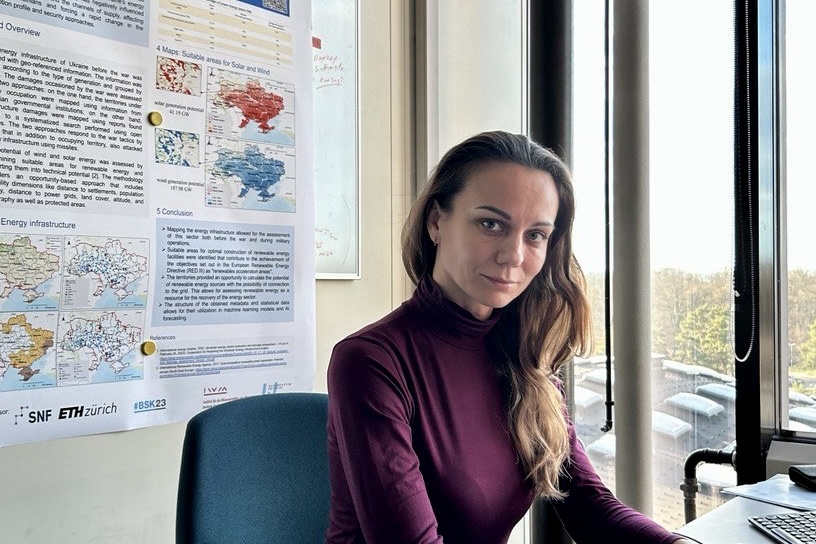


Dr. Iryna Doronina, working at the Chair of Energy Systems (Department of Energy and Process Engineering), has explored how the destroyed Ukrainian energy infrastructure can be rebuilt using renewable energy. Her research focused on innovative technologies — hydrogen systems, energy efficiency solutions and Power-to-X — that can be adapted and scaled up for Ukraine’s territorial and infrastructural transformation.
“Based on information from statistical sources, market reports and responses to formal requests, I collected and compiled a database of 1,700 energy infrastructure facilities. This includes thermal and nuclear power plants, hydropower stations, substations, and renewable energy facilities – both currently in operation and those that have been damaged or destroyed. Distribution and transmission networks are also included, as well as regional power systems. All facilities were manually mapped, verified, and standardized to ensure a transparent and consistent spatial database for analysis in a Geographic Information System (GIS)”, says Iryna Doronina.
The next step involved conducting a spatial analysis of Ukraine’s renewable energy potential. Using 25 diverse indicators – including land use restrictions, environmental impact assessments, social acceptance, and economic viability – the researcher developed Ukraine’s first high-resolution maps, identifying suitable areas and potential for wind and solar energy generation (fig. 1 and 2). The estimates showed that Ukraine has a total geographical technical potential of more than 229 GW, including 41.19 GW of solar and 187.98 GW of wind energy. Even if only a fraction of this potential is implemented, theoretically it could cover the electricity consumption needs that Ukraine had before the war.
It also opens strategic opportunities for private sectors to contribute meaningfully to Ukraine’s recovery — while laying the foundation for potential renewable hydrogen exports. The integration of these approaches for understanding the potential of territories of Ukraine with the possibility for implementation of German technological expertise enables a nuanced and practical framework for rebuilding Ukraine’s energy sector.
The data set and GIS based methodology have already been recognized by international agencies such as the International Energy Agency (IEA) and are being used in the development of recovery strategies, showing that research tackles real-world decision-making.
Dr. Iryna Doronina is a Visiting Professor at the Technical University of Munich (TUM) and a member of the REDEFINE Lab. In Ukraine, she worked as an Associate Professor before joining ETH Zurich in 2022 as a Senior Researcher and Research Lead. There, she conducted extensive research on the impact of the war and assessed the potential of renewable energy and its role in Ukraine’s future reconstruction. The main part of this research was carried out during her time at ETH Zurich. In January 2024, she was invited to TUM, where she now explores the practical application of Ukraine’s renewable energy potential in the context of German technologies.
Read the full article here:
Doronina Iryna, Galleguillos-Torres Marcelo, Doronin Vasyl, Grêt-Regamey Adrienne, “GIS-based Analysis for Identifying Priority Regions and Developing Renewable Energy in Post-war Ukraine”, Renewable Energy, Volume 247, 2025.