
Civil Engineering M. Sc.
The field of civil engineering is extremely diverse, ranging from planning structures and developing innovative construction materials to executing complex building projects. This broad scope is reflected in the degree program: it offers a total of 22 areas of specialisation, covering various sectors of civil engineering, including structural engineering, sustainable construction, transportation systems, geotechnics, and many more.
Students shape their individual academic profile by selecting four areas of specialisation from the full range of options, aligning with their personal interests and career goals. For even greater flexibility, the fourth specialisation can be replaced by a customisable interdisciplinary module list – ideal for those who wish to think and work across disciplines.
| Type of Study | Full Time | Main Locations | Main Campus Munich |
| Standard Duration of Studies | 4 Semester | Application Period | Winter semester: 01.04. – 31.05. and Summer semester: 01.11. – 15.01. |
| Credits | 120 ECTS | Required Language Proficiency | German, English |
| Start of Degree Program | Winter Semester and Summer Semester | Tuition Fees | Semester fee, Fees for Students from Non-EU Countries |
Civil engineers deal with the design, planning, construction and the operation of building structures and infrastructure (roads, water and sewage systems) from an engineering science perspective. Conceptualizing, planning, calculating, designing, and organizing are important job characteristics for a civil engineer. Typical work fields are:
- Concrete, steel, timber, and glass constructions (e.g. buildings, dams, bridges and tunnels)
- Infrastructure (e.g. water and sewage systems, roads)
- Environmental protection and renewable energies (e.g. energetic refurbishment, geothermal technology and hydropower)
- Protection from environmental dangers (e.g. protection from floods, earthquakes and fire)
- Managing complex processes (e.g. approval procedures, construction site management, building in existing context, construction during ongoing traffic flow)
- Optimization concerning safety, comfort, energy consumption, sustainability, cost
As a graduate you possess enhanced skills and competencies in the cross-disciplinary areas of civil engineering. You are able to deal independently with complex tasks relating to your specialization. In your activities you take into consideration social, economic and ecological aspects, as well as discipline-related ones.
Moreover, you have broadened your knowledge in your chosen subject areas and developed an individual set of competencies. Your interdisciplinary approach allows you to apply your specialist knowledge beyond the boundaries of your discipline.
A large proportion of graduates from this program work in construction companies and in planning and engineering firms that are active in the areas of their chosen specializations. In addition, public administration, which is responsible for tasks in the areas of construction, housing, water, and infrastructure, also employs civil engineers who work closely with engineering firms.
The scientific nature of the program enables many graduates to pursue careers in research and development, both in industry and at universities. Civil engineers also find employment opportunities in industrial companies in related sectors and in consulting firms with relevant products and projects.
The programme lasts four semesters. Three semesters consist entirely of coursework (lectures, exercises, seminars, labs,..). The final semester is reserved for the completion of the master’s thesis.
Students must complete a certain number of credits in several thematic categories.
Specialisations
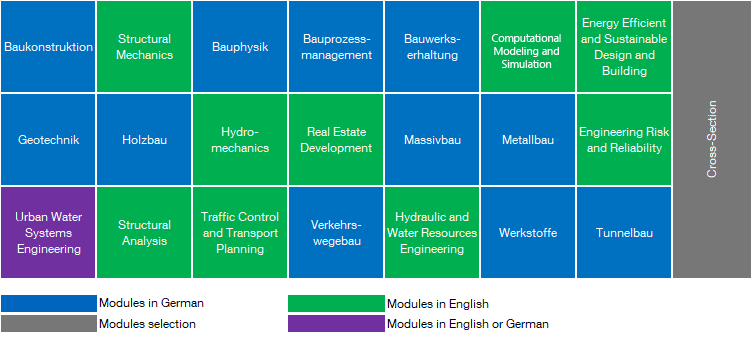
The specialisations are the core competence in one thematic field of the programme and determine the graduate’s professional profile. Students choose four among the 22 possible specialisations. (s. figure above)
Some specialisations are taught entirely in English, while others are taught in German. Students choose accordingly based on their proficiency in the language.
Electives from the entire Civil Engineering programme
Students must choose a number of electives from the entire module catalogue of the study programme, independently of their specialisation, to broaden their competence in civil engineering.
Supplementary courses
A small number of credits can be chosen from outside the civil engineering curriculum to strengthen the contextual competencies of the students. Language courses and soft skills can also be chosen in this category.
International Mobility
Students have the opportunity to participate in one of the many international exchange programs offered by TUM. The third semester is most suited for an international mobility, as it consists only of elective modules.
An application is possible for prospective holders of a bachelor's degree with a minimum duration of three years in civil engineering or a related field of engineering. At the time of the application, you can still be studying the final semester of your bachelor’s programme. The bachelor’s degree must be available for enrolment in your first semester of the MSc programme at TUM.
- Apply through the TUMonline application portal and upload your documents for admission there.
- Instructions for applying for a master's program: Detailed information on the application process (step-by-step instructions)
- More information on the application process: Application Info Portal
- The legal basis for the application is the Academic and Examination Regulations
Application periods:
The master’s Programme in Civil Engineering offers admissions every semester. Application deadlines for the respective semester:
- 31 May for the next winter term
- 15 January for the next summer term
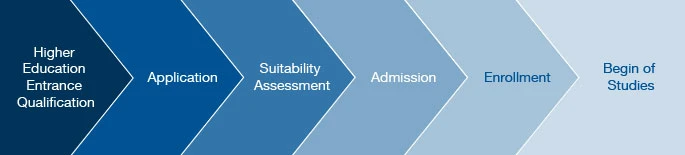
The general process includes the following steps:
1. Formal application
- Online application and upload of all documents necessary for admission
- Formal check of the documents by the enrolment office
- Formally correct applications get forwarded to the admissions committee for civil engineering
2. Evaluation
- First-stage evaluation: the intermediate result can be a direct admission, a direct rejection or the invitation to an interview
- Second-stage evaluation: a personal interview with two members of the committee. This normally takes place online, the date is arranged individually with the candidate
- The second-stage results decide upon either acceptance or rejection of the applicant
3. Admission and enrolment
- After an acceptance, the applicant must accept the offered study place in the TUMonline application portal
- Online application for enrolment, upload additional documents for enrolment
- Handing in certified copies of the official application documents to the enrolment office of TUM
Bachelor’s degree
Your bachelor's degree must have a minimum duration of three years and provide you with the prerequisites necessary to succeed in advanced civil engineering classes. These are mostly studies in Environmental Engineering, Civil Engineering or equivalent engineering disciplines. The fitness of the bachelor’s degree is evaluated based on the following course groups and weighted according to the credits of these groups in TUM’s civil engineering bachelor’s program:
- Higher mathematics
- Engineering mechanics, Fluid mechanics
- Computation in civil and environmental engineering
- Construction management, construction law
- Building physics
- Structural Analysis, building construction, design of structures
The more of these prerequisites you cover in your bachelor’s programme, the higher the chance of getting admitted.
Proof of language proficiency
The master’s programme is taught in German or English, depending on the specialisation. Applicants must prove their language proficiency by either:
- One of the recognised certificates in English OR German listed on the website of the enrolment office
- Official proof that the medium of instruction in your bachelor's degree was English OR German
- The TUM-internal qualification “English C1 Gateway to Masters” (available only to undergraduate students of TUM)
Please note that proof of language proficiency is a required document for admission and must be submitted before the application deadline expires. Please plan accordingly.
- Degree Certificate and Diploma or Subject and Grade Transcript of Studies to Date (if already available at the time of application)
- Transcript of Records of your courses and grades so far (if the final degree is not available at the time of application)
- Statement of purpose - maximum two pages explaining the reasons for picking this programme and highlighting your specific aptitude for civil engineering at TUM
- Complete and Current Résumé
- Passport
- Proof of German or English Language Proficiency (see also Requirements for admission)
- Preliminary Documentation (VPD) if the qualification for graduate studies (e.g. a Bachelor’s) was obtained outside Germany)
The enrolment office may require additional documents depending on your educational background and your country of origin. Complete the online application to receive a comprehensive list of the required documents.
Please consider the specific requirements for documents for application and enrollment at TUM.
Before the evaluation
The enrolment office of TUM checks if all formal criteria of the application are fulfilled. If relevant documents are missing or do not meet the requirements, they are marked as “not OK” in the TUMonline applicant account.
For questions regarding the formal criteria (including the VPD) and/or the processing of your application documents, please contact the enrolment office directly under study@tum.de
Selection process
Selection takes place through an aptitude assessment. This is a two-step procedure after the enrolment office has formally approved the application. In this procedure, the admissions committee determines whether you meet the specific requirements for this Master’s program.
The first step is to evaluate the documents. Applicants receive points for the following parts of their application:
- Content of the undergraduate studies (max. 60 points)
- Average grade of the undergraduate studies (max. 20 points)
- CV and quality of the statement of purpose (max. 20 points)
Applicants with 80 points or higher receive an admission. Applicants with 69 points or lower receive a rejection. Applicants with scores between 70 and 79 points proceed with the second step of the evaluation.
In the second step, applicants are invited to a personal interview with two committee members. The interview is a discussion about the applicant’s academic background, motivation for the study program, and a check of the applicant’s ability to answer relevant technical questions on an undergraduate level.
The interview time spans between January and March for the summer semester and April to August for the winter semester. The concrete appointments are coordinated via email between the committee and the individual applicant.
Legal basis of the aptitude assessment is Appendix 2 of the study regulations (available under documents)
After the acceptance
After receiving an acceptance, applicants must log in to their TUMonline account and accept the study place. As a next step, they apply for enrolment and submit all official documents, certified as true copies, to the enrolment office of TUM.
The beginning dates of semesters and lectures are published here.
- Application for Enrollment (signed)
- Degree Certificate and Diploma (authentic document)
- Transcript of Records (authentic document)
- Most Current Photo (as for ID)
- Digital notification of your health insurance status from a German public health insurance provider (requested by applicant)
We may require additional documents depending on the type of educational background you earned and your country of origin. After accepting an offer of admission in TUMonline, you will receive a list of documents you must submit to TUM in hardcopy for enrollment.
Please consider the specific requirements for documents for application and enrollment at TUM.
Student accommodation in Munich
Finding a place to stay in Munich can be difficult, but it is not impossible. The TUM-Accommodation Support has compiled all useful information on its website and provides personalised housing advice.
General Orientation at TUM
If the master’s programme is your first contact with TUM, you will find useful information on the campus, the administration and various events for beginning students here.
Orientation weeks for international students
TUM offers a variety of events and orientation programmes for international students in all programmes. You can find the information on their website
Orientation for Civil Engineering students
Before the first day of lectures, a detailed introduction event is organised by the School of Engineering and Design. It includes an explanation of the study regulations, a presentation of the fields of study, and practical advice for your first steps in the programme. All students accepted in the first semester receive an invitation via email.
The student council of the Civil and Environmental Engineering department also organises welcome events for the beginning students of our master’s programs. You can find the current schedule on their website. https://www.fs.bgu.tum.de/en/masters-introduction/
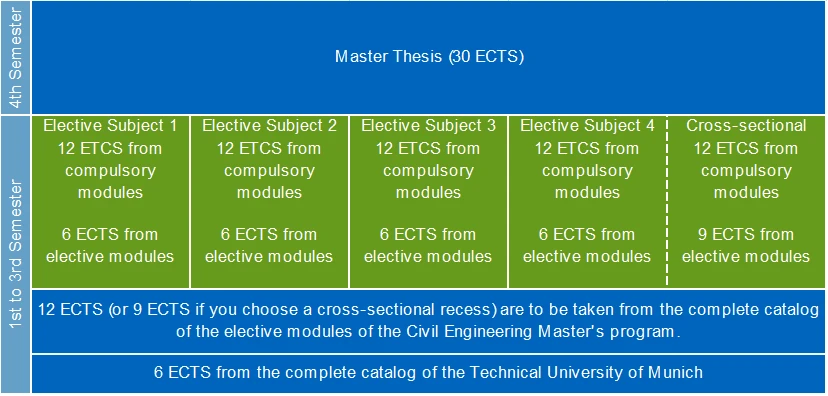
The programme lasts four semesters. Two semesters consist entirely of coursework (lectures, exercises, seminars, labs,..). The third semester is split between coursework and the practical study project. The final semester is reserved for the completion of the master’s thesis.
Students must complete a certain number of credits in several thematic categories.
Specialisations
The specialisations are the core competence in one thematic field of the programme and determine the graduate’s professional profile. Students choose four among the 22 possible specialisations. (s. figure above)
Some specialisations are taught entirely in English, while others are taught in German. Students choose accordingly based on their proficiency in the language.
Electives from the entire Civil Engineering programme
Students must choose a number of electives from the entire module catalogue of the study programme, independently of their specialisation, to broaden their competence in civil engineering.
Supplementary courses
A small number of credits can be chosen from outside the civil engineering curriculum to strengthen the contextual competencies of the students. Language courses and soft skills can also be chosen in this category.
There are 22 specialisations, and students select four of them upon their acceptance into the programme.
In each of the Fields of Study, the students must complete:
- 12 credits from required modules
- 6 credits from elective modules specific to this specialisation
The fields of study are:
| Specialisation | Language of instruction | Specialisation | Language of instruction |
| Baukonstruktion | German | Holzbau | German |
| Geotechnik | German | Bauphysik | German |
| Bauprozessmanagement | German | Verkehrswegebau | German |
| Bauwerkserhaltung | German | Massivbau | German |
| Metallbau | German | Werkstoffe | German |
| Tunnelbau | German | Structural Mechanics | English |
| Structural Analysis | English | Hydromechanics | English |
| Traffic Control and Transport Planning | English | Real Estate Development | English |
| Hydraulic and Water Resources Engineering | English | Computational Modelling and Simulation | English |
| Energy Efficient and Sustainable Design and Building | English | Engineering Risk and Reliability | English |
| Urban Water Systems Engineering | German and English | Cross-Sectional specialisation | Up to the student’s choice |
The cross-sectional specialisation can, for example, be in architecture, mechanical engineering or even IT. It can also be used to complement the other three fields of specialisation with further useful civil engineering modules. The required modules of the cross-sectional specialisation account for 12 and the electives for 9 credits
Mentoring
To provide students with the best possible support during their studies, one of the fields of specialisation is chosen as their major subject. The supervisor for this field takes on a mentor role, supporting and advising students on choosing the right fields of specialisation. However, this mentor not only ensures that the course content aligns with the occupational profile but also, for example, that the selected courses and modules are suitable for a stay abroad and that they align with the students' professional visions. This is particularly important when choosing a cross-sectional specialisation, as in this case, both required and elective modules must be approved by the mentor.
Schedules
Summer semester 2026
Schedules of specialisations
BKO | BMA | BPH | BPM | BWE | CMS | EPB | GEO | HOB | HYD | IMO | MBA | MET | RAZ | STA | SWW | TUB | VTP | VWB | WBW | WKS
Required Modules of all specialisations
Changes to individual courses are always possible! Please check TUMonline to find out when and in what form your course will take place.
Winter semester 2025/26
Schedules of specialisations
BKO | BMA | BPH | BPM | BWE | CMS | EPB | GEO | HOB | HYD | IMO | MBA | MET | RAZ | STA | SWW | TUB | VTP | VWB | WBW | WKS
Required Modules of all specialisations
Examination plan
The dates of the required exams are usually scheduled one semester in advance and are visible in TUMonline at the beginning of the lecture period. The following PDF only provides an overview. Only the dates listed in TUMonline are binding.
Examination plan overview Status: Winter Semester 2025
Please check the current exam date and location in TUMonline. You must register for all exams via TUMonline.
Guidelines and Forms
- Form "Choice of the Cross-sectional Specialization Subject of the master's program"
- Form "Changing the combination of the Specialisation Subject"
- Application for Recognition of Examinations
General information
- Introduction to the Master's in Civil Engineering
- Introduction Student Council
- Introduction to the buddy programme
General study regulations of TUM (APSO)
This is the overarching set of regulations, valid for all degree programs at TUM
Updates are continuously published on the TUM website.
Beginning of studies from summer term 2023
- Specific study regulations of the master's programme (FPSO) [German | English]
- Study programme documentation [German]
- Module Handbook [German | English]
Beginning of studies from winter term 2019-20
- Specific study regulations of the master's programme (FPSO) [German | English]
- Study programme documentation [German]
- Module Handbook [German | English]
Beginning of studies from winter term 2018-19
- Specific study regulations of the master's programme (FPSO) [German | English]
- Study programme documentation [German]
- Module Handbook [German | English]
Beginning of studies from winter term 2016-17
- Specific study regulations of the master's programme (FPSO) [German | English]
- Study programme documentation [German]
- Module Handbook [German | English]
Beginning of studies from winter term 2013-14
- Specific study regulations of the master's programme (FPSO) [German | English]
- Study programme documentation [German]
- Module Handbook [German | English]
Beginning of studies from winter term 2011-12
- Specific study regulations of the master's programme (FPSO) [German | English]
- Study programme documentation [German]
- Module Handbook [German | English]
Beginning of studies from winter term 2010-11
- Specific study regulations of the master's programme (FPSO) [German | English]
- Study programme documentation [German]
- Module Handbook [German | English]
Beginning of studies from winter term 2008-09
- Specific study regulations of the master's programme (FPO) [German | English]
- Study programme documentation [German]
- Module Handbook [German | English]
Exam dates
Most of the exams are planned a semester in advance. Please look up TUMonline under “My Studies” for information on the exam dates.
You may also refer to this overview; however, changes can occur at any time, and the most reliable information is visible only in TUMonline.
Exam registration
Each semester, there is a fixed period for exam registration. Typically, the winter term begins around November or December/December for the summer term starts around May or June. The examination officers will send emails to all students reminding them of the deadlines.
You must be registered to participate in the exam, submit a seminar paper, or an exam report.
You can deregister from an exam up to seven days before the examination date.
Illness during the exams
Students who are unable to attend examinations due to health reasons must provide a medical certificate of their condition to the examination officer of their programme.
Compensation of disadvantages
Acute or chronic illness, disabilities and other impairments might hinder you from performing in the exams. The examination board can approve special conditions in the exam as compensation for disadvantages, mostly in the form of extending the exam durations.
Please consult with the study advisor, the examination officer or the advisor for students with special needs.
Repeating exams
Failed attempts on exams and papers do not appear on your transcript.
If you fail a required module, you must repeat the exam; otherwise, you will not be able to graduate.
If you fail an elective, you do not need to retake it. You can replace the credits with a different elective from the same category.
An exam passed successfully cannot be repeated, even if it was passed for a different study programme at TUM.
Study progress control
A normal study progress is 30 ECTS credits per semester, which leads to a completion of the programme in four semesters.
Students can study more slowly, if they do not fall below following thresholds of study progress control:
After the 2nd semester: at least one required module must be successfully passed
After the end of the 3rd semester: 30 credits
After the end of the 4th semester: 60 credits
After the end of the 5th semester: 90 credits
After the end of the 6th semester: 120 credits
A 7th semester is possible for final attempts on remaining credits
Students who fall short of these thresholds get cut from the programme.
Recognition from previous studies
Recognition of courses from previous studies is possible during the first two study semesters in the MSc programme.
The courses must be at a master's level in your previous studies. Courses from bachelor’s programmes (regardless of the duration of these programmes) cannot be accepted. For “classical” 5-year engineering degree programmes, the course must be verified from your home university to be at the level of 2nd cycle -equivalent to a master's.
The courses to be recognised must provide a grade; simple “pass/fail” results cannot be taken in the local curriculum.
To organise the process, please consult with the study programme coordinator in your first semester of studies.
Recognition of required modules
The course from previous studies must be equivalent to the required module at TUM, with the same competencies and credits. This is decided upon y the lecturer of the required module at TUM,
Recognition of electives in the specialisation
Here, an exact equivalent course at TUM is not necessary. The courses must fit the category of the curriculum and not be thematically overlapping with other modules of the same catalogue. The study programme coordinator can give the approval for this recognition – in consultation with the chair organising the specialisation.
Recognition of supplementary courses
The courses you wish to recognise must be at a master’s level and fulfil the general requirements for the supplementary modules. The study programme coordinator can give the approval for this recognition.
Recognition from a semester abroad
If you make an exchange semester, you can transfer up to 30 ECTS credits per semester from the partner university.
For Erasmus+ students, clarifying the recognitions before mobility is mandatory. The information on how to do this will be provided to you during the application process for the exchange.
For all other exchange programmes, an a priori clarification is not mandatory but recommended. You are welcome to consult with your study programme coordinator before finalising the learning agreement.
The master's thesis is the final project of the master's programme. It results in the submission of a written report and a presentation.
Regulations
The earliest point for beginning the thesis, the deadlines for registration and submission are defined in the study regulations:
Students are eligible to start the thesis after reaching 75 credits. The duration of the thesis is six months after the registration date.
How to find a thesis topic
The thesis must be supervised in one of the chosen specialisations by a chair of the Civil Engineering programme (or a professor with secondary membership in the faculty). A master’s thesis in personalised specialisation must be applied for with a previous application to the examination board and approved by the examination board. The topic has to be identified within the research field of the chair. The students chose the thematic field of their thesis according to their personal interest or inclination and get in touch with the possible supervisor. Many chairs publish available thesis topics on their websites (see the list below); however, they are also open to topics proposed by students. A master’s thesis can be conducted in cooperation with an external company, administration or research institute. However, the official supervision lies with a chair that is eligible to supervise theses of the programme.
List of chairs with published master's thesis topics:
Registration of the thesis
Registration is conducted by the supervising chair. Students must provide their supervisor with a transcript of records to demonstrate that they have met the credit threshold for registration. The time between submission of the written report and presentation does not count to the duration of the thesis.
General information regarding the thesis can be found here.
There are many ways to spend a shorter or longer period abroad during the master’s studies, for studying or an internship.
In addition to the well-known Erasmus+ program, TUM students have access to several other exchange opportunities. You can find detailed information in the TUM Wiki of your degree program under „Going on exchange - Wege ins Ausland“: Internationales / Exchanges – M.Sc. UI
A recognition of modules from a stay abroad can be achieved in two ways:
- Recognition as equivalent
- Free elective credits
The recognition as equivalent means that a module from the TUM study programme is replaced by an identical module from the partner university. The decision on this equivalence is taken by the professor responsible for the course at TUM based on the module descriptions. The forms for the recognition are provided by the examination officer.
Recognition in the free elective credits does not require a full equivalence of the modules. If they fit in the thematic scope of the specialisation and they are not overlapping with already passed modules at TUM, they can be transferred directly. The chair organising the specialisation approves the recognition as “Partner university elective module”
You can find further information on the credit recognition process in the TUM Wiki of your degree program under „Going on exchange - Wege ins Ausland“: Internationales / Exchanges – M.Sc. BI
Students staying abroad with a leave of absence can bring in up to 20 credits per semester from the partner university without cancelling the leave of absence.
Are you a student from a foreign university interested in a stay at TUM? Please check the TUM Wiki under „Coming to TUM on exchange“: Internationales / Exchanges – M.Sc. BI
Civil Engineering at TUM

The Civil Engineering degree programme at TUM combines civil, environmental and geoengineering sciences. The degree programme is characterised by its versatility and complexity and offers a wide range of career opportunities. Video: Holger Fleig / TUM
EDUwood: climate protection potential of timber construction

The EDUwood research project from the TUM School of Engineering and Design investigated how the new campus of the Technical University of Nuremberg can be realized practically and sustainably in timber construction and what climate protection potential is associated with this. Video: ProLehre / TUM