
Computational Mechanics M. Sc.
The master's program in Computational Mechanics at the TUM School of Engineering and Design is structured along the disciplines of structural and fluid mechanics, mathematics and computer science. Based on mechanical fundamentals, it aims to incorporate mathematical principles, computational methods and software development.
Nowadays and even more in the future, the development of sustainable and efficient engineering systems and products relies on computational mechanics simulations. The degree program thus focuses on solving real-world engineering problems of interest to society using numerical modeling and simulation methods. The small cohort size and the diverse international background of the students make this program ideal for interdisciplinary exchange of ideas and building a strong network for your future career.
| Type of Study | Full Time | Main Location | Campus Munich |
| Standard Duration | 4 Semester | Application Period | 01.01. – 31.05. |
| Credits | 120 ECTS | Required Language | English |
| Start | Winter semester | Tuition Fees | Semester fee, Fees for Students from Non-EU Countries |
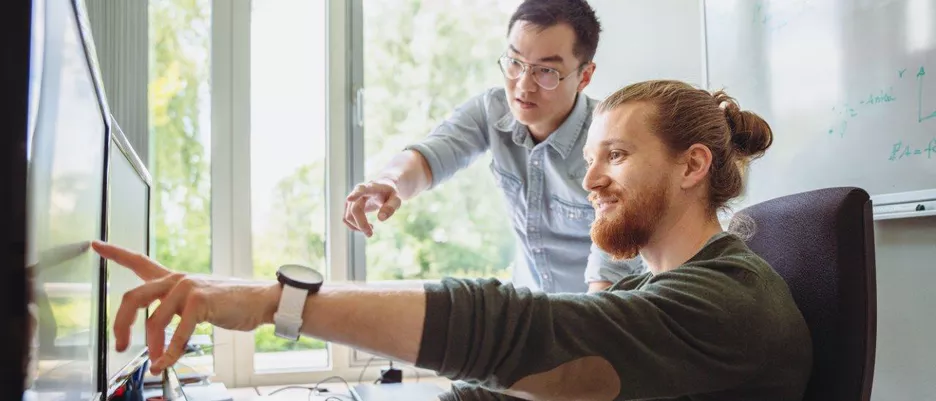
Our program enables you to take advantage of the rapid increase in computing resources to enhance complex mechanical systems with sophisticated numerical analysis. This will also enable you to develop resource-efficient and sustainable products that support the technological changes of the 21st century.
We believe that a solid engineering education is based on a deep understanding of the fundamental principles of solid mechanics, fluid mechanics and mathematics. Therefore, the program provides you with key skills in continuum and fluid mechanics, finite element analysis, and computational materials modeling. The course content includes computational fluid or structural dynamics in engineering, artificial intelligence and machine learning. Create your own curriculum from a variety of electives.
As a methods-oriented discipline, you will be well-prepared for a career in engineering, such as civil, mechanical, automotive, or aerospace engineering. Our research-oriented master's program trains highly qualified professionals for industry and academia to advance engineering simulation. We consider it a valuable sign of our education quality that about one third of our graduates go on to pursue doctoral studies. Join us at TUM and let us shape the future of computational mechanics together!
More information:
Study Program Documentation for the Master's program Computational Mechanics (PDF)
As a graduate of the Master of Science Program in Computational Mechanics you have developed a portfolio of skills and competences in the field of numerical simulation, modeling of engineering problems for a consequent numerical simulation as well as a profound understanding of mechanical problems.
You are able to analyze problems in the field of engineering and transfer them into appropriate numerical models. Via this process you are capable of evaluating the assumptions of the respective models and their limitations, the artifacts which can be created during the modeling and evaluation process as well as the possible expansions of models. You develop and derive new ideas during your work for optimizing engineering processes and are able to assess a range of software tools.
Furthermore, your skills allow you to classify different types of modeling as well as artifacts in simulations. Also, you are capable of applying and evaluating different programming principles, the underlying partial differential equations for various problems and the assumptions for material descriptions and low and high frequency analyses.
As a graduate with a Master of Science in Computational Mechanics you are able to work in many different areas as you gain a deep understanding in mechanics, programming, modeling, and simulation. You can start a career e.g. as software engineer or as design, calculation or simulation engineer, respectively.
Since our students come from various technical backgrounds, the first semester consists of mandatory subjects devoted to studying fundamental topics in the different disciplines: Structural Mechanics and Analysis, Fluid Mechanics, Computational Mechanics, and Computation in Engineering. Furthermore, you will receive a tailored introduction to C++ in an onboarding week.
In the second and third semesters, students choose elective subjects to specialize in their fields of interest. The elective courses allow students to gain a wide range of knowledge in different disciplines, such as civil engineering, mechanical engineering, or informatics. Additionally, you will participate in the mandatory group project, Software Lab, which is an interdisciplinary team project (3–4 students) that combines the analysis and solution of engineering problems with the development of software solutions.
The fourth semester is dedicated to the completion of the Master’s thesis. It can be written either at the chairs involved in Computational Mechanics, or in cooperation with industry, or other academic partners.
Contents
The Master’s program Computational Mechanics addresses the treatment of mechanical problems through numerical methods and their implementation in computer codes. To this end, we have a strong focus on teaching the fundamental principles and methodologies in Mechanics.
Our mandatory courses are:
- Continuum Mechanics
- Advanced Fluid Mechanics
- Finite Element Methods 1
- Computational Material Modeling 1
- Computation in Engineering 1
- Software Lab in Computational Mechanics
Our elective courses comprise two core elective catalogues and include:
Modeling & Mechanics
- Structural Dynamics
- Computational Material Modeling 2
- Computational Fluid Dynamics
- Theory of Plates
- Theory of Shells
- Advanced Finite Element Method
Data, Uncertainty & Computing
- Introduction to Functional Analysis
- Stochastic Finite Element Methods
- Artificial Intelligence in Computational Mechanics
- Optimization
- Advanced Parallel Computing and Solvers in Engineering
Further offers can be found in the catalogue of technical elective subjects. In consideration of the interdisciplinary spirit of the study program, it is possible to choose individual elective subjects outside of the provided catalogue, thereby tailoring an individual study profile. This optional choice might include, e.g., courses from the ATHENS program or other schools and departments at TUM.
The curriculum is rounded off by general education modules that include soft skills or language courses.


- You obtain your entrance qualification for master's degree program.
- by 31 May: You apply for the degree program. We recommend to apply by 15 March for international students for early feedback and visa application.
- June to August: You take part in the aptitude assessment. Possibly, you are invited to an interview.
- June to August: You are admitted.
- You then accept the study place and enroll yourself.
- Beginning of October: You start your studies.
Application via TUMonline: Apply via the TUMonline application portal and upload your documents for admission there.
Support: Instructions for applying for a master's program (step-by-step instructions) and Application Info Portal
Legal Notice: The basis is the program-specific Academic and Examination Regulations (FPSO)
Minimum requirements to apply for a Master's program at TUM are a recognized undergraduate degree (e.g. a bachelor’s) and the successful completion of the aptitude assessment procedure. Aptitude assessment allows the TUM school or department to which you are applying the opportunity to evaluate your individual talents and motivation for study.
Generally, applicants with a qualification for postgraduate studies (e.g. a Bachelor’s) obtained outside of Germany must have their documents reviewed in advance through uni-assist (Preliminary Documentation).
Please also note the additional conditions for applicants with a degree from an Indian or Chinese/Vietnamese/Mongolian university (see Documents required for Online Application).
Eligibility for the Master’s Program in Computational Mechanics is demonstrated by:
- One of the following degrees:
- an above-average Bachelor’s Degree in Civil Engineering, Mechanical Engineering, or comparable programs (see below) obtained from a German university; or
- an internationally acknowledged above-average Bachelor’s Degree in the programs specified in lit. a) obtained from a foreign university; or
- an above-average Diplom, Bachelor’s or Master’s Degree in the programs specified in lit. a) obtained from a German Fachhochschule [University of Applied Sciences]; or
- a Diplom, Magister, or Master’s Degree in the programs specified in lit. a) obtained from a German university; or
- a degree obtained from a foreign institution of higher education which is equivalent to those specified in lit. c) and d) The degree must initially only be available at the time of enrollment. A preliminary transcript is sufficient for the application.
- An adequate knowledge of the English language. See below for further information on the possibilities to prove your English proficiency.
- A proof of very basic German knowledge (if your language of instruction was not German in your previous education). This proof can be a certificate of any German course (any level) of the Goethe Institute or another language school (including your home university). If you cannot prove basic German knowledge during your application, you have to complete a basic German course during your first two semesters at our University.
- Passing the aptitude test, see Admission Process.
Compatible Bachelor Programs
In addition to degrees in Civil and Mechanical Engineering, degrees from the following list are considered comparable programs.
- Aerospace Engineering
- Applied or Structural Mechanics
- Structural Engineering
- Engineering Mechanics
- Mechanical Engineering and Automation
- Mechatronics Engineering
- Naval Architecture
- Marine Engineering
- Automotive Engineering
- Mechanical Engineering and Production
Please note that applications with a degree from the following fields are generally only acceptable if you provide a substantial background in structural and fluid mechanics.
- Mathematics & Applied Mathematics
- Informatics
- Information Technology
- Electrical Engineering
The following documents must (or can, if optional) be uploaded during the online application.
- Degree Certificate and Diploma or Subject and Grade Transcript of Studies to Date
- Transcript of Records
- Proof of English Language Proficiency
- Complete and Current Résumé
- Ranking Certificate (optional, when available)
- Passport
- Letter of Recommendation from a Professor (no job reference). Please provide this cover letter to your professor or referee. If your referee does not want to hand out the recommendation letter to you, they can also send it to come@tum.de. The referee will then get a confirmation email that we received your recommendation letter. Please upload this confirmation email instead of the actual recommendation letter in the application portal.
- Statement of purpose (Letter of Motivation) The statement of purpose should be limited to 500 words and must be written in English.
- Essay The essay should be limited to 500 words and must be written in English. The topic for the essay is published each year on this website around the beginning of December.
Topic for 2026:
Explain how specific courses or projects from your Bachelor’s curriculum have shaped your understanding of computational mechanics, and identify one concept you found particularly challenging. Reflect on how your personal learning process in that area influences the way you expect to approach the Master’s in Computational Mechanics. Limit yourself to the key elements of your curriculum and create links to the Master’s curriculum rather than merely listing a number of courses from your Bachelor’s curriculum.
Required admission documents for some applicants:
- For students with a degree from outside Germany: Preliminary Documentation (VPD)
- For students with a degree from a Chinese/Mongolian/Vietnamese University: APS certificate
- For students with a degree from an Indian university except for Indian Institutes of Technology: GATE score card with a score of at least 550 points
- For non-German speaking students: proof of basic German language proficiency
If you cannot submit a certificate upon application or matriculation, you can do so until the end of the second semester, as stated on your acceptance letter. This deadline is strict and cannot be altered by us.
Selection takes place through an aptitude assessment procedure. Aptitude assessment is a two-part procedure after the submission of an official application to a program. In this procedure, the TUM school or department determines whether you meet the specific requirements for its master’s degree program.
In the initial stages, the documents you have provided will be evaluated using a point system. Depending on the amount of points accumulated, applicants are either immediately admitted, rejected or invited to an admissions interview.

In case of admission, you can accept your spot and will then have to submit the application together with documents for enrollment.
Documents required for enrollment:
- Application for Enrollment (signed)
- Degree Certificate and Diploma (authentic document)
- Transcript of Records (authentic document)
- Most Current Photo (as for ID)
- Digital notification of your health insurance status from a German public health insurance provider (requested by applicant)
We may require additional documents depending on the type of educational background you earned and your country of origin. After accepting an offer of admission in TUMonline, you will receive a list of documents you must submit to TUM in hardcopy for enrollment.
A variety of scholarships are offered at TUM. However, there is no specific Computational Mechanics scholarship that we offer. If you would like to find and apply for a scholarship, we advise you to have a look at the general TUM webpage on scholarships. Information about scholarships and waivers for the TUM tuition fees for international students can be found on this webpage.
If you need assistance in the process of applying for a scholarship, please do not hesitate to contact us.
Up-to-date information
The application period for winter term 2026/27 is now open. The topic for the essay can be found in the section Required Documents for the Online Application.
The following page contains some information that can be helpful for getting started at TUM. Please do not hesitate to contact us via e-mail in case you have questions or concerns.
General information about getting acquainted on Campus can be found here.
WelCOME week
The welCOME week always takes place one week prior to the official semester start. Please plan your trip and arrival in Munich accordingly.
As part of the welCOME week, we invite you to the following events.
- welcome reception with detailed information about your studies,
- social event: potluck dinner,
- campus tour,
- library tour,
- introduction to C++,
- joint city tour.
Further information, including a time schedule, will be provided prior to the semester via e-mail to all students who have accepted their study spot.
For the potluck dinner, we ask all students to bring a small portion of their favorite food to share with all others. The dish could potentially come from your home country.
Introductory Slides
- Introduction by Prof. Müller
- Introduction by the study coordinators & examination officer
- Introduction by the student council
Semester Dates and Deadlines
The semester dates can be found centrally on the TUM website.
How to Find Accommodation & Living in Munich
If you are looking for further information on living in Munich, visit the TUM information page on finding accommodation.
Public student accommodation is offered by the Studentenwerk (limited availability).
German Language Requirement & Courses
TUM requires proof of basic German knowledge upon matriculation. If you haven't submitted a certificate upon matriculation, you can do so until the end of the second semester, as stated in your acceptance letter. The deadline is strict and cannot be altered by us, so please make sure you have attended a course and passed a test by the end of your second semester.
The following list contains a number of places to look for German courses:
- TUM Sprachenzentrum
- Deutschkurse bei der Universität München e.V.
- Goethe Institut
- A more comprehensive overview offered by Studentenwerk
TUMonline & Moodle
- TUMonline is TUM's platform for organizing your studies, which you are already familiar with from your application. Please refer to the information page or this Wiki entry for additional details.
- Moodle is TUM's e-learning platform. Lecturers will usually provide their supporting material, such as lecture notes or task sheets, via Moodle.
Campus Maps & Roomfinder
Maps of TUM's buildings can be found on the maps and plans page. If you are looking for a specific room, you can use TUM's roomfinder.
The room numbers at TUM have four digits:
- the first digit represents the floor,
- the second digit represents the building,
- the third and fourth digits denote the room number.
Building numbers on the north site are prefixed with an “N”.
Fit for TUM
Fit for TUM is a service fair for newcomer students at TUM. It usually takes place in the same week as the welCOME week.
CSE Primer
Our sister program Computational Science and Engineering offers a separate introduction to various tools such as Matalb, Linux, Git, and C++. You can participate starting from the first regular week of the semester.
All information can be found on the corresponding Moodle page.
Below, we list the compulsory and elective subjects available in COME.
The following overview applies to students enrolled in the study program version 2025 (intake from 2026 onwards).
Students enrolled in the study program version 2021 (intake between 2021 and 2025) can find an archived version of the curriculum overview here.
You will need to pass
- 40 credits of compulsory modules,
- 45 credits of technical electives, therein
- at least 12 credits from the catalogue “Modeling & Mechanics”,
- at least 10 credits from the catalogue “Data, Uncertainty & Computing”
- 12 credits can be chosen as individual electives,
- 5 credits of general education modules, and
- 30 credits for the Master's thesis.
At least 120 credits must be earned to complete the degree program. However, it is not necessary to earn exactly 120 credits. The minimum number of modules required to earn at least 120 credits is then used to calculate the degree completion.
All of the following six modules must be passed successfully. Please note that you must have passed at least one of the required modules by the end of the second semester.
| Module Number | Module Title | Semester | Credits |
|---|---|---|---|
| BGU32028 | Finite Element Method | 1. | 6 |
| BGU44013T2 | Computation in Engineering 1 | 1. | 6 |
| BV330009 | Computational Material Modeling 1 | 1. | 6 |
| BV020001 | Continuum Mechanics | 1. | 6 |
| BGU41021 | Advanced Fluid Mechanics | 1. | 6 |
| BV030004 | Software Lab in Computational Mechanics | 2. & 3. | 10 |
The list of elective subjects is continuously updated. Below, we sort the elective subjects by chair.
Computational Modeling and Simulation/Computing in Civil and Building Engineering
| Module Number | Module Title | Semester | Credits |
|---|---|---|---|
| BGU44014T2 | Computation in Engineering 2 (self study, *) | Summer | 6 |
| BV030011 | Computational Linear Algebra (if not taken as comp.el.) | Winter | 3 |
| ED130085 | Industrial Applications of Structural Mechanics, Dynamics and Multiphysics I | Summer | 3 |
| ED130086 | Industrial Applications of Structural Mechanics, Dynamics and Multiphysics II | Winter | 3 |
| BV030012 | Engineering Databases | Winter | 3 |
| BV650003 | Professional Software Development | Summer | 3 |
| BGU65009 | Artificial Intelligence in Engineering | Summer | 3 |
(*) Please contact Vijaya Holla (vijaya.holla@tum.de) in case you are interested to this course on a self-study basis. He will enroll you into the corresponding Moodle-course.
Computational Solid Mechanics
| Module Number | Module Title | Semester | Credits |
|---|---|---|---|
| BGU33011 | Computational Mechanics for Car Body Design | Summer | 3 |
| BV330003 | Computational Plasticity (*) | Winter | 3 |
| BV330008 | Explicit FEM and Transient Analysis | Summer | 3 |
| BV330004 | Fracture and Damage (*) | Winter | 3 |
| BV330001 | Structural Optimization 2 (*) | Winter | 3 |
(*) If not taken as part of a core elective module.
Engineering Risk Analysis Group
| Module Number | Module Title | Semester | Credits |
|---|---|---|---|
| BGU60018 | Estimation of Rare Events and Failure Probabilities | Summer | 3 |
| BGU60020 | Risk Analysis | Winter | 6 |
| BGU60021 | Risk Assessment and Reliability of Engineering Systems | Summer | 6 |
| BV600019 | Stochastic Finite Element Methods | Winter | 6 |
| BGU60024 | Seminar on Elements of Machine Learning | Winter | 3 |
| ED130013 | Prognostics and Health Management | Summer | 3 |
| ED130116 | Computational Data Analysis with Python | Summer | 5 |
Hydromechanics
| Module Number | Module Title | Semester | Credits |
|---|---|---|---|
| BGU41019 | Modeling and Simulation of Turbulent Flows | Summer | 6 |
| BV040053 | Computational Fluid Dynamics (*) | Summer | 6 |
| BV410004 | Fluid Mechanics Lab | Winter | 3 |
(*) If not taken as a core elective module.
Structural Analysis and Dynamics
| Module Number | Module Title | Semester | Credits |
|---|---|---|---|
| BV010010 | Advanced Finite Element Methods (*) | Summer | 3 |
| BGU32029 | Nonlinear Finite Element Method (*) | Summer | 3 |
| BV320013 | Investigations in practical structural analysis (lecture series over two semesters in German) | Winter + Summer | 3 |
| BV320007 | Isogeometric Analysis and Design | Summer | 3 |
| BGU32022 | Finite Element Method for Fluid-Structure Interaction with Open-Source | Summer | 3 |
| BV010011 | Membrane Workshop | Summer | 3 |
| BV320006 | Modeling in Structural Analysis (in German) | Summer | 3 |
| BV010023 | Structural Optimization 1 (*) | Winter | 3 |
| BGU32025 | Structural Wind Engineering | Winter | 6 |
| BV320001 | Theory of Plates (*) | Winter | 3 |
| BV320002 | Theory of Shells (*) | Summer | 3 |
| ED120115 | Computational Design and Fabrication 1 | Winter | 6 |
| ED120116 | Computational Design and Fabrication 2 | Summer | 6 |
| ED120114 | Project Week Computational Design and Fabrication | W/S | 3 |
| ED130115 | Particle Based Methods in Engineering | Winter | 3 |
(*) If not taken as part of a core elective module.
Structural Mechanics
| Module Number | Module Title | Semester | Credits |
|---|---|---|---|
| BV430008 | Structural Dynamics (*) | Summer | 6 |
| BV020007 | Boundary Element Method | Summer | 3 |
| ED130099 | Structural Dynamics Lab | Winter | 3 |
| BV430002 | Integral Transform Methods | Summer | 3 |
| BGU43026 | Modelling and Simulation in Structural Dynamics | Winter | 3 |
| BGU43019 | Soil Vibrations - Emission, Propagation, Immission, Abatement | Winter | 3 |
| BV430005 | Stability of Structures | Winter | 3 |
(*) If not taken as part of a core elective module.
Others
| Module Number | Module Title | Semester | Credits |
|---|---|---|---|
| MA9304 | Introduction to Functional Analysis (BV/COME) | Winter | 5 |
| MW0376 | Biofluid Mechanics | Summer | 5 |
| MW1817 | Biomechanics - Fundamentals and Modeling | Summer | 5 |
| IN2026 | Scientific Visualization | Winter | 5 |
| IN2147 | Parallel Programming | Summer | 5 |
| ED140023 | Deep Learning for PDEs in Engineering Physics | Summer | 4 |
| ED140017 | Vibroacoustic Simulation - Statistical Energy Analysis and Hybrid Methods | Summer | 3 |
| MW2152 | Modeling, Control and Design of Wind Energy Systems | Winter | 5 |
| MW2323 | Computational Acoustics | Summer | 5 |
| MW0696 | Particle-Simulation Methods for Fluid Dynamics | Winter | 3 |
| MW0866 | Multibody Simulation | Summer | 3 |
| MA3305 | Numerical Programming 1 (CSE) | Winter | 8 |
| CIT123000 | Scientific Computing and Machine Learning | Winter | 5 |
| ED140002 | Physikbasierte Modellierung und Simulation additiver Fertigungsverfahren für Metalle | Winter | 5 |
| MW2453 | Discontinuous Galerkin-Methods for Numerical Simulation | Summer | 5 |
| SOT86701 | EuroTeQ Collider. Enhancing Connections for Sustainable Futures (MSc) | Winter | 6 |
Study Projects
During your studies, you can include a study project in your curriculum. Study projects are offered depending on availability and are often agreed upon between a supervisor and a student individually. If you're interested in doing a study project, you can reach out to a professor or research assistant in COME whose research and topics you're interested in and ask whether there are topics for study projects. In case you're in doubt, do not hesitate us via come@tum.de for further questions. The below modules only differ in the awarded credits and thus the agreed-upon workload. The details can be worked out with your supervisor.
| Module Number | Module Title | Credits | Corresponding Chair |
|---|---|---|---|
| ED130117 | Study Project in Computational Mechanics | 3 | All COME chairs |
| ED130118 | Study Project in Computational Mechanics | 4 | All COME chairs |
| ED130119 | Study Project in Computational Mechanics | 5 | All COME chairs |
| ED130120 | Study Project in Computational Mechanics | 6 | All COME chairs |
Within the technical elective subjects, we offer the two core elective catalogues, 'Modeling & Mechanics' and ‘Data, Uncertainty & Computing’. You must achieve at least 12 or 10 credits, respectively, from both catalogues.
Modeling & Mechanics
| Modulnummer | Modultitel | Semester | Credits |
|---|---|---|---|
| BGU41028 | Computational Fluid Dynamics | 2. | 6 |
| BV430008 | Structural Dynamics | 2. | 6 |
| BV320001 | Theory of Plates | 2. | 3 |
| BV320002 | Theory of Shells | 2. | 3 |
| BV330010 | Computational Material Modeling 2 (*) | 3. | 6 |
| BV010010 | Advanced Finite Element Method | 2. | 3 |
Data, Uncertainty & Computing
| Modulnummer | Modultitel | Semester | Credits |
|---|---|---|---|
| MA9304 | Introduction to Functional Analysis (BV/COME) | 3. | 5 |
| BGU65014 | Artificial Intelligence in Computational Mechanics (**) | 2. | 6 |
| BV320017 | Optimization (*) | 3. | 6 |
| BGU60019 | Stochastic Finite Element Methods | 3. | 6 |
| MW1746 | Advanced Parallel Computing and Solvers in Engineering | 2. | 5 |
(*) These modules consist of two lectures. If you want to include these modules in your electives, make sure to register for the corresponding exam. It's not possible to account for this module by passing the individual subjects.
If you're in doubt about these regulations, please do not hesitate to contact us at come@tum.de.
(**) Interested students are welcome to join the Python course for engineers and scientists (LV-Nr: 0000003544) offered by Dr. Jithender Timothy in the lecture-free period before the summer and winter term.
This will help you in the lectures and tutorials on AI in COME. No credits can be offered, however, a certificate will be issued for each participant completing the course.
Participation is highly recommended.
For further questions about the course, please contact Dr. Timothy (jithender.timothy@tum.de).
We can accredit up to 12 credits from individually chosen modules (like courses in the ATHENS Program, or modules offered by other departments ). You can find a list of individual elective courses that have been accepted in the past here. However, this list does not contain all courses that could be accepted as individual electives since there are too many courses that could be accredited as individual elecitve courses to list all of them. Generally, we can accredit most courses that either improve your knowledge in the theories behind methods of computational mechanics or deal with applications of computational mechanics. However, fundamental modules from bachelor studies or modules with contents very similar to modules from the COME curriculum are excepted from the accreditation.
Procedure
If you want to take an individual elective course, please ask the course coordinator whether it can be accredited as an individual elective. This is also necessary in case the course is listed in the above file. The reason for this procedure is that individual elective courses are not part of your curriculum but must be added to it manually. This is done by the examination administrator, who requires confirmation from the course coordinator before adding this course to your curriculum.
Examples
If you, for example, want to gain further knowledge in aerospace, you could take the courses "Aeroelasticity" (MW2228) and "Aircraft Performance" (MW0832). Both courses are worth 5 ECTS each. Therefore, you would have 10 ECTS of individual electives. Then, you will have to obtain 35 credits from the technical elective subjects within COME.
You need to pass 5 credits of general education elective modules, which can be chosen from numerous module offerings.
The general education elective modules are counted as academic credits. The grade is therefore not included in the calculation of the final grade.
The catalog can also be exceeded. This means that modules with more than 5 credits can also be included.
The list of general education modules is continuously updated. If you find a module that interests you, please don't hesitate to contact us.
Language courses
Language courses can be accounted for within the general education modules. You can find a list of offers on the website of the language center and in TUMonline.
The following rules apply:
- The minimum level of a German language course is B1 in order to be considered within the general education catalog.
- English courses are only valid if they are specific technical courses, such as English for Engineers or similar. They have to be above the standard English requirements that we require you to have in order to study at TUM. In case you're in doubt about the requirements, please contact the examination office
- Language courses in the students' native language are not permitted.
- For all other languages, there are no requirements.
If a specific course is not linked to our curriculum in TUMonline, please write an email to come@tum.de.
Center of Key Competences
A lot of general education courses and workshops are offered by the Center of Key Competencies. You will find all the information about their courses on the website and the corresponding Wiki.
Kontextlehre WTG
A lot of seminars and workshops can also be found at the TUM School of Social Sciences and Technology within the Science ⋈ Technology ⋈ Society (Kontextlehre WTG) program.
Most of the courses that are offered in English are linked to our curriculum in TUMonline. If a specific course is missing, please write an email to come@tum.de.
Virtuelle Hochschule Bayern
The Virtuelle Hochschule Bayern (VHB) is a joint institution connecting universities across Bavaria. It offers a variety of online courses that can be taken by students enrolled at a Bavarian university.
You can check the current course offers in the VHB course catalog. Recognition within the general electives profile is granted upon request. Please write an informal email stating the course title to come@tum.de and ask for recognition of the specific course.
Courses from VHB are not linked to the curriculum in TUMonline.
Despite the fact that the following page collects a lot of formal information, we would like to emphasize that writing your Master's thesis should, in the first place, be something you enjoy and are interested in. So, if you're still in the process of finding a suitable topic, take some time, have a look around at the COME chairs, and talk to the supervisors who are working in a field that suits your interests.
Find a Thesis Topic
In general, there are three ways to find your perfect Master's thesis topic:
- There is a fully worked-out project proposal. These are usually published on the chairs' websites.
- You are interested in a specific scientific topic and know a researcher at one of our chairs is working on that topic. You can contact them and discuss possible projects that could be carried out in the scope of your thesis. The research topics and corresponding researchers are usually listed on the chairs' websites.
- You have a thesis topic worked out on your own, or in collaboration with a company, and would like to know whether this topic could be done within the scope of your thesis. Take the initiative and contact a supervisor at one of the COME chairs that you think is suitable for this topic. If you're not sure about who this could be, you are welcome to discuss the matter with your study coordinators.
In all cases, you will need to actively look for a thesis topic. We won't assign topics automatically.
Please allow for some time for finding a thesis topic and the time it takes until registration. If you have a fixed timeline for your thesis in mind, please start sufficiently early with the process.
General Rules
It is possible to complete your thesis either at university or in industry, and it is worth 30 credits. The following rules should be noted.
- You can start your Master's thesis if the following holds:
- You have successfully completed at least 78 ECTS,
- You have completed all but one compulsory and one core elective subject,
- In case you're still waiting for exam results to be published, registration is possible from the beginning of any semester if it is expected that the above two rules will be fulfilled after the examination period.
- The period of time between thesis registration and submission of the completed Master's thesis must not exceed 6 months.
- The Master’s thesis has to be defended in the master’s colloquium.
- The thesis can be supervised by a number of chairs within the TUM School of Engineering and Design.
- Any of the COME chairs within the department of Civil and Environmental Engineering is suitable.
- If you're interested in writing your thesis at a chair in another department, please write to us at come@tum.de, and we will quickly check your request.
- If you want to write your thesis in collaboration with industry, you have to find an academic co-supervisor at a chair at TUM. Please get in touch with your COME coordinator for assistance. We will gladly help you in finding the right chair for your external thesis topic.
Registration
Once you have accumulated enough credits, identified a suitable thesis topic, and obtained approval from your supervisor, your thesis will be registered at the school office. This process will be conducted by your supervisor and is fully digital. You will receive an email with a confirmation request. You don't need to register the thesis yourself.
Further Information
- Courses and further information on scientific writing and working can be found at the Centre for Key Competences and the university library.
- You can find the official TUM citation guideline here.
- The English Writing Center offers free one-to-one consulting in English writing to all members of the TUM community, as well as Thesis Writers' workshops, out of which the following two might be interesting to you:
Submission
You must upload the thesis to the school portal (at the latest 6 months after registration). Please check further details with your thesis supervisor.
Your supervisor will take care of the grading of your thesis and will report the grade to the COME examination administration via the online portal of the school. The examination administration will enter your grade into your curriculum in TUMonline.
Please check in the meantime whether your curriculum is complete:
- Are all grades inserted?
- Do you still need some accreditation (e.g., ATHENS course, language course...)?
- Can you skip some elective credits in order to improve your GPA?
Please contact the COME examinations administration if something needs to be changed.
The COME examination administration will forward all your grades to the central examination office to produce your degree certificate. The corresponding course director will sign it. You will receive an information letter (to your address, which you have entered in TUMonline) from the examination office as soon as the certificate is finished, in which they will ask you to collect the certificate. Generally, you may need to wait a few weeks after completing your curriculum for this letter.
In addition to the degree requirements, you are welcome to participate in further offers at TUM.
Extracurricular courses and modules do not count towards the fulfillment of your degree but can be shown on your transcript of records most of the times.
In the following we give hints to varous offers at and around TUM:
- Summer school Ferienakademie Sarntal, takes place once a year,
- EuroTeQ courses, developed in partnership with academic partners in the EuroTeQ network,
- TUM project weeks, in which you work on interdisciplinary projects that tackle current societal needs,
- TUM plug-in modules, to broaden your horizon and get a flavour of other disciplines,
- courses from the Athens network, study a specific topic at another European university for a week (few courses might also be counted in your curriculum, reach out to us via come@tum.de to check accreditation).
Recognition of exams from other universities:
You can apply for recognition of credits for parts of a degree program completed outside TUM. The prerequisite for the recognition of achievements that were not completed at TUM is their equivalence. This means that the knowledge and skills acquired do not differ significantly from the content of the corresponding modules at TUM (the basis for this is Art. 63 BayHschG or §16 APSO). You can find guidelines on how to carry out this process via the links below.
- Information on recognition of modules abroad (in EN and DE)
- Recognition from a German university (in EN and DE)
- Form for Recognition
Please note:
- You can only apply for recognition of credits after you have enrolled.
- An application for recognition of credits can only be submitted once and must be submitted within the first year of study. The application should be submitted as early as possible so that you can plan your studies properly.
- In the case of credits from a semester abroad, recognition must be applied for within the semester following the stay abroad.
- The recognition procedure is completed with the signing of the application by the responsible module supervisor(s). It is not possible to submit a new application after the recognition procedure has been completed.
- Once recognition has taken place, it is no longer possible to reapply for equivalence for a course other than the one recognized. If the equivalence of the recognized achievement is applied for with achievements from different modules, this must be checked in the same recognition procedure.
- If credits amounting to at least 30 ECTS are recognized, you will be upgraded by one semester. From 52 ECTS you will be upgraded by two semesters and from 82 ECTS by three semesters.
Study Progress
The general study regulations prescribe certain milestones you have to reach in the corresponding semesters. The following list summarizes the necessary number of credits you have to have passed after each semester, starting from the third semester.
- minimum of 30 credits after 3 semesters
- minimum of 60 credits after 4 semesters
- minimum of 90 credits after 5 semesters
- minimum of 120 credits after 6 semesters
This effectively limits the maximum duration of study to 6 semesters. Please also consider that you have to pass at least one compulsory module by the end of the second semester.
Exam dates:
Please check TUMonline regularly for exam dates, especially shortly before the exam, to see if there are any changes.
Please register for the examination for all courses you are taking this semester (including projects/seminar papers etc.). Only if you are properly registered in TUMonline, the chair has access to your account and can enter your examination results.
Regulations
- TUM website on on Statutes and Regulations
- Version of the COME study regulations for study start in 2021
- Version of the COME study regulations for study start in 2022
- Version of the COME study regulations for study start in 2026
Further documents
- Module handbook from 2024/25
- Degree program documentation
- Guidelines for safeguarding good scientific practice
- Overview of the curriculum for students in the SPO version 2021
- Application for recognition of credits
Course schedules
We encourage the pursuit of a stay abroad through the various offers at TUM. Contact your study coordinator for an individual counseling.
Further information about exchange programs at the ED can be found on the going on exchange wiki page.
Under certain conditions, academic achievements can be recognized for your studies. We recommend that you consult with your academic advisor (come@tum.de) at an early stage to clarify the possibility of credit transfer. The form for the academic recognition of subjects can be found in the Documents section.
Information on taking a leave of absence can be found on the corresponding TUM page.
Please keep in mind that the application for the leave of absence has to be handed in latest until the start of the lecture period of the semester you want to take the leave in.
After successfully completing the course requirements and master’s thesis, you will graduate with a Master of Science (M.Sc.) degree and begin your professional life. For tips and advice on graduation and your next steps, see also Graduation.
Graduation Documents
Upon completion of all compulsory modules (including the Master's thesis) and having obtained at least 120 credits in total, you have completed the Master's program in Computational Mechanics.
If this is the case for you already:
Congratulations on successfully finishing your Master's studies, and welcome to the group of COME alumni around the world, and all the best for your personal and professional future.
Here is some information that might be important for you.
- You will stay enrolled during the semester in which you have passed your final exam. You will be exmatriculated by the end of the semester, in which you are officially informed about your final graduation through the CST - Graduation Office. Please also see this TUM page on withdrawal from the university.
- You don't need to actively deregister from TUM.
- You will receive your final degree certificate, transcript of records, and a ranking table from the central offices. To find more information on your final graduation documents, please see here.
Graduation Ceremony
We organize a graduation ceremony every year around October/November to celebrate your success.
The event is held jointly with our sister program, Computational Science and Engineering. Therefore, the event's location will alternate between the main campus and the Garching campus (currently: even years, main campus, odd years: Garching campus).
You are also welcome to join the ceremony if you have not yet graduated. The only prerequisite is your registration for your Master's thesis.
Information about the event is distributed each year during the summer.