
Engineering Geology and Hydrogeology M. Sc.
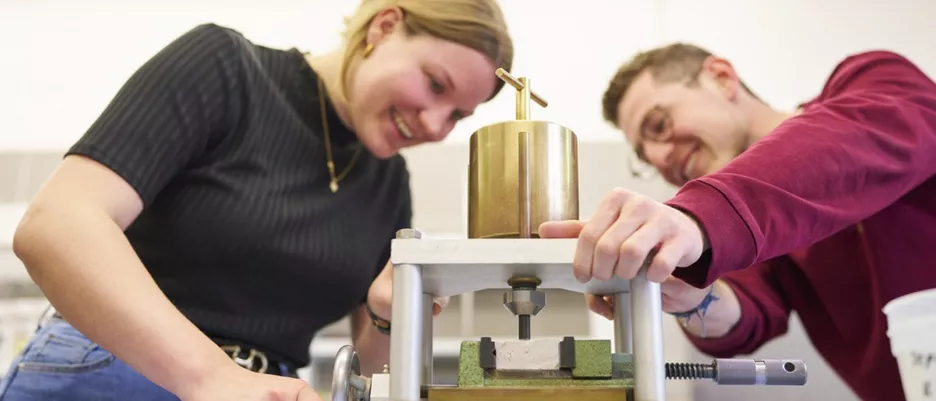
Geology rocks! Should your everyday working life only take place at a desk and PC? Or are you ready for more? The Master's program in Engineering and Hydrogeology offers not only traditional lecture hall events but also laboratory internships and field exercises.
Our professors and staff from the four chairs of Engineering Geology, Hydrogeology, Slope Movements and Geothermal Technologies will train you in the best possible way for your future professional life with a varied range of practice-oriented events. You have got it in your own hands to set the main areas of interest in the elective area and the focus for your master's degree. In addition to classic lecture hall events, you can expect laboratory practicals and numerous field exercises.
TUM is the only university in Germany that offers a master's degree program which offers such a wide range of courses for students in the field of applied geosciences and additionally fulfils the curricular requirements for the "Expert for Geotechnics" with the specialisation "Engineering Geology".
| Type of Study | Full Time | Main Locations | Campus Munich |
| Standard Duration of Studies | 4 Semester | Application Period | Winter Semester: 01.04. – 31.05. Summer Semester: 01.11. – 15.01. |
| Credits | 120 ECTS | Required Language Proficiency | English, German |
| Start of Degree Program | Winter Semester Summer Semester | Costs | Student Fees, Tuition fees for international students |
The challenges of our time include the topics of "sustainable mobility and infrastructure", "clean water" and "clean energy", as well as "natural hazards and risk assessment" in line with the UN's 17 Sustainable Development Goals. With a master’s degree in Engineering and Hydrogeology you can make a significant contribution here. Engineering geology provides solutions to infrastructure problems (e.g. through tunnel construction), hydrogeology contributes to clean drinking water, geothermal energy can be used to prospect climate-neutral energy resources, and engineering geomorphology makes its contribution to the assessment of alpine natural hazards (for example, by researching the retreat of permafrost in the Alps).
As a graduate of the master's program in Engineering and Hydrogeology, you will be equipped with a broad range of knowledge in the field of applied geosciences. Graduates of this degree program have the best possible qualifications for positions at the interface between classical civil engineering and geology and are well equipped for later work in both practice and research.
Students of the Master’s degree program Engineering Geology and Hydrogeology (M.Sc.) learn to tackle geological and technical problems with scientific and engineering expertise. The degree program is located at the interface of natural and engineering sciences. Its students deepen their knowledge of applied geology and deal with geological, mineralogical, and petrographic methods, particularly against the background of issues in civil engineering, environmental engineering, surveying, and mechanical engineering. They learn to explore and investigate the natural subsurface, evaluate the properties of rocks and mountains, and determine the hydrochemical and hydrogeological properties of water. They can specialize in engineering geology, alpine natural hazards/engineering geomorphology, hydrogeology, or geothermal energy.
Graduates of the degree program are experts in the geologically and hydrogeologically sound design of a wide variety of infrastructures and assessing hazards of geosphere-human interaction. They know how to plan and implement measures in traffic route construction, special civil engineering, tunnel and cavern construction, geothermal plants, and alpine natural hazards in a sustainable and low-risk manner. This qualifies them for responsible jobs in engineering offices, construction companies, or public administration, as well as for continuing their scientific work within the framework of a doctorate.
Study Structure
The first three semesters cover discipline-specific fundamentals in the areas of engineering geology and hydrogeology. These are accompanied by laboratory and project work. Additionally, in the second and third semesters, elective modules provide the opportunity to specialize on an individual basis.
The fourth semester is devoted to the Master’s thesis, in which students’ acquired knowledge and methodological competencies converge.
Course Content
The first three semesters cover discipline-specific fundamentals in the areas of engineering geology and hydrogeology. These are accompanied by laboratory and project work. Additionally, in the second and third semesters, elective modules provide the opportunity to specialize on an individual basis. The fourth semester is devoted to the master’s thesis, in which students’ acquired knowledge and methodological competencies converge.
Depending on your choice of modules and specialisations, you will have further specialist knowledge in addition to strong core skills in engineering geology and hydrogeology. For example, you can focus on engineering geology, engineering geomorphology, quaternary geology, geostatistics, slope movement mapping and geoinformation systems, numerical modelling, mineral resources, technical rock science, geothermal energy or geoenergy plus regional geology and chemical analysis.
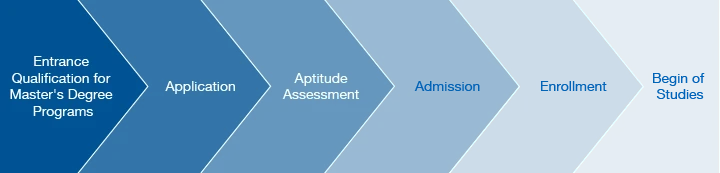
Application via TUMonline: Apply via the TUMonline application portal and upload your documents for admission there.
Support: Instructions for applying for a master's program (step-by-step instructions) and Application Info Portal
Legal Notice: The basis is the program-specific Academic and Examination Regulations (FPSO)
Admission requires specialist knowledge from a first degree in geosciences, environmental engineering, civil engineering, or comparable courses of study in the fields of geosciences, environmental sciences, or construction.
The application documents include a transcript of records (at least 120 credit points for a six-semester bachelor's degree program, 150 for a seven-semester program, and 180 for an eight-semester program), a resume, and a letter of motivation. The aptitude assessment process evaluates academic qualifications, grades, and the letter of motivation, and may also include a personal interview. Proof of English and German language proficiency at level C1 is mandatory.
The Aptitude Assesement is defined in the Academic and Examination Regulation
- Degree Certificate and Diploma or Subject and Grade Transcript of Studies to Date
- Transcript of Records
- Proof of German Language Proficiency
- Proof of English Language Proficiency
- Certification of Internship / Work Experience / Vocational Training
- Statement of purpose (Letter of Motivation)
- Complete and Current Résumé
- Passport
- Preliminary Documentation (VPD) if the qualification for graduate studies (e.g. a Bachelor’s) was obtained outside Germany)
We may require additional documents depending on your educational background and your country of origin. Complete the online application to receive a comprehensive list of the required documents.
Please consider the specific requirements for documents for application and enrollment at TUM.
Selection takes place through an aptitude assessment procedure. Aptitude assessment is a two-part procedure after the submission of an official application to a program. In this procedure, the TUM school or department determines whether you meet the specific requirements for its Master’s degree program.
In the initial stages, the grades you obtained during your Bachelor’s program, as well as your written documents, will be evaluated using a point system. Depending on the amount of points accumulated, applicants are either immediately admitted, rejected, or invited to an admissions interview.
- Application for Enrollment (signed)
- Degree Certificate and Diploma (authentic document)
- Transcript of Records (authentic document)
- Most Current Photo (as for ID)
- Digital notification of your health insurance status from a German public health insurance provider (requested by applicant)
We may require additional documents depending on the type of educational background you earned and your country of origin. After accepting an offer of admission in TUMonline, you will receive a list of documents you must submit to TUM in hardcopy for enrollment.
Please consider the specific requirements for documents for application and enrollment at TUM.
| Lehrveranstaltung | Modul | Titel | Termin | Leitung | Art |
| !!Vorstellung der Vertiefungsrichtungen!! | Raum 3404 | - | 21.01.2026 15-16:30 Uhr | 4 Professoren | Vorstellung |
| Master-Workshop | Raum 2408 | 06.02.2026 14:00-15:45 Uhr | Thuro | Pflicht - alle! | |
| Vorbesprechung MSc IGH | Raum 2408 | 13.04.2026 10:00 Uhr | Thuro | ||
| Techniken der Ingenieurgeomorphologie | ED130073 | Engineering Geomorph. | 17.04.-18.04.2026 | Krautblatter | VT IGM |
| GÜ Wachtl | ED130080 | Gelände und Labor | 24.04.2026 | Thuro; Mattheis | VT ING |
| GÜ Hangbewegungen der Südalpen | ED130080 | Gelände und Labor | 14.-17.05.2026 | Krautblatter | VT IGM |
| GÜ Hangbewegungskartiertung | ED130075 | Landslides in Theory and Practice | 26.05.2026-29.05.206 | Krautblatter | Pflicht - alle! |
| Westalpen | ED130080 | Gelände und Labor | 04.06.-07.06.2026 | Thuro | Regionale Geologie |
| GÜ Angewandte Quartärgeolgie | ED130080 | Gelände und Labor | 19.06.2026 | Lempe | VT Ing |
| GÜ Hydrogeologie und Wasserwirtschaft | ED130080 | Gelände und Labor | 27.07.-31.07.2026 | Einsiedl | VT Hydro |
| Hydrogeol. Geländemeth. Tag 2-5 | ED130080 | Gelände und Labor | 03.08.-06.08.2026 | Einsiedl. Baumann, Zosseder | VT Hydro |
Recognition of credits can be requested for parts of a degree program completed outside TUM. The prerequisite for the recognition of credits not earned at TUM is their equivalence. This means that the knowledge and skills acquired must not differ significantly from the content of the corresponding modules at TUM (based on Art. 63 BayHschG and §16 APSO). Guidelines on how to carry out this process can be found via the links below.
We encourage the pursuit of a stay abroad through the various offers at TUM. Contact your study coordinator for an individual counseling.
Further information about exchange programs at the ED can be found on the going on exchange wiki-page.
Information on taking a leave of absence can be found on the corresponding TUM page.
Please keep in mind that the application for the leave of absence has to be handed in latest until the start of the lecture period of the semester you want to take the leave in.