
Industrial Biotechnology M. Sc.
Manufacture plastics from carbon dioxide (CO2), silk using bacteria and renewable resources or liquid fuels from organic waste? The Industrial Biotechnology program deals with the industrial production of substances with the help of new biocatalysts and biotechnological procedures.
As a highly interdisciplinary field, "white biotechnology" comprises the biosciences (molecular biology, biochemistry, microbiology and bioinformatics) on the one hand. On the other hand, methods of (bio)process engineering and technical chemistry are required in order to realize the full potential of the new biocatalysts and to develop sustainable production processes on an industrial scale. As a future technology of the third millennium, IBT is considered to be of outstanding importance, especially for the European economy.
With the Research Center for White Biotechnology on the Garching campus, the Technical University of Munich (TUM) is creating a strong, interdisciplinary research and training program in this field.
| Type of Study | Full Time | Main Locations | Garching |
| Standard Duration of Studies | 4 Semester | Application Period | Winter Semester: 01.04. – 31.05. Summer Semester: 01.11. – 15.01. |
| Credits | 120 ECTS | Required Language Proficiency | German |
| Start of Degree Program | Winter Semester Summer Semester | Costs | Student Fees: 85.00 €, Tuition fees for international students |
Industrial biotechnology (“white biotechnology”) uses microorganisms or their components (enzymes) as biocatalysts for the industrial production of substances. These include special chemicals, fine chemicals, food and food additives, intermediate products for agricultural and pharmaceutical sectors, as well as additives used in manufacturing, but also, and increasingly, high volume chemical products and fuels. In the process, “white biotechnology” relies on renewable resources and attempts to selectively transform these, with the help of biological systems, into valuable chemical products.
As a highly interdisciplinary science, on the one hand industrial biotechnology comprises the biosciences (molecular biology, biochemistry, microbiology, and bioinformatics), which it draws upon in order to identify new biocatalysts. On the other hand, methodologies of (bio)process engineering and technical chemistry are required in order to realize the full potential, in both technical and industrial terms, of new biocatalysts and so as to achieve new and efficient biological production processes on an industrial scale.
From this point of view, a special feature of this non-consecutive master’s program in Industrial Biotechnology lies in the cross-disciplinary selection of students: graduates of bachelor’s programs in both the biosciences and engineering can be admitted to the course. At the beginning of the master's program in Industrial Biotechnology, complementary and discipline-specific foundational knowledge is conveyed (process engineering for bioscientists or biosciences for engineers).
For a comprehensive description of the program, please refer to the degree program documentation:
The Master’s program in Industrial Biotechnology at the Technical University of Munich aims to provide scientists with a vocational education and training that incorporates broad and pertinent knowledge of methodologies and the discipline. The goal is to train highly qualified specialists able to design and implement new biological processes required in industrial production processes on the interface between the biosciences and process engineering.
Graduates will have complemented, and expanded upon, their previous knowledge of the natural sciences and of engineering and, in addition, possess advanced specialist knowledge in the areas of enzyme engineering, metabolic engineering, bioprocess engineering, and bioseparation engineering.
Opportunities arise for graduates across the full spectrum of bioprocess development and optimization, from the laboratory to the industrial production. In addition to the chemical industry, potential fields of occupation also include the biotechnological sector, plant and apparatus engineering, the pharmaceutical industry, and environmental engineering.
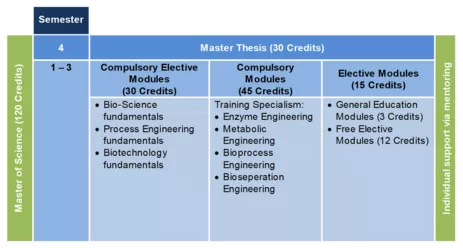
The standard duration of the Master degree program in Industrial Biotechnology is 4 semesters. Overall, the study program encompasses 120 ECTS, which are divided into 90 ECTS for modules (consisting of courses such as lectures, seminars, tutorials, and practical courses) and 30 ECTS for the Master's Thesis. 45 ECTS in mandatory modules and 30 ECTS in compulsory elective modules as well as another 15 ECTS in elective modules are to be earned. Each semester 30 ECTS should be achieved.
During the first two semesters, science and engineering graduates are taught the interdisciplinary fundamentals. Choosing from a list of required elective modules, students themselves put together the semesterized curriculum, which has been adapted to the bachelor’s degree, with the help of a mentor.
- Bioscience fundamentals: Students with a bachelor’s degree in engineering gain an understanding of bioscience fundamentals.
- Process engineering fundamentals: Students with a bachelor’s degree in science are taught the engineering fundamentals of process engineering.
- Biotechnology fundamentals: Students with a bachelor’s degree in bioprocess engineering are taught the biotechnology and engineering fundamentals.
The list of mandatory and elective modules refers to the module handbook and the statute of the Master's Program Industrial Biotechnology, dated June 13, 2019. Exemplary lists of the subject modules to choose from can be found on our Wiki.
Starting in the 2nd and 3rd semester, this is supplemented by subject-specific training in the mandatory focus areas, i. e. enzyme engineering, metabolic engineering, bioprocess engineering, and bioseparation engineering.
Through elective modules in the first three semesters, there is also the possibility of expanding one's own competence profile with modules from a wider range of courses offered by the TU Munich or another university.
Students pursue their master’s thesis in the fourth semester, ideally after they have passed all module exams. This independent, academic work is based on a topic relevant to industrial biotechnology and is supervised by a professor or any expert supervisor of the TU Munich who is a member of the departments involved in the study program.
During the study program, there is the possibility to include an (international) research internship in the study plan (max. 10 ECTS). Industrial internships are also supported but cannot be incorporated into the curriculum. Evonik Nutrition & Care offers internships especially for students in the IBT Master’s program.
Application deadlines and enrolment
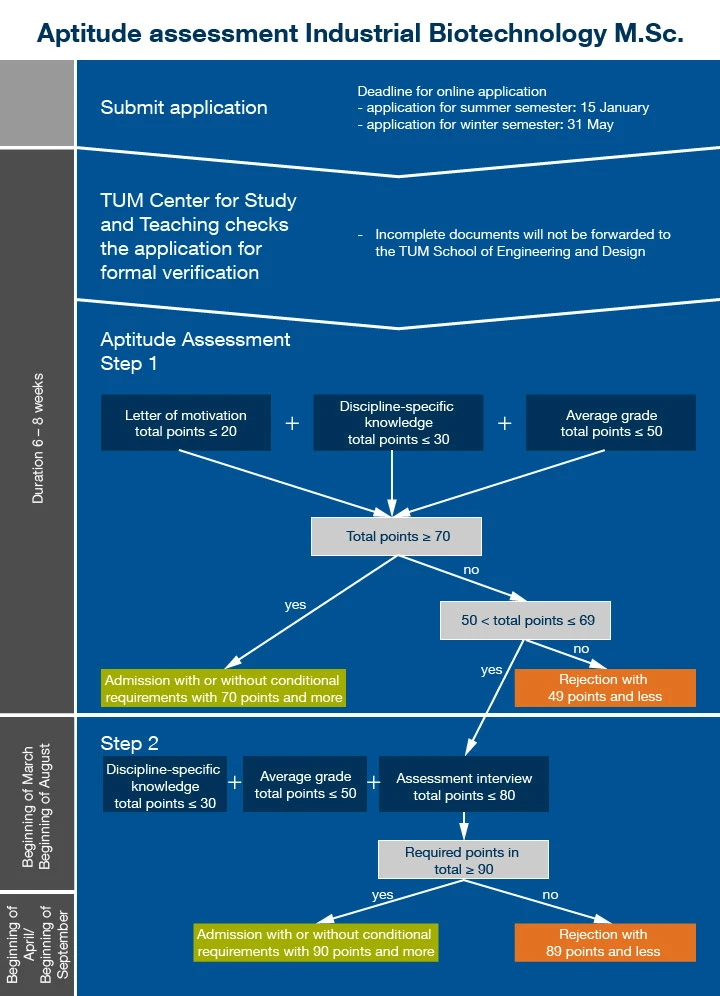
- Application period for the winter semester (WiSe): 1 April – 31 May of the respective year.
- Application period for the summer semester (SoSe): 1 November – 15 January of the preceding year.
The aptitude interviews take place at the following times:
- For the winter semester: beginning of July
- For the summer semester: beginning of March
The invitation to the aptitude interview will be sent by email at least one week before the interview date.
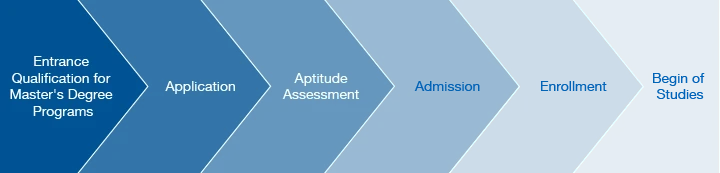
After successfully completing the application process and receiving admission, all documents required for enrolment must be submitted
- by 15 August (for the winter semester) or
- by 15 February (for the summer semester).
If you do not have all the documents required for enrolment by this date, they can be submitted up to five weeks after the start of lectures at the latest.
Please note that enrolment will only take place once all the necessary documents have been received in full.
Application via TUMonline: Apply via the TUMonline application portal and upload your documents for admission there.
Support: Instructions for applying for a master's program (step-by-step instructions) and Application Info Portal
Legal Notice: The basis is the program-specific Academic and Examination Regulations (FPSO)
Suitability for the Master's programme in Industrial Biotechnology must be demonstrated by:
- a qualified Bachelor's degree (Bachelor of Science) of at least six semesters acquired at a domestic or foreign university or a degree of at least equivalent value in the fields of biochemistry, (molecular) biotechnology, biology, bioprocess engineering, chemical engineering, energy and process engineering, engineering sciences, chemical biotechnology or comparable fields of study.
- In addition, students who have achieved at least 140 credits in one of the above-mentioned bachelor's degree programmes may be admitted to the master's programme upon application. The bachelor's degree certificate must be submitted within one year of the start of the master's programme.
- Applicants who have obtained a bachelor's degree abroad must submit a language certificate by the end of the application period.
The following documents must be submitted digitally and on time to TUM:
- Application for authorisation
- Degree Certificate and Diploma or Subject and Grade Transcript of Studies to Date with at least 140 ECTS (certified copy)
- Complete and Current Résumé
- Curricular analysis IBT
- Statement of purpose (Letter of Motivation)
- Transcript of Records
- Passport
- Preliminary Documentation (VPD) by uni-assist - for international applicants only
- Proof of German Language Proficiency
We may require additional documents depending on your educational background and your country of origin. Complete the online application to receive a comprehensive list of the required documents.
Please note that you may enroll in this degree program, as long as you submit the required graduation documents (transcript & diploma) within one year.
For more information about applying for a master's degree at TUM, please visit: https://www.tum.de/en/studies/application/master
Selection takes place through an aptitude assessment procedure. Aptitude assessment is a two-part procedure after the submission of an official application to a program. In this procedure, the TUM school or department determines whether you meet the specific requirements for its master’s degree program.
In the initial stages, the grades you obtained during your bachelor's program, as well as your written documents, will be evaluated using a point system. Depending on the amount of points accumulated, applicants are either immediately admitted, rejected or invited to an admissions interview.
Points are awarded to assess professional qualifications by comparing the applicant's skills with those of a graduate of a comparable programme at TUM. The learning objectives of the individual modules and their scope (ECTS) are taken into account.
In the second stage, applicants are invited to an approximately 20-minute selection interview. The final suitability of the applicant is determined equally by the average grade on the bachelor's degree certificate and the result of the selection interview.
Further information can be found in Appendix 2 of the FPSO.
- Application for Enrollment (signed)
- Degree Certificate and Diploma (authentic document)
- Digital notification of your health insurance status from a German public health insurance provider (requested by applicant)
- Entrance qualification for Master’s degree programms
- Transcript of Records (authentic document)
- Most Current Photo (as for ID)
Depending on your educational background and origin, we may require additional documents. After accepting an offer of admission in TUMonline, you will receive a list of documents you must submit to TUM in hardcopy for enrollment.
Please note that you may enroll in this degree program, as long as you submit the required graduation documents (transcript & diploma) within one year.
Current information
We have moved - you will find our offices here https://nav.tum.de/building/5515
Please write from your TUM E-Mail (not personal E-Mail address) and state your matriculation number when you contact the study office.
TUM First Steps – Programm Sommersemester 2026
https://www.tum.de/studium/im-studium/das-studium-beginnen/first-steps
- TUM First Steps | Infosessions, 23. - 26. Februar 2026: Format: Onlinevortrag mit Live-Q&A, auf Englisch, Anmeldung erforderlich
- TUM First Steps | Student Experiences, 27. Februar 2026: Format: Onlinevortrag mit Live-Q&A, auf Englisch, Anmeldung erforderlich
Mentoring Program
Throughout your studies, the program director is available to you as a mentor. In consultation with your mentor, you will select your individual timetable (for elective compulsory modules) to ensure a coherent and qualifying course of study.
Student Representatives
The student representatives of the M.Sc. Industrial Biotechnology program at TUM advocate for student interests, provide feedback in committees, and serve as points of contact for any study-related questions.
International
- Lecture series on the topic of housing (German and English), no registration required. The maximum number of participants is 300. Further information at: https://www.tum.de/studium/im-studium/wohnen-und-arbeiten/wohnen (DE+EN), target groups by origin.
- https://living.tum.de/listings?viewMode=list
- TUM Buddy Programme: https://www.tum.de/studium/internationale-studierende/tutoren-undbuddy-programmed
The program comprises a total of 120 credits, which are organized in modules. These are divided into 90 credits for coursework modules (including lectures, tutorials, and practicals) and 30 credits for the Master’s Thesis.
Students are required to complete: 45 credits in mandatory modules, 30 credits in elective compulsory modules, and at least 15 credits in elective modules.
Students are expected to earn 30 credits per semester.
Important: At least one elective compulsory module (as listed in Annex 1 of the FPSO) must be successfully completed by the end of the second semester.
Mentoring Program
Throughout your studies, the program director is available to you as a mentor. In consultation with your mentor, you will select your individual timetable (for elective compulsory modules) to ensure a coherent and qualifying course of study.
Academic Progress
The General Academic and Examination Regulations (APSO) define specific milestones that must be met within each semester. The following list summarizes the required number of credits to be earned after each semester, starting from the third semester:
- at least 30 credits after 3 semesters
- at least 60 credits after 4 semesters
- at least 90 credits after 5 semesters
- at least 120 credits after 6 semesters
This effectively limits the maximum duration of study to six semesters. Please also note: At least one elective compulsory module must be passed by the end of the second semester.
Detailed information on dates relating to the semester structure, deadlines, lecture times, semester holidays, public holidays and student council meetings can be found at the following links:
https://www.tum.de/en/studies/application/application-info-portal/dates-periods-and-deadlines
Statutes and regulations
Course documentation
Timetable
Statues and regulations 2019 Industrial Biotechnology (study start BEFORE wintersemester 2024/25)
Statues and regulations Industrial Biotechnology (study start wintersemester 20224/25 or later)
- Recognition of examination results:
Application form for recognition of results
Guidelines to the recognition of achievements
General information on recognition
Research internship
Antrag Anmeldung Forschungspraktikum
Beurteilung Forschungspraktikum
- Master's thesis:
Guidelines for master's thesis and master's examination
ED-Portal
- Diploma Supplement:
Application for inclusion of individual activities in the diploma supplement
- Late registration for examinations:
https://www.tum.de/en/studies/during-your-studies/organizing-your-studies/examinations
- Withdrawal from examinations:
Application form for exam withdrawal
https://www.tum.de/en/studies/during-your-studies/organizing-your-studies/examinations
Examinations and Exam Dates
Please check the exam dates regularly in TUMonline, especially shortly before the exam, in case there are any changes.
Make sure to register for all assessments you plan to take in the semester (this includes projects, submission of seminar papers, etc.). Only then can your exam results be recorded.
Information on examination matters:
https://www.tum.de/en/studies/during-your-studies/organizing-your-studies/examinations
https://www.tum.de/en/studies/during-your-studies/organizing-your-studies/examinations/registering-and-cancelling-examinations
Late registration for exams is only possible in exceptional cases.
Application form for withdrawal from an exam
Compensation for disadvantages (Nachteilsausgleich)
The Examination Board is responsible for all matters relating to examinations, from applications for study places and the aptitude assessment procedure to the entire administration of grades and examinations during the course of study. It meets once per semester.
Applications to the Examination Board should be sent to mscibt@ed.tum.de .
Recognition of academic achievements from other universities:
You can apply for recognition of academic achievements for parts of your studies that were completed outside TUM. The prerequisite for the recognition of academic achievements that were not completed at TUM is their equivalence. Guidelines on how to carry out this process and an application form can be found below and on our webpage.
Application form for recognition of academic achievements
Guidelines for the recognition of credits Webpage
Guideline to the recognition of credits
Please note:
You can only apply for recognition of credits after you have enrolled. An application can only be submitted once and must be made within the first year of study.
Recognition of credits earned abroad:
Your choice of modules abroad is based on information provided by the partner university (especially its website).
Experience reports from other students can also be helpful.
The courses listed in the Learning Agreement are not automatically recognised.
The person responsible for international affairs cannot make any binding statements regarding recognition – this is the sole responsibility of the examination board.
Diploma Supplement:
In the TUM Diploma Supplement, students can have their individual additional activities, such as stays abroad or special projects, officially documented in addition to their course of study.
Application for the inclusion of individual activities in the Diploma Supplement
Industrial internships
- The Student Office supports leave of absence for internships, but the work cannot be credited towards the degree programme.
Research internships abroad
- Students are supported in their search for internships at foreign research institutions (overseas and in Europe).
- Partial funding through the ERASMUS programme is possible.
- Research internships can be credited to the degree programme as a freely selectable subject module worth 10 ECTS credits.
Research internships at TUM
- Can be included in the degree programme as an elective module worth 4, 6 or 10 credits.
- Prior registration of the research internship with the Student Office is required (Registration for the research internship).
If you would like to complete a research internship, please email the completed and signed application form for the research internship.
After you have completed the research internship, the examiner must complete the form for assessing the research internship and email it to the Student Office.
Registration for the research internship
Assessment of the research internship
During your studies at TUM, you have the opportunity to study abroad for up to two semesters or complete an internship abroad. You can find more information about the various programmes on the TUM-Global-Webseite.
In the IBT programme, you can study abroad at several partner universities in various European countries as part of the Erasmus+ programme. With the TUMexchange exchange programme, you can study for one semester at one of the partner universities outside Europe in Africa, Asia, Australia, North or South America.
The Going Abroad page of the TUM Global & Alumni Office provides comprehensive information on stays abroad. If you have any further questions, you can find the relevant contact persons for the topic of ‘International Affairs’ on the Wiki page Contacts - IE.
- TUMexchange
The TUM Global & Alumni Office is primarily responsible for organising stays abroad through the TUMexchange programme: https://www.international.tum.de/en/global/tumexchange
- Financial aspects of scholarships (especially Erasmus+)
Scholarships are usually administered by the relevant teams at the central TUM Global & Alumni Office – not by the International Office of the TUM School of Engineering and Design (ED). This applies in particular to the Erasmus+ programme.
https://www.international.tum.de/en/global/going-abroad
- Application documents:
- Letter of motivation (in English or the local language, max. 1 page DIN A4, only for first choice)
- Curriculum vitae with photo (in English or the local language)
- Transcript of grades (B.Sc. & M.Sc., if applicable)
- Study plan for abroad (with non-binding course selection, only for first choice)
- Language certificates (e.g. Abitur, TUM Language Centre, DAAD test)
No TOEFL/IELTS required for the application – however, partner universities may require this later. If applications are made in countries with different languages of instruction:
Upload all language certificates in one PDF file
Local language skills (e.g. Swedish, Dutch) are also an advantage.
If you have any questions, please contact international.ie@ed.tum.de .
- Further information:
Lead time: Please note that lead times can be long – up to 18 months – depending on the university, country and financing model!
Partner universities: A list of all partner universities for the above-mentioned degree programmes can be found on the TUM website.
Detailed information can be found on the corresponding Wiki-Website.
Information on applying for a leave of absence can be found on the relevant TUM page.
Please note that the application for a leave of absence must be submitted no later than the start of the lecture period of the semester in which you wish to take the leave of absence.
The Master's thesis is usually completed in the fourth semester after successfully passing all module examinations as an independent scientific paper on a topic from industrial biotechnology under the supervision of an examiner from one of the faculties involved in the programme.
Guidelines for the Master's thesis and Master's examination
The thesis can be written abroad, but must be supervised by an examiner authorised by TUM. Regular contact must be ensured – this must be agreed in advance.
The administrative process takes place in the ED portal at portal.ed.tum.de. There you can clearly view all information and submit the written thesis digitally.
Please also see information on our webpage: https://www.tum.de/en/studies/graduation/theses/formalities
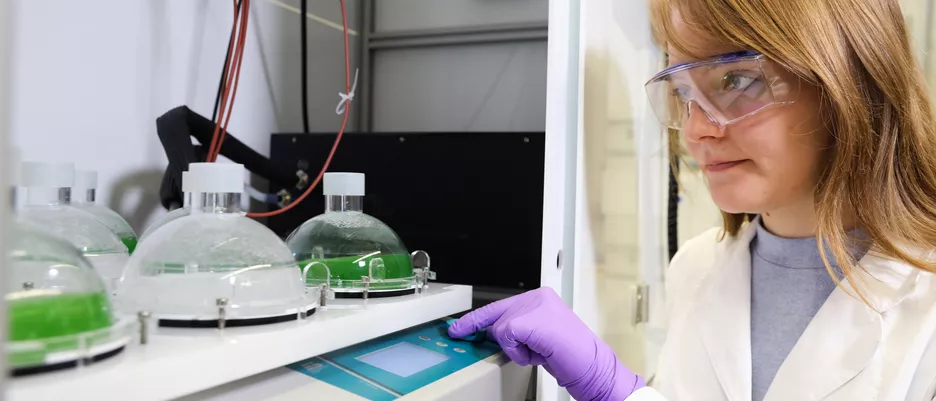
Bioplastics from blue-green algae for the climate

Climate-friendly and rapidly degradable: Researchers at the Technical University of Munich (TUM) use blue-green algae and the soil bacterium Pseudomonas putida to produce bioplastics. Image: Tassilo Letzl / TUM