
MINT Orientation certificate
The orientation semester for MINT (Mathematics, Information technology, Natural sciences and Technology (in english: STEM - stands for Science, Technology, Engineering, Mathematics) studies is aimed at school leavers, students changing subjects, and qualified professionals interested in engineering, natural sciences, and technology.
It is intended to help them decide and find a course of study that matches their talents and interests.
| Type of Study | Full Time | Main Locations | Garching, Munich, Weihenstephan |
| Standard Duration of Studies | 1 Semester | Application Period | Summer semester 15.11. – 15.01. |
| Credits | 17 ECTS compulsory modules + at least 8 ECTS elective modules | Required Language Proficiency | German |
| Start of Degree Program | Summer Semester | Tuition Fees | Semester fee, Fees for Students from Non-EU Countries |
The MINT study program is a decision-making aid for choosing a course of study that corresponds to individual talents and interests. It provides academic, organizational, and social preparation for a bachelor's degree program at the Technical University of Munich.
Its purpose is to provide guidance in finding a course of study that matches individual talents and interests. Participants are regularly enrolled as students at TUM and can explore the study programs of the participating disciplines without obligation.
The subject modules are offered by the following schools:
- TUM School of Engineering and Design
- TUM School of Computation, Information and Technology
- TUM School of Natural Sciences
- TUM School of Life Sciences
Please note that individuals who have already been enrolled in a degree program for more than 2 semesters will not be admitted.
You can find a comprehensive overview of the study program in the following program documentation (in German, PDF).
The MINT students can select and successfully complete a suitable degree program based on the knowledge and skills acquired during the orientation semester.
They gain essential knowledge, making it easier to take up an (undergraduate) Bachelor's degree program at the Technical University of Munich. Furthermore, graduates acquire interdisciplinary qualifications that can be used profitably in their later professional lives beyond their studies.
As a MINT student, you are regularly enrolled at TUM, take examinations, and collect credits that can be recognized in a later Bachelor's degree program. This gives you more freedom and flexibility in the timing of your subsequent Bachelor's degree.
The MINT study program is a decision-making aid for choosing a course of study that corresponds to individual talents and interests. It provides academic, organizational, and social preparation for a bachelor's degree program at the Technical University of Munich.
Its purpose is to provide guidance in finding a course of study that matches individual talents and interests. Participants are regularly enrolled as students at TUM and can explore the study programs of the participating disciplines without obligation.
The subject modules are offered by the following schools:
- TUM School of Engineering and Design
- TUM School of Computation, Information and Technology
- TUM School of Natural Sciences
- TUM School of Life Sciences
The curriculum consists of various components:
Compulsory modules (17 credits):
Mathematics: As a cross-sectional science, mathematics is closely interlinked with the engineering sciences, forming a compulsory module.
Orientation: By participating in selected elective modules, students gain insights into the various areas of natural sciences and engineering and the interdisciplinary connections.
Perspective: Participants gain an insight into current research topics and trends in engineering practice as well as potential fields of activity and job profiles in the engineering sciences by attending specialist lectures and excursions.
Sustainability: The topic of sustainability is also integrated into the curriculum. Students can understand technologies' social causes, characteristics, and consequences, consider the potential for achieving sustainability goals, and develop suitable solutions.
Interdisciplinary skills: Personal, social, and methodological skills are strengthened through teamwork in learning groups, time management methods, skills analysis, and enhanced decision-making skills.
Elective area (at least 8 credits):
On the one hand, the specialist modules provide basic knowledge; on the other hand, they enable students to gain insight into the respective STEM subject. Elective modules from physics, chemistry, computer science, mechanics, electrical engineering, geodesy, and life sciences can be chosen according to interest. STEM-specific modules are offered for the elective area, which imparts basic knowledge and is linked to the performance level of school leavers.
Additional modules:
Additional modules (voluntarily attended). These include, in particular, modules and individual courses from regular Bachelor's degree programs of the participating Schools, which are intended to provide additional orientation in the MINT courses set out in the curriculum. Examinations can be taken in the additional subjects (as long as they are not essential orientation examinations), which may be recognized in the Bachelor's degree course.
Transcript of record:
A transcript of record ("TOR"), which is issued after the end of the respective summer semester, provides information on all completed modules of the semester, including grading (compulsory modules, compulsory elective modules, additional modules), regardless of whether the studium MINT certificate is obtained or not. The certificate can be obtained by completing the modules offered (compulsory modules of 17 credits and elective modules of at least 8 credits).
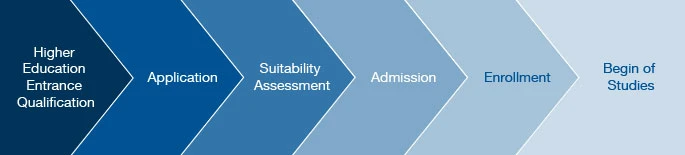
Apply via the TUMonline application portal (select "Modulstudium" as the type of study) and upload your documents for admission there.
Instructions for applying for a bachelor's program: Detailed information on the application process (step-by-step instructions). If uni-assist does not offer the MINT program, select the degree program "BSc Engineering Sciences".
More information on the application process: Application Info Portal
The legal basis for the application is the Academic and Examination Regulations
Admission to the MINT programme is granted to applicants who
- have a recognised university entrance qualification.
- With foreign university entrance qualifications you will need proof of German language proficiency
- have not been enrolled at a university for more than two semesters at the time of admission to the MINT programme
- have submitted their application documents before the deadline in a proper manner
- Higher Education Entrance Qualification
- Proof of German Language Proficiency
- Complete and Current Résumé
- Passport
- Preliminary Documentation (VPD) by uni-assist - for international applicants only
If the VPD is not yet available at the time of application, upload the application for VPD - and submit the VPD as soon as it becomes available. However, the application for the VPD must have been submitted during the application period.
We may require additional documents depending on your educational background and your country of origin. Complete the online application to receive a comprehensive list of the required documents.
Please consider the specific requirements for documents for application and enrollment at TUM.
- Application for Enrollment (signed)
- Higher Education Entrance Qualification (authentic document)
- Most Current Photo (as for ID)
- Digital notification of your health insurance status from a German public health insurance provider (requested by applicant)
We may require additional documents depending on the type of educational background you earned and your country of origin. After accepting an offer of admission in TUMonline, you will receive a list of documents you must submit to TUM in hardcopy for enrollment.
Please consider the specific requirements for documents for application and enrollment at TUM.
Documents relevant to enrollment can be submitted after the semester has begun. Please enroll as soon as you have received your admission and transfer the semester fee. Without enrollment, you do not have student status, which means you will not receive any information and cannot participate in courses.
Before the studies
At the beginning of the semester, digital information events will be offered (see table below), which is not yet complete and subject to change. The first event is an introduction to studium MINT, followed by an overview of the bachelor's programs at TUM.
Tag | Zeitfenster | Vortrag |
01.04.2026 | 09.00 - 10.00 Uhr | Einführung studium MINT |
| 10.00 - 11.00 Uhr | B.Sc. Aerospace |
02.04.2026 | 09.00 - 10.00 Uhr | B.Sc. Ingenieurwissenschaften / Engineering Science |
| 11.00 - 12.00 Uhr | Bachelorstudiengänge am Standort Straubing: Bioeconomy, Chemische Biotechnologie |
|
| Sustainable Engineering for Materials and Processes |
07.04.2026 | 11.00 - 12.00 Uhr | B.Sc. Physik |
| 08.04.2026 | 09.00 - 10.00 Uhr | B.Sc. Maschinenwesen |
08.04.2026 | 10.00 - 11.00 Uhr | B.Sc. Bauingenieur- Umweltingenieurwesen |
| 11.00 - 12.00 Uhr | Bachelorstudiengänge B.Sc. Chemie, Chemieingenieurwesen, Lebensmittelchemie, Biochemie |
09.04.2026 | 10.00 - 11.00 Uhr | Geodesy and Earth Observation |
| 11.00 - 12.00 Uhr | Mathematik |
15.04.2026 | 10.00 - 11.00 Uhr | Forstwissenschaft und Ressourcenmanagement / Agrarwissenschaften und Gartenbauwissenschaft |
| 11.00 - 12.00 Uhr | Brauwesen und Getränketechnologie, Lebensmitteltechnologie, Pharmazeutische Prozesstechnik |
|
| Diplom Braumeister |
| 12.15-13/13.25 Uhr | Exkursion Forschungsbrauerei, please let us know when you wish to attend (on 1st April) | |
22.04.2026 | 10.00 - 11.00 Uhr | LS Biologie, Molekulare Biotechnologie, LS Ernährungswissenschaft |
1.4. oder 8.4. | 14.00 - 15.00 Uhr | Elektro- Informationstechnik |
|
| Informatik, Wirtschaftsinformatik, Games Engineering |
|
| B.Sc. Maschinenwesen |
Enrolled students will be notified in advance with links to the digital events.
A welcome event will take place on 10th April at the Garching campus. This will be the first opportunity for students to meet each other and the program coordinator in person. The student council will also introduce itself.
Exact dates and information will be communicated to students in good time.
On this webpage you will find dates about the semester start and reading period.
TUM open campus in March 2026
For international students
TUM First Steps – Programm Sommersemester 2026
https://www.tum.de/studium/im-studium/das-studium-beginnen/first-steps
- TUM First Steps | Infosessions, 23. - 26. Februar 2026: Format: Onlinevortrag mit Live-Q&A, auf Englisch, Anmeldung erforderlich
- TUM First Steps | Student Experiences, 27. Februar 2026: Format: Onlinevortrag mit Live-Q&A, auf Englisch, Anmeldung erforderlich
General information:
Checklist for starting your studies
Once you have enrolled in the program, you will gain access to the course catalogue, which will be activated at the beginning of the semester (1st April). You can register for courses independently and put together a study schedule according to your interests. You can refer to the orientation semester curriculum (see modules), but you can also attend courses from regular bachelor's programs.
How much work is involved in the program?
The MINT program is designed as a full-time program. MINT classes are spread out over the entire week (Monday to Friday), and students are also expected to study on their own. To receive the certificate, students must earn at least 25 credits. One credit is equivalent to approximately 30 hours of work (consisting of lectures, exercises, and independent study).
Where are the courses held?
The courses are held in Garching and Munich. Courses in the field of life sciences take place on the Weihenstephan campus. Your individual schedule depends on which courses you attend.
Will I receive a degree with the studium MINT?
The MINT program is not a degree program, i.e., it does not lead to a professional qualification. However, you will receive a certificate once you have successfully completed all compulsory and elective modules.
When will I be de-registered?
Since the orientation semester only takes place in the summer semester, you will be automatically de-registered at the end of the summer semester.
Study regulations (in German)
During the orientation semester studium MINT, you will attend compulsory modules. You can also attend elective modules according to your interests. A module can consist of several courses (e.g. lectures, exercises, tutorials). The module concludes with a module examination (e.g. written exam, oral exam, report, exercise performance). If you have a broad range of interests and want to take different elective modules, it is not easy to put together a timetable that does not overlap. Please do not hesitate to contact us if you have any questions.
Once you are enrolled, register for the Moodle course ‘studium MINT 2026’. This tool will provide you with regular important information about the orientation semester (however, not before 1st April).
Compulsory modules: 17 Credits
| SWS | Credits | |||
|---|---|---|---|---|
| Elementare Anwendungen der Mathematik in Informatik und Ingenieurwissenschaften | MA8802 | Vorlesung/Übung | 6 | 5 |
| Technik, Nachhaltigkeit und Gesellschaft | SOT53301 | Vorlesung/Übung | 2 | 3 |
| Welt der Ingenieurwissenschaften | SE0102 | Vortrag/Exkursion | 1 | 2 |
| Interdisziplinäre Orientierung | SE0101 | Vorlesung/Übung | 4 | 5 |
| Fit fürs Studium - Kompetenzen für erfolgreiches Studieren | ED100045 | Workshop | 2 | 2 |
Elective modules: min. 8 Credits
| Einführung in die Technische Mechanik für das studium MINT | BGU43017 | Vorlesung/Seminar/Übung | 5 | 6 |
| Allgemeine und Anorganische Chemie für das studium MINT | CH1218 | Vorlesung | 5 | 4 |
| Einführung in die Informatik für andere Fachrichtungen | IN8003 | Vorlesung/Übung | 4 | 5 |
| Grundlegende Konzepte der Experimentalphysik | PH9030 | Vorlesung/Übung | 4 | 3 |
| Elektrotechnik und Informationstechnik der mobilen Kommunikation | CIT543001 | Vorlesung/Übung | 4 | 5 |
| Satellitengeodäsie | BGU57015 | Vorlesung | 2 | 3 |
| Human- und Tierphysiologie | WZ0022 | Vorlesung | 4 | 6 |
| Allgemeine Ökologie | WZ6141 | Vorlesung | 4 | 5 |
| Zellbiologie (MINT) | LS20034 | Vorlesung | 3 | 3 |
| Einführung in die Statistik | MA9602 | Vorlesung/Übung | 2 | 3 |
Additional Modules*
|
|
|
|
| Credits |
|---|---|---|---|---|---|
| Material Science (English, presence, Weihenstaphan, knowledge of Chemistry, Physics, Maths required) | WZ5005 | Vorlesung | 5 | ||
| Thermodynamik und Energietechnik | BGU38017 | Vorlesung/Übung | 5 | ||
| Thermodynamics I | LRG0030 | Vorlesung | 5 | ||
| Geoinformatik (sehr gute Informatikkenntnisse erforderlich) | BGU47030 | Vorlesung/Übung | 5 | ||
| Vermessungskunde für Bauingenieure | BGU53051 | Vorlesung/Übung | 5 | ||
| Grundlage des nachhaltigen Bauens | BV620007 | Vorlesung | 3 | ||
| Grundlagen der Physikalischen Chemie (sehr gute Grundlagen in Mathe und Physik erforderlich) | CH4104 | Vorlesung/Übung | 5 | ||
| Toxikologie und spezielle Rechtskunde für Chemiker | CH0124 | Vorlesung | 3 | ||
| Einführung in die Biotechnologie (Biochemie Kenntnisse erforderlich) | CH0660 | Vorlesung/Seminar | 6 | ||
| Aufbau und Struktur organischer Verbindungen für CIW | CH0864 | Vorlesung/Übung | 5 | ||
| Grundlagen der Energiewirtschaft | EI0709 | Vorlesung/Übung | 5 | ||
| Elektrizität und Magnetismus (sehr gute Grundlage in Linearer Algebra erforderlich) | EI0101 | Vorlesung/Tutorium | 6 | ||
| Regelungssysteme (höhere Mathematik Grundlagen erforderlich) | EI0307 | Vorlesung mit integrierten Übungen/Tutorium | 5 | ||
| Photovoltaische Inselsysteme | EI0644 | Vorlesung/Übung | 5 | ||
| Einführung in die Softwaretechnik (Kenntnisse in Programmierung erforderlich) | IN0006 | Vorlesung/Übung/Tutorium | 6 | ||
| Grundlagen: Algorithemen und Datenstrukturen | IN0007 | Vorlesung/Übung | 6 | ||
| Grundlagen: Rechnernetze und Verteilte Systeme | IN0010 | Vorlesung/Übung | 6 | ||
| Modellierung von Unsicherheiten und Daten im Maschinenwesen (Kenntnisse in Lineare Algebra, MatLab erforderlich) | MW2345 | Vorlesung/Übung | 5 | ||
| Leichtbau | MW1919 | Vorlesung/Übung | 5 | ||
| Biologie für Nebenfächer | WZ8063 | Vorlesung | 3 | ||
| Lebensmittelrecht | WZ5183 | Vorlesung | 6 | ||
| Geschichte der Brautechnologie | WZ5053 | Vorlesung | 5 | ||
| Betriebswirtschaftslehre in der Getränkeindustrie | LS30011 | Vorlesung | 5 | ||
| Pharmazeutische Technologie | LS30032 | Vorlesung | 5 | ||
| Ökonomie für Life Science Engineering | LS30038 | Vorlesung/Übung | 5 | ||
| Grundlagen der Renaturierungsökologie |
| Vorlesung |
| 5 | |
| Materials Science | LS30079 | Vorlesung/Übung | 5 |
* Additional modules, which are modules from regular bachelor programmes.
Exams and exam dates
Check TUMonline regularly for exam dates, especially shortly before the exam, to see if there have been any changes.
Please register for all courses you are taking in the semester (including projects/submission of seminar papers, etc.). This is the only way to ensure that your examination results are recorded.
Examination period for the summer semester 2026: July 13 - August 8, 2026 (however, some examination dates may still take place until September 5, 2026).
The exact examination dates will be announced no later than the second week of lectures.
Information on examination matters
Examination dates will be published on the Moodle course Studium MINT as soon as they have been confirmed.
Exams may not be repeated in order to improve grades. You may repeat exams if you did not attend the exam or did not pass it.
You can find the exam results in your account statement and the transcript of records.
Compensation for disadvantages
General information on compensation for disadvantages can be found here.
The contact person for chronically ill students with disabilities is Ms Cornelia Götze: cornelia.goetze(at)tum.de.
Some of the credits you have earned can be recognised in your bachelor's programme. To find out which credits would be recognised, please contact the relevant academic advisor.
However, the recognition process can only be started once you are enrolled in the respective Bachelor's programme.
Here you will find more information on the recognition of credits.