

Power Engineering M. Sc.
Designing sustainable energy systems is one of the key challenges of our time. The Master's programme in Power Engineering qualifies you to play an active role in the global energy transition.
The transformation of the energy sector is one of the greatest technological challenges of the 21st century. The Master's programme in Power Engineering at the Technical University of Munich (TUM) provides you with the technical and social skills you need to play an active role in shaping this task. In a holistic, English-language and internationally oriented study programme, you will learn how future energy systems can be developed and operated in an ecological, affordable and sustainable manner.
Global warming, limited fossil resources and geopolitical dependencies make the transition to renewable energies indispensable. This requires engineers with in-depth expertise in electrical, thermodynamic and mechanical systems – and with an understanding of economic, ecological and political contexts across cultural and territorial boundaries.
With its mission statement of human-centred engineering, TUM stands for technological development that serves people and society. The Master's programme in Power Engineering follows this principle and trains specialists who are not only technically excellent, but also able to work in an interdisciplinary and intercultural manner – in international project teams and in a global working environment.
| Type of Study | Full Time | Main Locations | Munich, Garching |
| Standard Duration of Studies | 4 semesters | Application Period | 01.01. – 31.05. |
| Credits | 120 ECTS | Required Language Proficiency | English |
| Start of Degree Program | Winter Semester (October) | Costs | Student Fees: 85.00 €, Tuition fees for international students |
The Master's programme in Power Engineering at the Technical University of Munich provides in-depth engineering skills in the field of electrical and mechanical energy technology. The aim is to enable students to understand, develop and implement innovative and sustainable energy systems – both centralized and decentralized.
The programme is practice-oriented and offers a wide range of individual options:
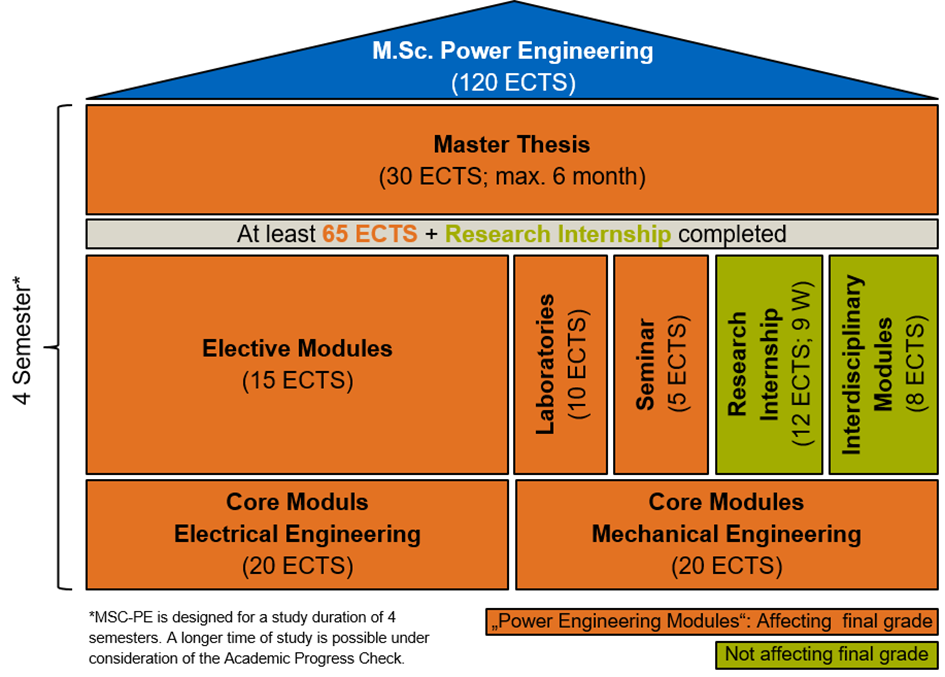
- In the first semester, core modules provide an in-depth understanding of the fundamentals of electrical engineering and mechanical engineering.
- In the second and third semesters, the focus is on specialisation. Students choose from a wide range of elective modules and participate in research projects on current issues. An accompanying seminar promotes scientific deepening and allows students to set their own individual priorities. In addition, management and personal skills can be expanded through interdisciplinary modules.
- In the fourth semester, the programme is completed with a Master's thesis in which the knowledge acquired is applied to a complex energy technology issue.
The course covers a wide range of topics, from traditional fundamentals to forward-looking technologies:
- Thermodynamics
- Fluid mechanics
- Energy system analysis and modelling
- Industrial processes and control engineering
- Power electronics
- Energy informatics
- Power generation technologies (fossil, nuclear, renewable)
- Wind energy
- Power transmission systems
- Smart grids
- Energy storage
- Electrical machines
- Sustainable mobility
- Energy management
The programme is aimed at future engineers who not only have technical expertise, but also want to understand and actively shape the social, ecological and economic conditions of the energy transition.
As a graduate of the Master's programme in Power Engineering, you will be well prepared to independently tackle complex tasks in the field of energy generation and supply. You will have sound technical knowledge, methodological confidence and interdisciplinary and social skills that will qualify you for a responsible position in industry, research and society.
Technical expertise
You will acquire in-depth knowledge in the key areas of electrical and mechanical energy technology. These include:
- Thermodynamic fundamentals of energy technology
- Comparison and evaluation of power generation technologies (wind, water, solar, geothermal, fossil and nuclear sources)
- Components of modern energy systems (electrical machines, energy storage, power electronics)
- Structure and control of smart grids
- Concepts for sustainable energy use (e.g. mobility of the future, energy sharing)
- International regulatory, socio-economic and ecological framework conditions
- Fundamentals of sustainable technical development
By combining core and elective modules, you can set individual priorities and expand your knowledge in a targeted manner.
Methodological competence
Through laboratory practicals, seminars, research projects and your Master's thesis, you will learn:
- to independently acquire new knowledge
- to develop and work on scientific questions
- to evaluate technical innovations – both in terms of their scientific relevance and their ecological and economic impact
- to model and analyse complex systems
- to develop interdisciplinary solutions
These skills will enable you to operate successfully in a dynamic and innovation-driven environment.
Social and intercultural competence
The programme has an international focus and specifically promotes collaboration in multicultural teams. You will acquire:
- Intercultural communication skills through joint project work with international students
- Insights into different perspectives on the energy transition – especially in the European context
- Social responsibility and the ability to reflect on the social impact of technical developments
- Teamwork and leadership skills in interdisciplinary project groups
Additional programmes such as the buddy programme, Erasmus partnerships and EuroTeQ courses broaden your international experience and promote your personal development.
The English-language Master's programme in Power Engineering at the Technical University of Munich prepares you for an international career in the energy sector – an area that is growing rapidly and developing dynamically as a result of the global energy transition.
Fields of activity in industry and business
Graduates work in:
- Energy supply companies: e.g. grid operation, integration of renewable energies, storage technologies
- Power plant and component manufacturers: development, planning and optimisation of energy systems
- Technology companies and start-ups: innovations in smart grids, sustainable mobility, energy informatics
- Consulting and project management firms: technical and economic evaluation of energy projects worldwide
Research and science
- Universities and research institutes: collaboration on energy technology projects, often with the opportunity to pursue a doctorate
- International cooperation: e.g. EU research programmes, development aid projects in the energy sector
International prospects
- Thanks to the international orientation of the programme and the fact that it is taught in English, graduates are particularly sought after by:
- Global companies
- Organisations focusing on sustainable development
- Projects in emerging and developing countries
- Many graduates return to their home countries after completing their studies and actively contribute to the energy transition there – often in cooperation with German or European companies.
Job market situation
- High demand for skilled workers: particularly in the fields of electrical engineering, energy technology, digitalisation and sustainability
- Quick career start: most graduates find a qualified full-time position within a few months
- Diverse career paths: from research and industry to policy consulting and entrepreneurship
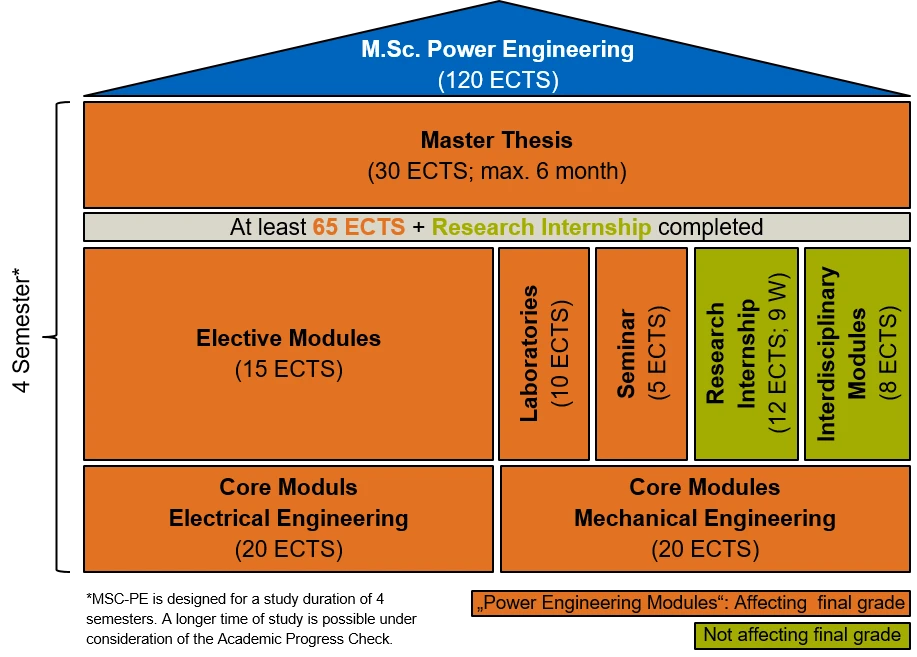
The Master's programme in Power Engineering offers students a high degree of freedom of choice in addition to developing core competencies in the fields of mechanical engineering and electrical engineering. The modules are supplemented by a research internship.
In the first and second semesters, students' prior knowledge from different disciplines is deepened through core modules in the fields of electrical engineering and mechanical engineering, for example in thermodynamics, high-voltage technology, energy systems and energy management.
The second and third semesters are devoted to specialization and individual focus through elective modules, for example on renewable energy technologies, thermal power plants, energy storage, wind energy and civil engineering. This period also includes a nine-week research internship, during which students work on current projects at a teaching or research institution.
A seminar deepens the knowledge acquired in the modules and offers the opportunity to focus further on a specific research topic. Students can broaden their personal development through supplementary modules outside their field of study.
The fourth semester is devoted to the Master's thesis, in which the specialist and methodological knowledge acquired is brought together in the form of a comprehensive assignment.
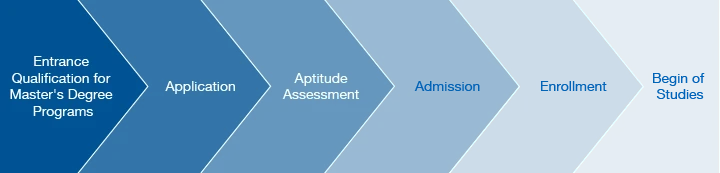
Application via TUMonline: Apply via the TUMonline application portal and upload your documents for admission there.
Support: Instructions for applying for a master's program (step-by-step instructions) and Application Info Portal
Legal Notice: The basis is the program-specific Academic and Examination Regulations (FPSO)
Dates & deadlines application winter semester 2026
- Start of application phase (opening of the application portal): 01 January 2026
- Application deadline TUM Test Power Engineering 2026 * : 21 January 2026
- Sending access data TUM Test Power Engineering 2026 *: 23 January 2026
- Trial run TUM Test Power Engineering 2026*: 23 - 29 January 2026, 12 noon German time (UTC+1)
- TUM Test Power Engineering 2026 *: 29 January 2026, 2pm German time (UTC+1)
- Sending of TUM Test Power Engineering 2026 certificates *: until 07 February 2026
- Recommended application deadline (especially for non-EU candidates due to visa issues): 15 March 2026
- Final application deadline: 31 May 2026
* : only for third-country nationals outside the scope of the "Lisbon Convention"
Missing documents cannot be submitted after the final application deadline. (Exception: If the VPD document preparation is not yet completed, please upload a confirmation that you have requested the VPD document instead and submit the VPD document through the application portal as soon as you receive it.)
Crediting of Previous Academic Studies
The check of the creditability of modules from your previous studies for MSC-PE can only be done after full enrolment at TUM, i.e. at the beginning of the first semester. A preliminary check or crediting during your application phase is not possible.
You may be admitted to the Master’s programme in Power Engineering if …
... you have a H+ rated (Anabin) Bachelor degree or equivalent in electrical or mechanical engineering, with a strong focus on power engineering and excellent grades.
... you can show proof of passing the TUM Test M.Sc. Power Engineering with a score of at least 39 points (only relevant for applicants outside the scope of the “Lisbon Convention”). However, the test result must not be older than 42 months.
Find out Anabin rating: anabin.kmk.org/no_cache/filter/institutionen.html
- Click on „Suchen nach Institution“
- Select at “Länder” the country of your university where you obtained your bachelor degree from and confirm “Länderauswahl bestätigen”.
- Select at “Orte” the city of your university
- All institutions/universities in the selected town will be displayed in the table below.
- In the column “Status” you can find out the rating of the university.
- The applicant’s expertise will be examined as part of an aptitude assessment.
Outstanding expertise in the fields of electrical and mechanical engineering, preferably in the field of power engineering, is particularly important. In principle, therefore, any applicant who can demonstrate this knowledge will be considered, regardless of the designation of the bachelor’s degree program in which this knowledge was acquired.
Candidates who have failed to prove their eligibility for the Master Program Power Engineering in a previous application process may re-apply once.
Regarding the English language requirements, please refer to the information here: ProofofProficiencyintheEnglishLanguage
Special Application Conditions for Certain Countries
For applicants outside the scope of the "Lisbon Convention" (third-country nationals) the admission decision in the stage 1 will be made on the basis of the result of a written online aptitude TUM Test Power Engineering.
If you have not obtained your qualification for postgraduate studies (e.g. your bachelor) at a non-German university, you need to apply for a Preliminary Documentation (VPD) via uni-assist before applying to TUM. This also applies to entrance qualifications obtained in EU/EEA countries.
Furthermore, applicants from certain countries/provinces must comply with special conditions (e.g. APS certificate). Please check this link to see if this is relevant for you.
Changing Subjects or Courses of Study
If you are already enrolled in a Master’s degree program at TUM and would like to change subjects or degree programs, you can find information here.
For details on documents to be submitted, please refer to the information in the TUMonline application portal, as well as to the Glossary of Documents
Please note: If you do not have all documents available yet (e.g. VPD), you can still prepare and submit the application via TUMonline and add the missing documents in TUMonline up until the application deadline.
Below you will find additional information on these documents.
TUM Test Power Engineering Certificate
Applicants for the Master’s program in Power Engineering who have obtained their Bachelor’s degree in a country outside the scope of the “Lisbon Convention” must provide evidence of successful participation in a TUM Test Power Engineering. Please note: The deciding factor is the country in which you obtained your Bachelor’s degree and not your nationality as a person.
Please note: In the TUM application portal, you will be asked to upload a "Notification of successful participation in the TUM Test Power Engineering with min. score of 33 points". However, 33 points is only a formally required minimum score for your application to be accepted. In the subsequent aptitude assessment, a minimum score of 39 points is required in order to be classed as suitable for the degree program.
APS certificate ("Certificate of the Academic Evaluation Center")
Please check here if you need to provide an APS certificate. The APS certificate is required to apply for the VPD.
VPD ("Vorprüfungsdokumentation") - Preliminary Record Examination for foreign applicants
All applicants with an entrance qualification that was not obtained at a German university need to have their documents processed by uni-assist. This also applies to entrance qualifications obtained in EU/EEA countries. Uni-assist generates a preliminary record examination (VPD), which determines whether applicants qualify for postgraduate studies in Germany.
You must submit a VPD that was issued specifically for your application to TUM. A VPD issued for an application at another German university will not be accepted for your application at TUM. However, if you wish to apply for more than one degree program at TUM, it is sufficient to apply for one TUM-specific VPD.
Your VPD will be accepted at TUM for an unlimited period of time as long as there have been no changes to the Master’s entrance qualification.
If the undergraduate program has not been completed at the time of application for MSC-PE, the VPD will be based on coursework received to that point.
To apply for the VPD, please submit your documents to uni-assist e.V within the relevant application period. Please be sure to send your VPD to TUM as soon as you receive it.
More information on the VPD you will find here.
Please note:
- Verification of your documents with uni-assist does not qualify as an application for TUM. You will need to apply to TUM via TUMonline before the relevant application deadline.
- If you have questions about applying for a VPD, please contact uni-assist directly. We cannot provide this information as uni-assist is a separate institution from TUM.
- If the selection option for the appropriate winter semester does not yet exist in the UniAssist application portal, please select the option for the previous summer semester.
Curriculum Vitae
Include an up-to-date (!) version of your CV in table form. Make sure, your education, projects, and professional experience are clearly stated. The length of the CV should not exceed two (maximum three!) pages.
Transcript of Records
It is not required that you have fully completed your previous degree at the time you apply for MSC-PE. However, you must have earned at least 150 credits in your previous degree program. Please submit your latest transcript of records. Your overall grade (CGPA) and the grading system should be clearly visible.
This document must be upload as an authenticated copy. See the main page of the application requirements for details.
If the original document was not issued in German or English, you have to upload an authenticated copy of the translated document (to German or English) as well. However, it is not sufficient to send the translation only.
Proof of Proficiency in the English Language
With regards to proof of English proficiency, please see the link below. Pay particular attention to the information "Verification of English Skills by Language of Instruction". https://www.tum.de/en/studies/application/application-info-portal/admission-requirements/language-certificates
Proof of Proficiency in the German Language → Optional
During your studies you can acquire German language skills e.g. by attending lectures offered in German language or by taking a dedicated German language course at the TUM Language Center.
GRE (Graduate Record Examination) / GATE (Graduate Aptitude Test in Engineering) / AWA (Analytical Writing Assessment) → All Optional
Copy of GRE / GATE / AWA certificates.
The aptitude assessment for MSC-PE comprises two stages.
Please note: In stage 1 of the aptitude assessment, there is a difference between applicants who have obtained their Bachelor's degree in a country within or outside the scope of the "Lisbon Convention". Applicants who have obtained their Bachelor's degree in a country outside the scope of the "Lisbon Convention" are referred to as "third-country nationals" in the following. Please note: The deciding factor is the country in which you obtained your Bachelor's degree and not your nationality as a person. In stage 1 of the aptitude assessment, third-country nationals must provide valid proof of passing the TUM Test Power Engineering with a score of at least 39 points (test result must not be older than 42 months). Therefore, please check carefully if the country where you have obtained your Bachelor's degree has ratified the "Lisbon Convention". Information on this can be found at this link https://www.coe.int/en/web/conventions/full-list?module=signatures-by-treaty&treatynum=165. Please note that the convention must be ratified; a signature alone is not sufficient.
Stage 1:
For third-country nationals
For third-country nationals the result of the TUM Test Power Engineering is assessed, for other nationals the grade of the bachelor degree and the subjects passed are assessed. In both cases, the highest possible score is 55 points. Applicants who have achieved 45 points or more are admitted directly. Applicants who have scored less than 45 points but at least 39 points will be invited for an interview (stage 2). Applicants with a test score of less than 39 points are not considered eligible for the MSC-PE program.
For non-third-country nationals
The criteria for stage 1 are as follows:
- Overall grade in your Bachelor degree (max. 25 points)
- Subjects during your Bachelor degree that are relevant to MSC-PE (max. 30 points)
- Mathematics (max. 12 points (equivalent to 30 or more ECTS credits from mathematical modules))
- Electrical Engineering (max. 9 points (equivalent to 45 or more ECTS credits from electrical engineering modules)):
e.g. circuit technology, electric fields and waves, solid-state physics and components, high-voltage engineering, power transmission technology, electrical machines - Mechanical Engineering (Power Engineering) (max. 9 points (equivalent to 45 or more ECTS credits from mechanical engineering modules)):
e.g. engineering mechanics, thermodynamics, fluid mechanics, heat and mass transfer, machine dynamic
Stage 2:
Applicants with less than 45 points but at least 39 points in stage 1 get an invitation for an interview.
The interview usually takes about 20 - 30 minutes and can be done in person at TUM or as video conference.
The content of the interview covers the following main topics:
- Motivation for MSC-PE (max. 15 points)
- Expertise and ability to do scientific work (max. 30 points)
- Communication skills in the English language (max. 10 points)
For the final score of stage 2, the mean value of your score in the interview and the score of stage 1 is calculated. Hence, the highest possible final score is 55. If your score of stage 2 is at least 40 points you will get admission.
Grade Converter
This grade conversion tool, together with your degree program’s Academic and Examination Regulations (FPSO), is a tool to help you convert grades earned in countries other than Germany, based on the “modified Bavarian formula":
- Nmax = Maximum grade of the foreign grading scale
- Nmin = Minimum passing grade of the foreign grading scale
- Nd = Grade obtained abroad
- Z = Grade value sought in the German grading system
Enter the maximum grade, the minimum grade, and your grade obtained in the system used at your university.
The result is your respective grade in the German system. The grades represent the following assessments of the examination performances:
- – 1.5 “very good”: excellent performance
- 1.6 – 2.5 “good”: performance well above average
- 2.6 – 3.5 “satisfactory”: average performance
- 3.6 – 4.0 “sufficient”: performance meets the standards in spite of deficiencies
- From 4.1 “fail”: performance does not meet the standards because of substantial deficiencies
Please note: This tool is only intended to provide a first orientation and the results are in no way binding.
Please note: Only applicants for the Master's program in Power Engineering who have obtained their Bachelor's degree in a country outside the scope of the “Lisbon Convention” need to provide proof of successful participation in a TUM Test Power Engineering.
Application & Admission
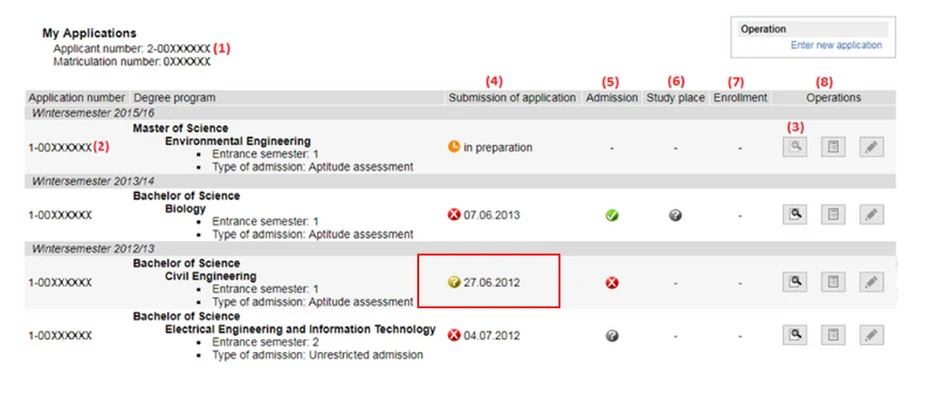
All applicants who have registered an online application account for the study program M.Sc. Power Engineering by the registration deadline TUM Test Power Engineering are admitted to the TUM Test Power Engineering. In other words, registering an online application account for the M.Sc. Power Engineering program is a prerequisite for taking the test. A separate registration for the TUM Test Power Engineering is not required. Information on how to register an online application account can be found here. To register for the TUM Test Power Engineering it is desirable, but not mandatory, to have uploaded all documents required in the application portal. However, please make sure that you have completed the online application account for the M.Sc. Power Engineering to the extent that you can finalize the creation of the account with the "SEND" button. Please ensure that you have selcted all the checkboxes at the end. Press the "Send" button. The status of "Submission of application" must be displayed with a yellow "?" button follow by a date (see screenshot below). If you have any problems sending your application successfully, please contact studium@tum.de. Please note that you will not receive any further confirmation of admission to the TUM Test Power Engineering at this stage.
If you would like to take the TUM test "off campus" (e.g. from home), an additional paid ($25) registration with Proctorio is required. This paid Proctorio registration takes place during participation in the mandatory TUM Test Power Engineering trial run.
If you would like to take the TUM test "on campus" at a TUM location, you must notify us via email to pa.mscpe@ed.tum.de.
Full registration for the TUM Test is ensured when the mandatory Trial run has been successfully completed.
Access data
Access data for the TUM Test Power Engineering (including the trial run) will be provided by email one week before the TUM Test Power Engineering. Please make sure to check your email account including the SPAM folder regularly for incoming emails from us during this period.
Format
Proctored online single-choice test, based on the Moodle platform
Duration
45 min
Content
The TUM Power Engineering test covers the three subject areas mathematics, electrical engineering and mechanical engineering. The exam will be about basic knowledge in these three areas, which should have been taught as part of your previous studies. To prepare for the test, we therefore recommend that you repeat and refresh your knowledge of the basics in these three subject areas from your previous studies.
Please understand that we cannot provide any further information on the content of the test. Furthermore, no sample papers or practice questions from previous years are available.
Location
Option 1: Non-TUM location ("from home")
- Software-assisted supervision (Proctorio)
- For this type of examination you need a webcam (built-in or external) and a microphone (built-in or external).
- The software records you while taking the exam and captures, if you have conversations, get up, leave the computer, or show other clearly fraud-suspicious behavior.
- Personal data is collected from you in order to ensure that there is no fraud. The supervision data is encrypted and pseudonymized and stored on German servers, so that it is best possible protected against unauthorized access.
- The data will ONLY be collected during the test and will be deleted after the test has been evaluated!
- Further information on Proctorio can be found here:
- Proctorio user fee: 25 $
Option 2: TUM location ("on campus")
- Room:
Zentrum für Schlüsselkompetenzen
Building 5515
Boltzmannstr. 15, 85748 Garching b. München
https://nav.tum.de/building/5515 - Human supervision
Equipment
- To participate in the TUM Test Power Engineering (both for the "from home" and "on campus" option) you have to provide and use your own computer that meets these requirements.
- Browser: Chrome, Edge, Brave
- Proctorio supervision plugin
- For the "from home" option: webcam (built-in or external) and microphone (built-in or external).
Trial run & Payment
It is obligatory to perform the trial run in time several days before the TUM Test. The "real" exam is only visible and accessable for you after you have taken the DEMO exam. Please study also carefully the demo video and info pages provided in your TUM Test Power Engineering Moodle account. Please use exactly the same technical equipment (e.g. computer, browser, microphone, camera) and room environment that you will have at the TUM Test. Also, the trial run is when you pay the $25 registration fee for Proctorio.
Certificate
A few days after the TUM Test Power Engineering you can download a confirmation of participation together with the test result. If you want to apply for the M.Sc. Power Engineerint, you have to upload this certificate as one of the documents in your TUMonline application account.
ZOOM Emergency Hotline
https://tum-conf.zoom-x.de/j/69740594434?pwd=Oj5XgJxYGiwvBSmux7eVWa6RB52x9F.1
Meeting-ID: 697 4059 4434
Kenncode: 059650
Emergency Phone
(Only, if ZOOM option is not available)
+49 89 289 24273
Visa Matters
Unfortunately, we cannot influence individually the processes of issuing visas by the local German embassies. We are also unable to communicate with the responsible embassies in this regard. This is the sole responsibility of the embassies. Please have understanding for this.
However, we refer to the regularly held TUM info sessions Visa and Residence Permit. Further information you can find here.
Furthermore, it is possible to apply for a "Prospective Student Visa" even without admission. This means that the applicant do not have to wait for admission to apply for a visa. The "Prospective Student Visa" is valid for three months and gives study applicants the opportunity to meet the requirements for admission. If the time is not sufficient, the period of stay can be extended thereafter for a maximum of another six months. Once students have been granted admission, they can then apply directly for a residence permit for study purposes.
At this point we explicitly refer to the Disclaimer.
If you decide to postpone your study after sucessfull admission please follow the guidelines here.
If admission to the Master's program in Power Engineering has been granted, it is valid for all subsequent applications for this program. According to the current status of the statutes, there is no time limit on the validity.
Please note:
- You will not be automatically readmitted for next year's study programs. You must become active yourself and create a new application in the application portal again, taking into account the deadlines. To do this, please resubmit last year's application documents with an updated CV. However, you do not have to go through the whole aptitude assessment again. The admission requirements are still fulfilled. If the application portal asks you to upload a document "Notification of successful participation in a TUM Test Power Engineering", please upload your admission letter instead.
- Deferment is only possible for a full year, not for only one semester.
We recommend applying as early as possible (preferably as early as January of the corresponding year). This will give you enough time to prepare for your trip to Germany.
And one more note: We do not recommend enrolling for a semester in which you cannot arrive in time for the start of classes. The majority of courses in the program, as well as almost all exams, require your presence on-site. In addition, taking certain exams is mandatory starting in your 1st semester. If you cannot be on-site during your first semester, it may jeopardize your academic success. You can find more information here: https://www.tum.de/en/studies/during-your-studies/organizing-your-studies/statutes-regulations/explanations-legal-framework under "Study Progress Monitoring".
For all questions regarding fees and scholarships please refer to the general information of TUM:
Tuition Fees for Students from Non-EU Countries - TUM
https://www.tum.de/en/studies/fees/tuition/scholarships-and-waivers
A short summary can be found here (status April 2024).
Scholarships for Indian Students: https://www.education-future.org/
Current Information
TUM Graduate School PrepDoc Program 2026
The TUM Graduate School PrepDoc Program 2026 is now open for registration! Are you a TUM master’s student and considering a doctorate at TUM as the next step in your education and career? PrepDoc 2026 provides excellent resources for future doctoral candidates at TUM. Come and join us at a panel discussion with TUM professors, collect information on funding methods and international opportunities, find out more about the process of choosing your supervisor, listen to a personal experience report from a former international doctoral candidate, and explore your goals and motivations during a professional coaching session. We look forward to meeting you at one or more of our events! Check out our website for more details on the program and registration: https://www.gs.tum.de/en/gs/prepdoc-program/
Engineers for Germany – Now Fully Available
TUM Climate Ventures Winter 2025/26
Please ensure that you meet the study progress requirements – see the tab “Structure & Modules”
Arrival
Since orientation and information sessions are scheduled for new students in the first half of October, it is recommended that you arrive in Munich no later than the beginning of October.
Start lecture period winter semester: Mid-October
Although the date above is the official start of the lecture period, due to the fact that attendance is not mandatory in most courses and furthermore many courses offer the possibility of online participation from a distance, in exceptional cases (e.g. Visa issues) students may arrive at TUM later than mid-October. However, please keep in mind that you must be present at the Munich campus for the exams, which begin in mid-February.
If you decide to defer your studies, please consider the information provided under “Application and Admission”.
Tuition fees
If you have to pay tuition fees, please note that the transfer may take some time. Please transfer the fee in good time so that you can register for courses. Please refer to our webpage for detailed information.
MSC-PE Student WhatsApp Group
MSC-PE student representatives have set up a WhatsApp group to share information and questions in the MSC-PE student community. Please note that this is a very useful tool but is not an official information channel of the MSC-PE management.
https://chat.whatsapp.com/FJvBIzi507XG7SQnWToTfP?mode=ac_t
German language courses
The MSC-PE program management strongly recommends that students acquire German language skills during their studies.. You can acquire German language skills by taking a dedicated German language course at the TUM Language Center.
Offers for German courses:
German courses at TUM: https://www.sprachenzentrum.tum.de/en/languages/german-as-a-foreign-language/
Online-courses: https://www.deutsch-uni.com/gast/duo/info/index.do?do=index&lang=en
Other online courses: https://www.study-in-germany.de/en/discover-germany/german-language/german-language_41118.php
Services for International Students
Overview: Services for International Students
TUM First Steps - Info Sessions for International Students
February 23-27, via Zoom
Info Session on Visa and residence permit
March 5, 2 pm CET, via Zoom
ED International Buddy Program
Study Progress Monitoring
- By end of 2nd semester:
- 10 Credits from Core Modules Electrical Engineering
- 10 Credits from Core Modules Mechanical Engineering
- By end of 3rd semester: 30 Credits
- By end of 4th semester: 60 Credits
- By end of 5th semester: 90 Credits
- By end of 6th semester: 120 Credits
Maximum 45 credits per semester
The progress check is carried out approx. one month after the end of the semester, so that all achievements are considered.
Compliance with the credit limits and corresponding time limits is binding. Failure to comply with these requirements will result in exmatriculation. If you are concerned that you will not meet the credit thresholds, please get in touch with the study office via pa.mscpe@ed.tum.de.
Please note that, especially in the case of illness or serious family problems (e.g. care of a close relative), the application for a semester of leave must be considered.
Examination Performances (Power Engineering Modules, 70 ECTS Credits)
Please note: The most up-to-date list can be found in the study program module list in TUM online.
Core Modules Electrical Engineering (mandatory: at least 20 ECTS Credits)
collab.dvb.bayern/spaces/TUMedschooloffice/pages/73389868/Students+%E2%80%93+MSC-PE
Core Modules Mechanical Engineering (mandatory: at least 20 ECTS Credits)
collab.dvb.bayern/spaces/TUMedschooloffice/pages/73389868/Students+%E2%80%93+MSC-PE
Elective Modules (addition) (15 ECTS Credits)
collab.dvb.bayern/spaces/TUMedschooloffice/pages/73389868/Students+%E2%80%93+MSC-PE
Laboratories (at least 10 credits)
collab.dvb.bayern/spaces/TUMedschooloffice/pages/73389868/Students+%E2%80%93+MSC-PE
Seminars (5 ECTS credits required)
collab.dvb.bayern/spaces/TUMedschooloffice/pages/73389868/Students+%E2%80%93+MSC-PE
Pass Credit Requirements (20 credits)
Interdisciplinary Modules (8 ECTS Credits)
You have to earn eight credits from non-power-engineering subjects. The choice is yours. In particular, modules from other departments / schools and also language courses are accepted, too.
Contextual Studies
Plug-in-Modules
German courses
- https://www.instagram.com/tum.sprachenzentrum/ / sprachenzentrum@tum.de
- Certificate: German for Engineers B2/C1
- More ...
Deutschkurse bei der Universität München
EuroTeQ Engineering University
Courses at the EuroTeQ Engineering University can be recognized as Interdisciplinary Modules. Further information about the EuroTeQ Engineering University and the application procedure can be found here:
https://www.international.tum.de/en/global/euroteq-course-catalogue/
https://www.eduxchange.eu/for-students-tum/explore
Please note that the study and examination periods as well as the examination modalities at the EuroTeQ partner universities are different. You are responsible for checking whether and how the EuroTeQ course and its examination fits to your semester and examination schedule at TUM. The MSC-PE Management cannot take on any coordination tasks here.
TUM Project Weeks
https://www.tum.de/en/studies/degree-programs/key-skill-programs/project-weeks
1.000+ Project Week
TUM Climate Ventures
https://www.tum-venture-labs.de/education/tum-climate-ventures/
China Expertise Program
https://www.sprachenzentrum.tum.de/en/sz/languages/chinese/china-expertise-program/
Registering and Cancelling Examinations
Note: Only the information provided by the chairs regarding exam registration is binding.
Exam deregistration deadline: until one week before the exam
Compensation for Disadvantages
Failure of exams
In case of failure of exams (also due to non-attendance of exams without deregistration), they can be repeated several times. There is no limit to the number of retakes in MSC-PE as long as the deadlines of the academic progress control are met.
Failed exams do not affect the overall grade.
There is no obligation to take the repeat exam directly at the next opportunity. However, in the case of elective modules (all MSC-PE modules belong to the category of elective modules), the examiner is not obliged to offer a repeat exam more than once. This may be the case, for example, if lecture content has changed or the module has been dropped entirely. In addition, the examiner may decide to change the format of the repeat exam (written vs. oral).
If there is no possibility of a repeat exam, the module must be taken again or another module must be chosen.
If you wish to appeal against the examination result, you should first speak to the professor responsible for the examination. If this does not help to clarify the matter, you can officially appeal against the examination result as soon as you have received the semester examination notification. This will be provided to you by the TUM Graduation Office & Academic Records a few weeks after the start of the following semester. You will find the formal instructions for submitting an appeal (e.g. deadlines) on the semester examination notice.
Grade improvment
Passed exams cannot be retaken for grade improvement.
Academic Coaching
Academic Coaching: https://www.tum.de/en/studies/support-and-advice/support-during-studies/academic-coaching
TUM4Mind: https://www.tum.de/en/studies/support-and-advice/wellbeing/tum4mind
Withdrawing from Examinations – Medical Certificates
Note: On its own, a confirmation along the lines of "unable to participate in examination: yes / no" is insufficient.
The examination committee can only approve withdrawal requests for the period in which the reasons for non-participation are deemed to be credible and documented. For this reason the medical certificate must contain the following information:
- The timeframe — beginning and end date — of the illness-related withdrawal.
- The medical certificate must state the reasons for withdrawal in such a way as to allow the examination committee to clearly conclude that you were unable to participate (i.e. mandatory bed rest or the inability to come to, and/or be physically present during the examination without experiencing severe pain or discomfort). A medical diagnosis is not required. If the attending physician believes a medical diagnosis provides a more plausible explanation than just a description of the symptoms, without unreasonably compromising the patient's privacy, a medical diagnosis can still be supplied.
- The physician is essentially tasked with providing a qualified medical opinion as to whether withdrawal from a course examination is warranted.
- If you are undergoing inpatient treatment, written confirmation from the hospital or treatment facility must be provided.
Please refer to the mediacal certificate requirements and other information described in this document (PDF, 117 KB) (German); feel free to hand it to the practice treating you.
Examination results
The Graduation Office and Academic Records Department in Garching will inform you by email that you can access your official examination results via TUMonline. The results are deemed to have been delivered three days after dispatch. The one-month appeal period begins on the date of delivery.
The list of modules is binding for the selection. There is no general possibility to bring in modules other than those listed.
Since the MSC-PE modules are elective modules, in general it is also not possible to recognize modules from the previous bachelor degree program with which you applied for the MSC-PE program. For modules taken in a degree program other than the bachelor's degree program with which you applied for MSC-PE, or for courses that were not directly credited towards your Bachelor's degree, an equivalency check with MSC-PE modules must be performed.
Further information can be found here. Please note: You need to submit the application as well as all required documents within the first year of your studies. Please contact us to check the individual case.
Crediting of modules from study exchange programs abroad
In general, only those modules that correspond to the quality of MSC-PE modules can be credited. Exception: For the block 'Interdisciplinary Modules', the choice is free; non-MSC-PE modules can also be credited.
In general, there is no formal recognition for a module defined in the curriculum (1:1 recognition), but rather the externally acquired module itself is incorporated into the corresponding module area.
Credits earned abroad can only be brought into module blocks of the curriculum that have not yet been fully completed by other credits already earned.
Objectives
The research internship is intended to prepare students for their later scientific activities in research and development by providing them with insight into current research topics during their master studies. The research internship takes the form of project work. Each student in the master program works on an individual project assigned by a professor/supervisor from the respective chair within the scope of the research internship. Upon successful completion of the internship students will be able to draw up (apply learned concepts) and plan a project with an engineering character, to define milestones, as well as to document the progress and results of the project and to present them to an audience.
Procedure
The research internship covers 12 credits, corresponding to 9 weeks of full-time work. The module may be spread across several blocks of time within a maximum period of half a year. If the internship is divided into blocks, all supervised by the same examiner, a single report of completion of the research internship in the amount of 12 ECTS can be issued at the end of the semester. Absences (e.g. due to illness) of more than three days must be made up.
The research internship has to be carried out under the supervision of a TUM expert examiners. For MSC-PE these are all university professors, lecturers and junior fellows who teach a Core Module or a listed Elective Module. Furthermore, the following professors are nominated as expert examiners for MSC-PE by the Examination Board: Prof. Kreupl, Prof. Alexander Koch, Prof. Lienkamp, Prof. Wen, Prof. Zäh, Prof. Armanini, Prof. Oksanen, Prof. Rudolf Neu, Prof. Daub, Prof. Torgerson.
The student must independently seek a place for a research intership and supervision by a TUM expert examiner. There is no allocation of places arranged by the study office.
Registration can be done at any time of the year.
The entire administrative process will take place in the ED portal at https://portal.ed.tum.de/en/:
(Please note: Nothing will change for Research Internships already registered with a start date before 15 April 2025. No data from ongoing Research Internship can be imported into the ED portal. If your Research Internship is already registered, please submit it in the usual way.)
- You will look for a chair that will supervise your thesis and agree on a topic for the Research Internship.The student together with his professor/supervisor draws up a work plan defining project objectives, methods and schedule of completion.
- The supervising chair registers your Research Internship in the ED portal under the category 'Project studies / Projektarbeiten'.
- You will receive an email about the registration with a link to the ED portal and have to confirm the registration there.
- The School Office, in consultation with the Examination Board, will review the registration and you will receive approval or rejection by email.
- You work on the agreed project. Upon completion of the project, the student has to write a report and hold a presentation regarding the results of the project. The length and formal requirements of the report and presentation are not specified in the academic and examination regulations of the degree program (FPSO), but defined by the professor. You arrange the date for the presentation directly with the supervising chair.
- Upload the written report to the ED portal at the latest on the submission deadline and confirm the final submission.
- The examiners will evaluate your project work in the ED portal on a pass/fail basis without a grade and you will be informed about the result by email.
Please note: Research Internships are registered and managed in the ED portal until they are finalised. During this time, there is no synchronisation with the TUMonline portal. As soon as the Research Internship is completed and graded, the data is transferred to the Research Internship module in TUMonline.
Detailed description of the process can be found in the wiki at https://collab.dvb.bayern/display/TUMedschooloffice/Final+Theses+in+the+ED-Portal?showLanguage=en_GB.
If you have any technical problems, please contact support-koinon.ed@ed.tum.de
Failed or not completed research internship modules should be reported to the MSC-PE examination board. The module can be repeated as often as necessary.
Conducted at an External Institution
As with the thesis module, the research internship may be completed externally at a research institution or a research-oriented department of a company, provided the research character of the project work is maintained. If you would like to carry out the research internship in industry or an external institution, you must find a MSC-PE TUM expert examiner who will supervise the internship and give a final grade of "pass" or "fail". Please contact the professors directly on your own. The professor has to agree to the supervision of external projects and draw up a work plan together with the student before starting the external research internship.
Especially if it is conducted as an external internship in industry and it should not count as working days in terms of the "120 full days or 240 half day rule" (see below), the research internship cannot be carried out less than full-time. However, the module may be spread across several blocks of time within a maximum period of half a year.
If you are not a citizen of the European Union or European Economic Area and are aiming for an industrial internship longer than the nine weeks, please note that you may not work more than 120 full days or 240 half days in addition to the mandatory nine-week research internship without permission (https://www.internationale-studierende.de/en/footer-english/service/links-and-downloads#c2496).
If you cannot complete the external internship in the lecture-free period alone, you have the option of applying for a leave of absence.
Recognition of previous work as a research internship
The MSC-PE FPSO provides in §37a (3) the possibility of recognition of successfully completed research projects or equivalent achievements as research practice. The decision lies with the MSC-PE Examination Board.
As a rule:
- Work completed within the scope of a Bachelor or Master degree program that is a prerequisite for admission to the master program MSC-PE cannot be recognized toward the research internship.
- Work or activities within the scope of a student job held during the master program cannot be later recognized toward the research internship.
In exceptional cases, periods of employment after the bachelor degree and before commencement of the master program may be acknowledged as research internship, provided that the employment encompassed research activities at a research-oriented institution. Students seeking to have employment activities recognized toward fulfillment of the research internship should contact the master examination board. Recognition is only possible if the items on the following "checklist" can all be answered with "yes":
- Was the duration of the activity at least three months, of which at least nine weeks were pure research activities (full-time, correspondingly longer in the case of part-time work)?
- Was the research activity started after completion of the Bachelor's or Diploma program (the date of the certificate is relevant)?
- Was the research activity completed before the start of the MSC-PE (the date of first enrollment is relevant)?
- Can a job reference be submitted which states the duration, scope, type of activity and an assessment?
- Can the activity be described in the form of a scientific manuscript of at least 10 pages with the following sections:
- Title
- Author, course of studies, student’s ID
- Abstract
- State of the art (with at least 10 references to scientific publications - conference proceedings or journal articles - no manuals, operating instructions, application notes or similar!)
- Applied scientific methods and procedures (with at least 5 references to scientific publications conference proceedings, journal articles or textbooks - no manuals, operating instructions, application notes, etc.!)
- Results and progress achieved beyond the state of the art
- Conclusion
If these requirements are met, the recognition can be applied for by sending an informal application to pa.mscpe@ed.tum.de. The following documents must be attached to the email as a pdf scan:
- Bachelor's or diploma certificate
- Proof of first enrollment MSC-PE
- Job reference
- Scientific manuscript, as described in more detail above
The six-month Master Thesis concludes the MSC-PE Program and it has to be carried out at a chair of TUM expert examiners. For MSC-PE these are all university professors, lecturers and junior fellows who teach a Core Module or an Elective Module. Furthermore, the following professors are nominated as expert examiners for MSC-PE by the Examination Board: Prof. Kreupl, Prof. Alexander Koch, Prof. Lienkamp, Prof. Wen, Prof. Zäh, Prof. Armanini, Prof. Oksanen, Prof. Rudolf Neu, Prof. Daub, Prof. Torgerson.
If you would like to conduct your Master Thesis at an external institution (e.g. chair of a professor not listed as a MSC-PE TUM expert examiner, external research institute or company), this can only be done in agreement and cooperation with one of the above-mentioned MSC-PE TUM expert examiners, who will then be the official topic provider and will carry out the grading of the Master Thesis. The topic of the thesis should be related to the field of power engineering. Please identify and contact the corresponding officially supervising professor or chair by your own and in a timely manner. Please note: We at TUM are not involved in contractual matters between you and the external institution.
Please also note possible offers for master theses under Master Thesis Offers.
Students can start the master thesis if they have passed 65 credits from "Power Engineering Moduls" (Core Modules, Elective Modules, Laboratories, Seminar) plus the research internship.
Before registering, please check carefully whether you really meet the credit requirements for registering for the master thesis (see above) and whether these are correctly displayed in your TUMonline account. Please note that for MSC-PE a confirmation from the program management to you or your supervisor that you fulfill the requirements for the registration for the master thesis is not foreseen.
Administrative Process
Registration can be done at any time of the year.
The entire administrative process will take place in the ED portal at https://portal.ed.tum.de/en/:
(Please note: Nothing will change for theses already registered with a start date before August 5, 2024. No data from ongoing theses can be imported into the ED portal. If your thesis is already registered, please submit it in the usual way.)
- You will look for a chair that will supervise your thesis and agree on a topic for the thesis.
- The supervising chair registers your thesis in the ED portal.
- You will receive an email about the registration with a link to the ED portal and have to confirm the registration there.
- The School Office, in consultation with the Examination Board, will review the thesis registration and you will receive approval or rejection by email.
- You work on the agreed project and prepare the written thesis.
- Upload the written thesis to the ED portal at the latest on the submission deadline and confirm the final submission.
Depending on your degree program, you may also have to write an exposé and/or give a presentation on your thesis. You arrange the date for the presentation directly with the supervising chair. - The examiners will evaluate your thesis in the ED portal and you will be informed about the grade by email.
Please note: Theses are registered and managed in the ED portal until they are finalised. During this time, there is no synchronisation with the TUMonline portal. As soon as the thesis is completed and graded, the data is transferred to thesis module in TUMonline.
If you wish to return the topic of your thesis during the thesis period or need to apply for an extension or suspension of the thesis, you can also do this via the ED portal. To do this, log in to the portal and select the corresponding option in the respective thesis.
Detailed description of the process can be found in the wiki at https://collab.dvb.bayern/display/TUMedschooloffice/Final+Theses+in+the+ED-Portal?showLanguage=en_GB.
If you have any technical problems, please contact support-koinon.ed@ed.tum.de
If the master thesis was the last achievement of your studies, please refer to the information at End of Study below.
Academic-legal basics
The legal basics regarding the master thesis are fixed here:
Course Schedule
In principle, all modules in the MSC-PE program are electives. Therefore, within limits, you can freely compose the modules according to your interests. There is no predefined study plan. You must or may put together your own study plan with the help of the module descriptions.
However, at the beginning of the program, it is recommended to focus on completing the core modules first.
Internationalization
Here you will find detailed information on internationalising your studies: collab.dvb.bayern/spaces/TUMedschooloffice/pages/73390136/Going+Abroad+Outgoing+-+MSC-PE
Focus
Upon request and in cooperation with the students, focus areas were identified to deepen specific knowledge. These are
- "Power Generation" (PG)
- "Power Storage" (PS)
- "Power Economics" (PE)
- "Power IT" (PIT)
In order to simplify the selection of modules in this respect, the modules that students consider particularly relevant for the individual focus groups are marked in the lists accordingly (bold --> particularly suitable; normal --> well suited). This labeling is reviewed at regular intervals with the student representatives to ensure that it is up to date.
Please note that this is only non-binding information and not a sign of quality. Modules that are not labeled are equally suitable for the design of the individual curriculum.
Please also note that a focus in the sense of a specialization is not explicitly mentioned in the final document, but only indirectly results from the modules listed on the certificate.
Registration for courses and exams
Registering for courses is only possible after the start of the respective semester and after you have been completely enrolled.
Although for many lecture-based courses registration is not mandatory to attend the lectures, registration is strongly recommended to get full access to the corresponding Moodle course where relevant documents for the course are provided.
Please note: Registering for the course is not sufficient to be registered for the exam! You must register separately for the exam!
Location
The main location for courses is Garching.
Teaching format
The TUM is aiming to offer lectures in presence again from the start of the summer semester 2022. Often, the lecture is additionally offered in parallel in a digital format as an online lecture or video recording. However, the format provided is a decision of the lecturer and may be subject to change. Therefore, please inform yourself via the module description or by contacting the person responsible for the module in which format the respective course is offered.
Schedule conflict
In general, there is no mandatory attendance for courses at TUM. In the case of courses that are also available as video recordings, you therefore have the option of choosing these even if there is a schedule conflict with another course and then learning the content in self-study on a time-shifted basis. There are usually no schedule conflicts with the examination dates.
Selection of modules outside of the MSC-PE module list
In general, for your MSC-PE curriculum, you are not allowed to take courses outside the MSC-PE module list displayed in this wiki. The exception to this is the Interdisciplinary Modules, where you choose modules that are not part of the MSC-PE.
You are of course free to take courses without counting them towards your MSC-PE degree. They will then be shown as additional courses on your degree certificate.
Questions regarding specific modules
If you have any questions or problems (e.g. regarding contents, registration, exams) related to a specific module, please contact the respective person responsible for the module. You can usually find this person in the module description in TUMonline (bottom of the page) or on the homepage of the corresponding chair.
Extra credits
If you have earned more credits for a particular module group than are assigned for the module group, the total number of credits for that module group will be reduced / limited to the number of credits assigned for that module group.
Credit of additional Core Modules
You can take more than the required 4 Core Modules Electrical Engineering and 4 Core Modules Mechanical Engineering. In this case, the additional core modules are brought in as Elective Modules.
Extra modules
If you have successfully completed more module exams than are required for the master's degree, they will be listed on an extra certificate that will be attached to the final degree certificate. Furthermore, these additional modules may replace passed modules in the same category or in the "Interdisciplinary Modules" category (e.g., to improve the overall grade) as long as they meet the specific requirements of that module category. This adjustment is made at the request of the student at the end of the program before the final graduation documents are prepared.
Leave of Absence
www.tum.de/en/studies/during-your-studies/organizing-your-studies/leave-of-absence/
Only granted for important reasons, e.g.:
- An external internship, which cannot be completed in the lecture-free period alone
- Illness
- Maternity or paternity leave
- Care of a close relative
- Study stay abroad
The period of leave of absence is not taken into account for the academic progress check.
Note:
- During the leave of absence, examination performances or pass credit requirements cannot be obtained at TUM. However, it is possible to repeat failed exams. (Exception: Maternity and paternity leave)
- Note the application deadlines: The application has to be submitted in the interval between the beginning of the re-enrollment period and the start of the lecture period. You can hand in the documents supporting the reason for your leave of absence later if you cannot get hold of them in time. If the application is not submitted by the deadline, the leave of absence cannot be approved.
- The application for leave of absence must be submitted during the period of the days of re-enrollment until the first day of lectures of the semester. If the important reason for the leave of absence occurs later, without this was foreseeable, the application can be submitted up to five weeks after the start of the lecture period. (§ 11 clause 2 of the "Satzung der Technischen Universität München über die Immatrikulation, Rückmeldung, Beurlaubung und Exmatrikulation)
Compensation for Disadvantages

Final grading, additional modules, extracurricular activities
The overall grade is calculated as the weighted grade average of all modules (except Research Internship and Interdisciplinary Modules) and the Master's Thesis. The grade weights of the individual modules correspond to the assigned credits.
If you have taken and passed additional modules, they will be listed under additional modules and will not count toward the calculation of your final grade. If you would like to include these modules in the calculation of your final grade instead of other modules, please let us know before you apply for your final degree certificates.
In Chapter 6.1 “Additional Information” of the Diploma Supplement, you can provide individual details of extracurricular activities completed during your studies. Please refer to this document for further details.
Before final grading of your Master Thesis
If you need a confirmation before the final grading of your Master Thesis that you have completed all the requirements and will finish the studies in a timely manner (e.g. for a future employer or to apply for a work visa), please ask your supervising professor (TUM expert examiner) to send a statement to pa.mscpe@ed.tum.de confirming that the Master's thesis meets the requirements of a pass.
After final grading of your Master Thesis
If you have completed all your degree requirements and any additional courses you may have taken in the last semester, please send us an email to pa.mscpe@ed.tum.de with a confirmation that all courses are listed correctly in the TUMonline grade report (titles, credits, etc.). We will then initiate the issuing of the final graduation documents. Here you can find information about the Final Graduation Documents.
A preliminary degree certificate can be downloaded from your student dossier in TUMonline, once you confirmed that the grade report is correct and the graduation office checked your personal details and title of the master's thesis. You will receive an email once the preliminary degree certificate is issued. Immediately afterwards, you can download the document from your student dossier in TUMonline
If you need a verification of your TUM degree or a confirmation of study data please refer to this link.
Disenrollement
Please refer to the information here.
Generally, you need to remain enrolled until you have taken your last exam. For the final thesis, enrollment is mandatory until submission. For all other exams, you do not have to re-enroll if you take an examination which is allocated to the previous semester within the first week of the lecture period. This also applies to the obligatory presentation as part of the thesis.
Disenrollment from the university occurs automatically at the end of the semester, in which the final graduation documents are completed. You may also still take additional courses and complete exams up to the time of exmatriculation. If you would like these courses to be included in the final graduation documents, please make sure by notifying the MSC-PE management that your degree certificate is not issued until the end of the semester so that we can adjust the relevant courses accordingly.
For questions regarding reimbursement of previously paid semester fees, please contact studium@tum.de.
Graduation Ceremony
Details → Graduation Ceremonies → Mechanical Engineering, Interdisciplinary Engineering
If you need an invitation letter for inviting relatives and guests, please fill in your personal details in this invitation letter template and send it to mscpe@ed.tum.de for signature.
Academic Coaching
https://www.tum.de/en/studies/support-and-advice/support-during-studies/academic-coaching
Learning Workshops
https://www.tum.de/en/studies/support-and-advice/support-during-studies/learning-workshops
Women Empower
Contact: Himali Talware (Himali.talware@tum.de)
Women of TUM
https://www.community.tum.de/en/tum-community/women/
FEMTEC
Engineers for Germany
https://www.community.tum.de/en/engineers-for-germany/
Intercultural Communication Training
https://www.sprachenzentrum.tum.de/en/sz/intercultural-communication/
TUM Career Service
https://www.community.tum.de/en/career-service/
Agentur für Arbeit München
https://faszination-beruf.de/veranstaltungen-fuer-studierende/
Mental stress and illness
https://www.tum.de/studium/hilfe-und-beratung/gesundheit/tum4mind
https://www.tum.de/en/studies/support-and-advice/wellbeing/help-with-mental-stress
https://www.tum.de/en/studies/support-and-advice/support-during-studies/academic-coaching
https://www.krisendienste.bayern/mental-health-support-in-over-120-languages/
Modules / Lectures / Exams
For questions regarding specific modules, courses and the associated exams, please contact the corresponding persons of the respective chairs responsible for the module directly. You can find the persons responsible for the modules in the module descriptions and usually on the homepage of the chairs.
Enrollment & Semester ticket matters
For all enrollment-related questions (e.g. semester fees, semester ticket), please contact TUM central offices directly at studium@tum.de.
Visa, residence and work permit matters
Please contact the immigration office or studium@tum.dehttps
Information on work permits can also be found here:
https://www.internationale-studierende.de/en/during-your-studies/jobbing
https://stadt.muenchen.de/infos/studium-arbeiten-aufenthaltsrecht.html
Please note: The MSC-PE program management is not authorized to provide legal advice in this regard.
Fees and Scholarships
Application - MSC-PE#FeesandScholarships
Student Job
MSC-PE does not offer an organized program for teaching or research assistantships. Therefore, please check https://www.tum.de/en/studies/during-your-studies/living-and-working/jobs-and-internships. We also recommend asking your fellow students for their experiences on how to best find a student job.
Agentur für Arbeit München
https://faszination-beruf.de/veranstaltungen-fuer-studierende/
Opportunities on the Munich job market
Opportunities on the Munich Job Market - for TUM students
Scholarship for Indian Students
https://www.education-future.org/
Academic Coaching
https://www.tum.de/en/studies/support-and-advice/support-during-studies/academic-coaching
TUM Career Service
Engineers for Germany
https://www.community.tum.de/engineers-for-germany/
International Research Opportunities
www.imperial.ac.uk/students/global-opportunities/ug/summerresearchplacements/
Other
For other inquiries please contact mscpe@ed.tum.de.
General
MSC-PE Online Consultation Hour
Code: vA7xx6au
Each Monday, 8:30 am - 9:00 am (German time)
Program Management
Dr. med. Markus Eblenkamp
+49 89 289 15026
MS Teams
mscpe@ed.tum.de
Heike Wetzstein-Duesing
+49 89 289 15029
Boltzmannstraße 15, 85748 Garching
Raum: 5510.EG.006
pa.mscpe@ed.tum.de
MSC-PE Student WhatsApp Group
MSC-PE student representatives have set up a WhatsApp group to share any information and question in the MSC-PE student community. Please not that this is a very useful tool but is not an official information channel of the MSC-PE management.
https://chat.whatsapp.com/FJvBIzi507XG7SQnWToTfP?mode=ac_t
TUM ED International Students-for-Students Center & Buddy Program
TUM ED International Students-for-Students Center
ED International Buddy Program
Semester Representatives
MSC-PE Batch 2024
- Yash Sheth (yashsheth68@gmail.com)
- Ayush Sharma (go49jip@mytum.de)
MSC-PE Batch 2023
- Ayush Dewangan (ayush.dewangan@tum.de)
- Jihad Jundi (jihad.jundi@tum.de)
MSC-PE Batch 2022
- Aryan Thosar (aryan.thosar@tum.de)
- Dhakshain Balaji Venkatesh (ge87hed@mytum.de)
MSC-PE Batch 2021
- Erat Siddharth Mannadiar (siddhartherat1997@gmail.com)
MSC-PEBatch 2020
- Salil Satish Patwardhan (salil.patwardhan@tum.de)
- Ahmed Ali Mustansir (ge59dul@mytum.de)
Student Council Representatives
Florian Keller | Nico Tassinger
E-Mail: leitung@fsmse.de, Website: https://fsmse.de/, Instagram: https://www.instagram.com/mse.tu.munich/
TUM Contact and Directions
https://www.tum.de/en/about-tum/contact-directions
NavigTUM (TUM Room finder)
Wind energy using kites

Flying wind turbines - what sounds like a fantastic science fiction future is being realized by a Munich-based startup. Kitekraft builds flying wind turbines that are a combination of drone and kite.
Energy supply of the future
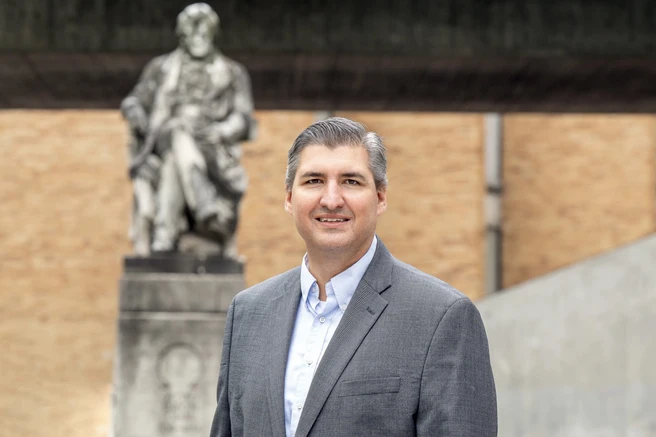
Prof. Reinaldo Tonkoski jr. joined the Technical University of Munich (TUM) in 2023 as head of the Chair of Power Transmission and Distribution. He brings a global perspective to the challenges and opportunities in sustainable energy systems. His passion for energy systems, education, and collaboration shines through the initiatives he leads.